Roundups on Wyoming’s Open Range
Adapted from Michael Cassity’s Wyoming Will be Your New Home.
Wyoming Territory’s Texas-born ranching system of the 1870s and 1880s ran primarily on neglect of the cattle—with two important exceptions. Spring, summer, fall and winter the stock was left to roam and graze untended. But twice a year, the cattle were rounded up—in spring for branding and in the fall prior to shipping. Logistically complex and geographically extensive, the roundups were planned carefully and their routes well publicized in advance. Their success depended on a well-understood system of brands, so that it would be clear whose cattle were whose.
The brands
Each ranch had its own brand and many had multiple brands. Brands would not go away, since they remained on the animals even after the absorption of one ranch by another, and would continue to perpetuate themselves as branded cows produced calves that would soon carry the same brand. The result was a proliferation of brands on the range.
In 1884, the Cheyenne Democratic Leader reported, “There are over 850 brands already on record in the County Clerk’s office and applications are constantly being received.”1 Though large, Laramie County was still just one part of Wyoming. One study of cattle brands in Wyoming maintains, “There were 5,000 brands of one kind or another in Wyoming and the overlapping ranches from outside the Territory . . .”2
Because of that profusion, the major brands, or at least those owned by members of the Wyoming Stock Growers Association, would be listed in brand books that could be carried in a hip pocket in the field for easy reference.
Although the ranchers often used what they termed their “customary range,” when they informally laid claim to the grass in an area, the extent of this range was often undefined except in the most general terms—and was also usually unfenced and unenforceable. As a result, cattle would intermingle, only to be separated at roundup time. These roundups, in contrast to virtually every other aspect of the range cattle business, were complex, carefully planned, and tightly organized operations. Organized and controlled by the Wyoming Stock Growers Association, the first roundups were conducted in 1874 and included mainly southeast Wyoming, which was divided into two roundup districts.
The next year, Silas Reed, Territorial surveyor general for Wyoming, noted, “The system . . . has become so complete that almost every herd of stock in the country is driven in, identified by its brand, and returned to the owner’s range— cattle are often found one hundred miles or more away. The losses from straying off are, under this system, reduced to almost nothing.”3
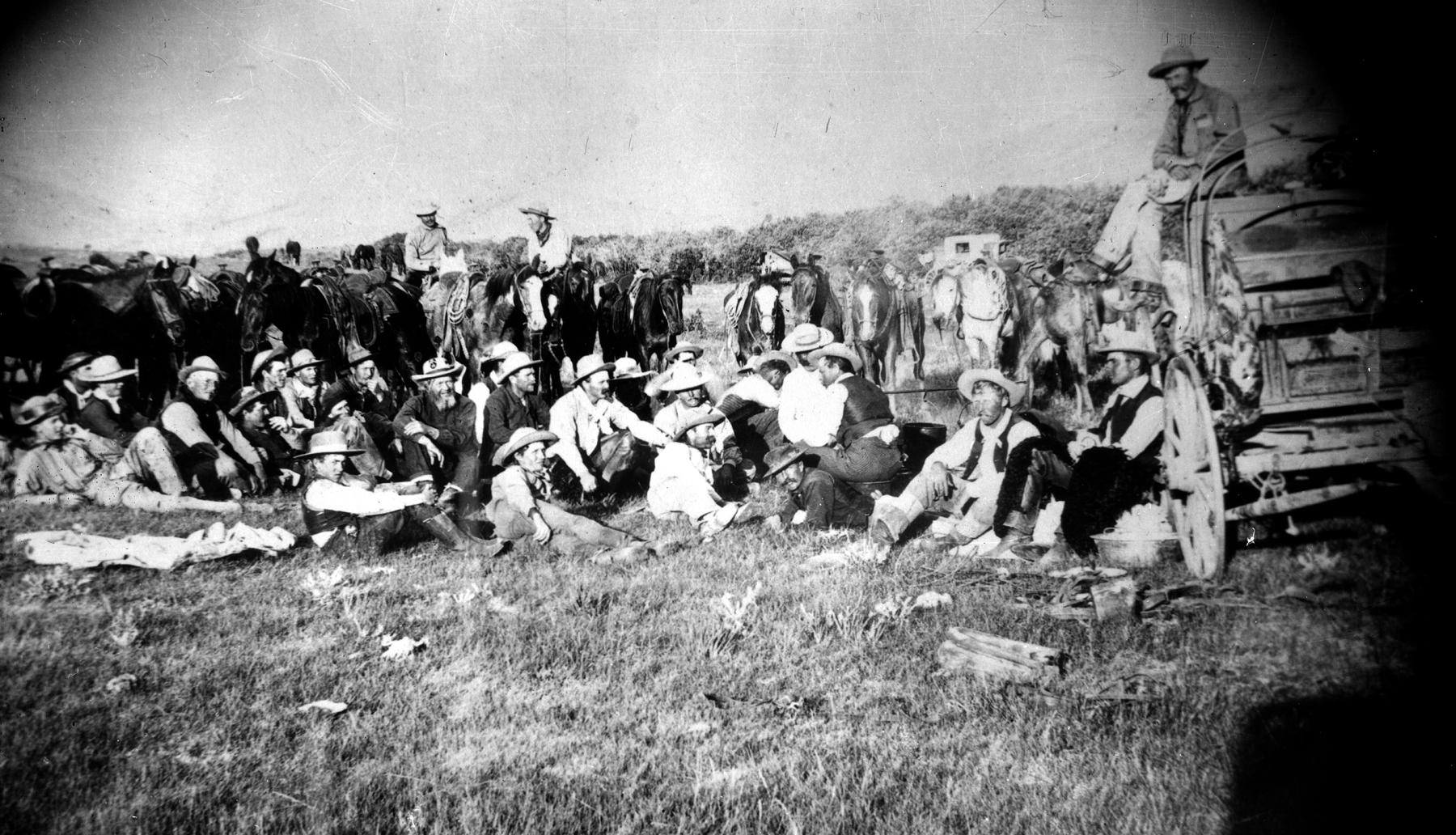
In 1878 the roundup system had expanded and for the first time included the area north of the North Platte River. By 1880 there were six roundup districts and by 1884 there were 31, each defined by drainages and other natural features, with references to individual ranches. By 1883 the official districts included the Big Horn Basin and by 1884 almost all of Wyoming Territory was included except Star Valley, Jackson Hole and a few scattered pockets.
1884 roundup announcements
The official roundup announcements designated a foreman for each district; that foreman, acting as a quasi-legal regulator, would make decisions and settle disputes, and, at the end, give permission for the various ranchers to take their cattle away. The district boundaries for each roundup were published in the local press along with the appointed date and place to start. The discipline, planning and systematic thoroughness of the roundups is clear in the official announcements from a sampling of roundup districts 1884.
No. 5: Commencing at Fort Laramie, May 20th, working the country as heretofore worked by No. 5, between the mountains and the Platte River on the south side, working up as far as Fort Fetterman, including LaPrele creek; thence working up the river, between the river and the first range, to and including Bates Hole; thence along the edge of the Laramie Plains, working Spring creek and the Little Medicine down as far as the Coe & Carter pens; thence through the Medicine Bow road, working upper Deer creek and upper Box Elder. Fall round-up to begin September 1st Jas. Shaw, foreman; Rufe Rhodes, assistant foreman.
No. 7: Laramie Plains round-up will meet at the lower bridge, near McGill’s ranch on the Big Laramie river, June 1st. Proceed to work the country between the river and the Black Hills divide as far south as Red Buttes; from thence work in two divisions, No. 1 continuing as far south as Twin mountain, thence back to Diamond Peak, working the Boulder and intermediate Creeks up the source of the Big Laramie river. Div. No. 6 will proceed from Red Buttes across the Big Laramie, working up to Cummins City, Fox Creek and Centennial country behind Sheep mountain and between the Big and Little Laramie rivers; thence in their order, Mill creek, Seven Mile, Four Mile, Cooper and Rock creek, and the tributaries; thence back to Big Laramie, working down stream to Canyon, Duck creek and Laramie Fork country; thence through Antelope Basin on the North Laramie, working Sheep creek and Little Medicine into Shirley Basin; thence back by Freeze-Out mountains to the mouth of Medicine Bow creek; working up said stream to its source, including Hampton and Dana Meadows, head of Pass Creek and Elk Mountain, thence to Wagon Hound creek, finishing on Foot creek. Fall round-up to begin October 1st Rufe Rhodes, foreman; William Lannen, foreman of Division No. 1, from Red Buttes south.
No. 14: Commence at the mouth of Sand Creek, June 1st Work up Cheyenne river, Horsehead, Alum Springs, Cottonwood, Robber’s Roost, Alkali and the Cheyenne river to the old AU7 ranch and down Beaver Creek. Fall round-up to commence October 15. Tom Trawcek, foreman, J. Howard Ford, assistant foreman.
No. 15: Commence May 15. Sage Creek, Old Woman Creek, up Lance creek to head; Harney creek, to beaver dams on Lightning Creek, fall round up to commence October 15.
No. 16: Begin work on May 10th at Matthews’ ranch on the Belle Fourche; thence up the Belle Fourche to Pumpkin Buttes and down the Belle Fourche and tributaries to Devil’s Tower, thence up Donkey Creek; thence to head of Little Powder; thence down Wild Cat to mouth of Horse Creek, working Little Powder and Horse Creek; thence work Cotton and down Little Powder, working its tributaries to its mouth. Fall round-up to begin October 1st. John Winterling foreman, Clinton Graham, assistant foreman.
No. 17: The Tongue River round-up will meet at Frank Owen’s ranch on Smith Creek, and will commence work on Monday, the 19th of May. It will work down the north side of Tongue river and all its tributaries on the north side to the mouth of Hanging Woman; thence up Hanging Woman to its head; thence down Badger creek to its mouth, including Deer creek; thence up the mountains, including Wolf, Soldier, Little and Big Goose creeks ; thence down Meade creek and Prairie Dog, thence up Dutch creek and its tributaries to the divide; thence move to Powder river, working from Montana line to north of Clear creek to form a junction with Crazy Woman round- up; thence both roundups will work Clear creek and Piney to their heads.
Fall roundup to commence on Oct. 1
H. G. Williams, foreman; Charles Carter, assistant foreman.
No. 18: The Powder River round-up will meet at the head of the North Fork of Powder River and will commence work on the 26th of May. It will work then down the north fork of Powder and up middle fork to Peter’s and Alston’s ranch; thence up Buffalo creek and through the pastures to Cedar mountain; then the round-up will wait at the head of south fork for two days for the wagon from round-up No. 6; thence down south fork of Powder river to its mouth; thence down Powder river to the mouth of Salt creek; thence up Salt creek to its head; thence to the head of Meadow creek, working it and passing to the head of Dry Fork of Powder river; thence down Dry Fork to its mouth; thence down Powder river to the mouth of Crazy Woman, working all tributaries of said streams. Fall round-up to begin October 5th. O. Morgareidge, Foreman; P. DuFran, assistant Foreman.
No. 20: Begin on May 1st, at head of Stinking Water, north side, working all the country on west side of South Fork thence down north side of river to Bridger crossing; thence crossing the river to mouth of Grey Bull; thence up Grey Bull on both sides to mouth of Meeteetse, when round-up shall divide, one branch working up Grey Bull and Meeteetse, the other portion of the round-up cross over to Sage Creek and working all country between Meeteetse and Stinking Water. That portion of country lying north of Stinking Water, and about Clark’s Fork, Bennett creek and Pat O’Hara’s is attached to the Stinking Water round-up as un-organized territory. Fall round-up to begin October 1st Peter McCulloch, foreman; John Gleaver, assistant foreman, and to be foreman of that branch of the round-up that works up Meeteetse and south side of Stinking Water.
No. 29: To meet April 20th, ten miles above mouth of LaBarge, on west side of Green River; thence work down Green River to Green River city; thence crossing Green River on the west side, working up Green River, working Slate creek and Fontenelle; thence crossing to Dry Piney, working aback to LaBarge; thence moving to Bryan, working west to Piedmont; thence working north to Ham’s Fork working all country between Piedmont and Ham’s Fork to divide between Muddy and Bridger creek, working up Ham’s Fork to head of stream. Fall round-up to begin October 1st. J. D. Alford foreman.
Memories of the roundups
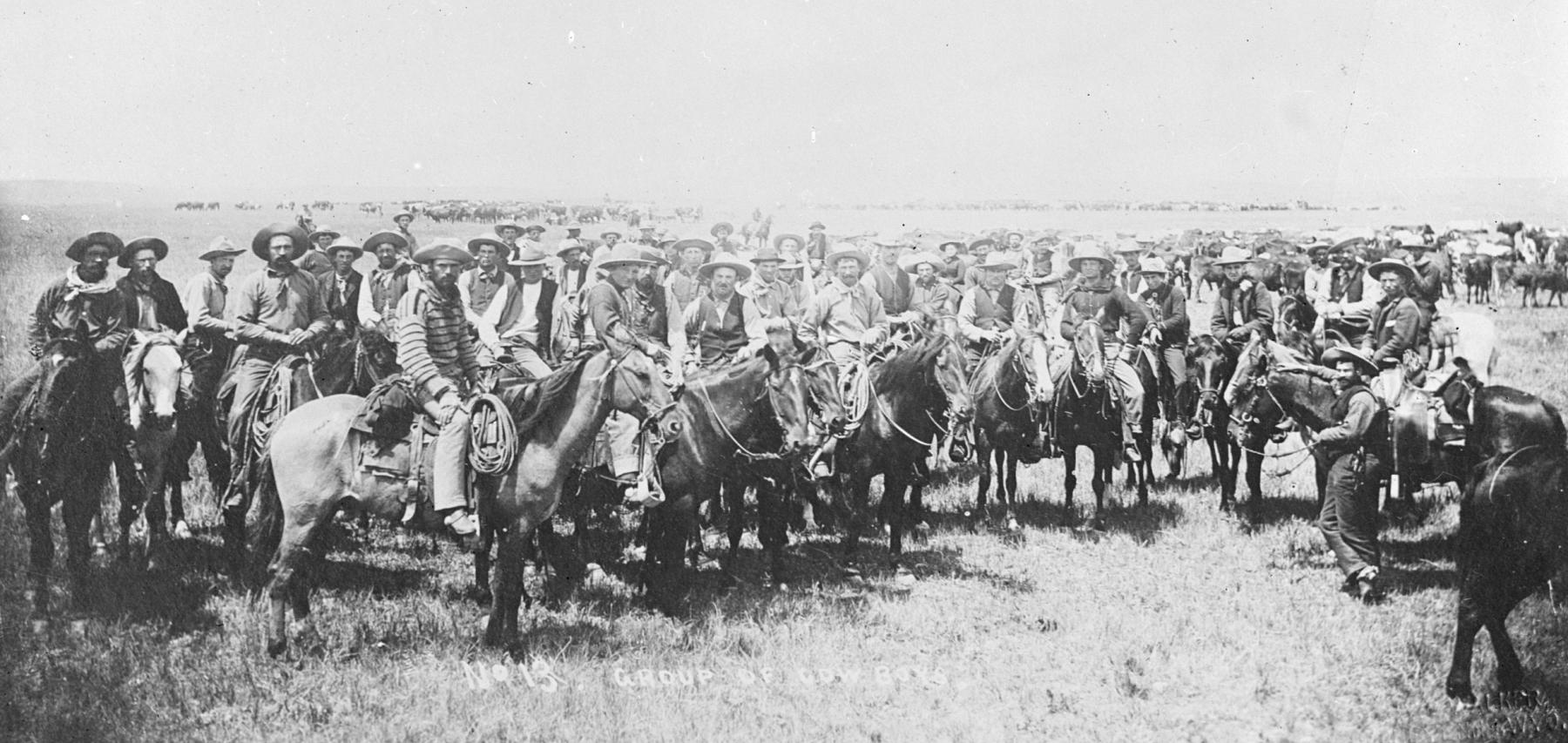
The range being grazed by the cattle was huge and the size of the roundups was correspondingly large. M. J. Gothberg, who worked for the Searights, recalled,
Before we reached Hat Creek there were about eight cattle companies’ wagons. This round-up district is where we met with another general round-up, working down from the northeast of the state and consisting of about ten different cattle companies. This made eighteen different outfits, with over two hundred riders when they pulled into camp on the day set for them to meet.
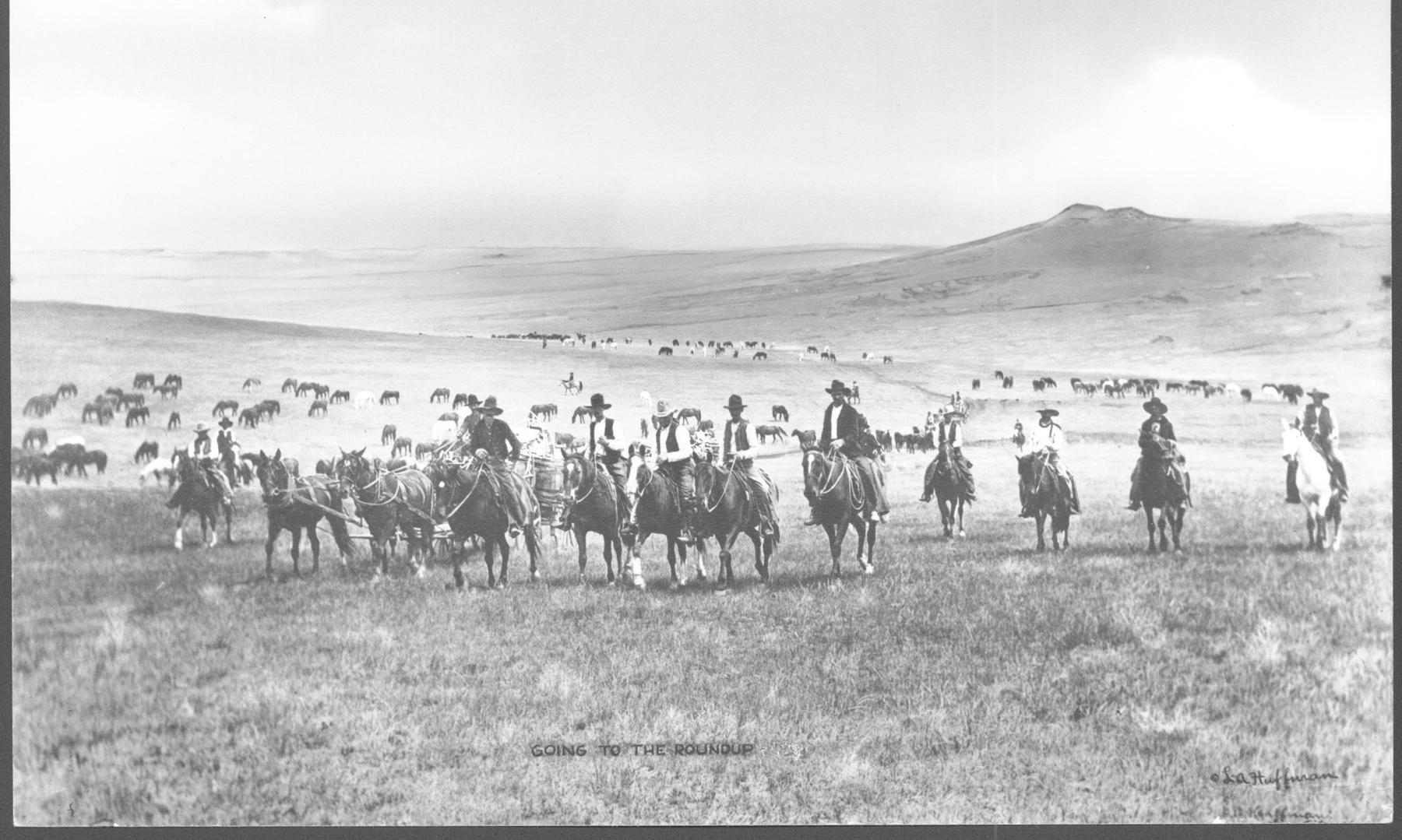
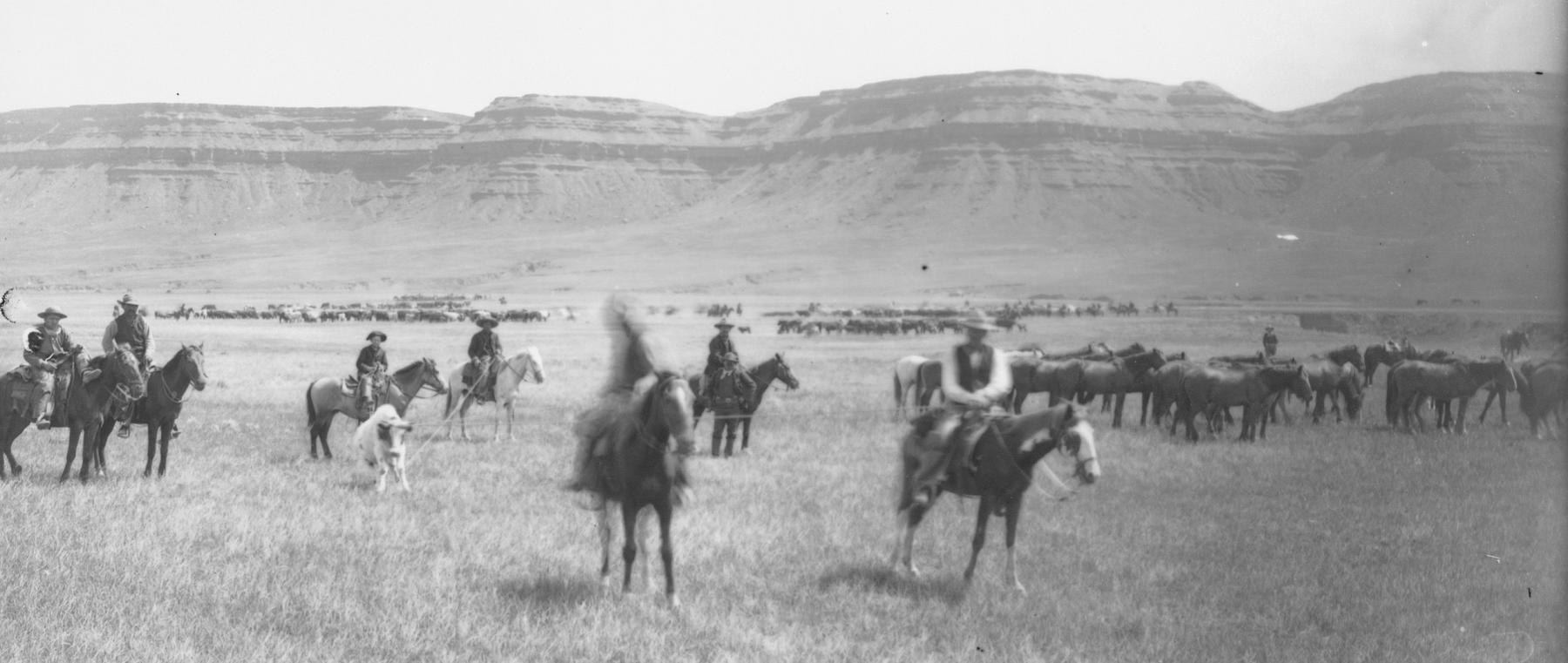
It was a great sight, as each separate outfit had its own herd of horses of from 120 to 150 head. They also trailed along those cattle that had strayed off of their range during the winter months and would be taken back from the spring roundups. The combined round-up on a single forenoon drive would cover such a large territory that there would be about 6000 head of stock. These cattle would be bunched up separately and not allowed to mix with those from the separate stream valleys. The bunch would range from four to eight hundred according to the way they came in. Each separate outfit would have its turn to get out its stock from these separate bunches. Then the balance would be turned loose on the range again. Within the next day or two, the two round-ups split up. A group of several wagons which I was with went west and rounded up to the head of Salt creek. Different outfits would drop out from time to time as they would get off their range[;] then they would send one man along to gather up what stray cattle belonging to them that they would find off their range and take them back.
Another participant, Oscar Flagg, recalled the roundup of 1883 in which he and others gathered on Crazy Woman Creek in Johnson County. He said that the roundup consisted of fourteen hundred head of horses, four hundred men and twenty-seven wagons. “For two miles along the river the wagons were camped, in order to afford room for the different bunches of horses to graze without becoming mixed.” The roundup was a virtual community—or, to be more precise, as many as thirty-one communities— on the move, working their way up and down Wyoming’s drainages.
[Editor’s Note: Special thanks to the author and to the Wyoming State Historic Preservation Office for making this article available and to the Wyoming Cultural Trust Fund for its ongoing support for this project. Michael Cassity’s historical monograph, Wyoming Will Be Your New Home, from which this article is adapted and excerpted, is one of many historic contexts published by the Wyoming State Historic Preservation Office. These documents are meant to offer a broad background against which historic developments can be better understood as the agency works to preserve properties and places important to an understanding of Wyoming’s past. The contexts also, however, are based on sound research and are full of well-told, vivid stories. With this in mind, WyoHistory.org has begun a collaboration with the SHPO office to bring more of this history to a wider readership. The Cultural Trust has provided the funds to make this collaboration possible. We offer our thanks to all.]
Endnotes
1. Cheyenne Democratic Leader; June 11, 1884.
2. Roland Welch, “Cattle Brands,” WPA Collections, subject file 397.
3. Reed was quoted in Spring, “‘A Genius for Handling Cattle’: John W. Iliff, 398–399.
4. The announcements were widely published and circulated. This list is taken from "Ready for the Roundup,” Cheyenne Sun, April 10, 1884.
5. M. J. Gothberg, Pioneer Range Rider and Rancher.
6. Flagg, “A Review of the Cattle Business in Johnson County, Wyoming since 1882 and the Causes that Led to the Recent Invasion,” 2. This document is a typescript of a series of articles that originally appeared in the Buffalo Bulletin in 1892, and is found in the J. Elmer Brock Papers, American Heritage Center, University of Wyoming.
Sources
- Cassity, Michael. Wyoming Will Be Your New Home: Ranching, Farming and Homesteading in Wyoming, 1860-1960. Cheyenne: Wyoming State Historic Preservation Office, 2011, 42-46.
- Cheyenne Democratic Leader, June 11, 1884.
- “M. J. Gothberg, Pioneer Range Rider and Rancher,” typescript, Federal Writers’ Project Collection, Wyoming State Archives, (hereafter WPA Collections), subject file 755.
- Spring, Agnes Wright. “‘A Genius for Handling Cattle’: John W. Iliff.” In When Grass Was King: Contributions to the Western Range Cattle Industry, edited by Maurice Frink, W. Turrentine Jackson, and Agnes Wright Spring. Boulder, Colorado: University of Colorado Press, 1956.
- “Ready for the Roundup,” Cheyenne Sun, April 10, 1884.
- Flagg, Jack. “A Review of the Cattle Business in Johnson County, Wyoming since 1882 and the Causes that Led to the Recent Invasion,” 2. This document is a typescript of a series of articles that originally appeared in the Buffalo Bulletin in 1892, and is found in the J. Elmer Brock Papers, American Heritage Center, University of Wyoming.
- Welch, Roland. “Cattle Brands,” typescript, WPA Collections, subject file 397.