The New Deal and Wyoming Agriculture, Part 2: Killing Cattle to Raise the Price
Many ranch families in Wyoming still remember the terrible drought and hard times of the early 1930s. They recall their grandparents’ stories of government agents coming to the ranch, buying cattle at depressed prices, and then shooting the oldest and sickest animals on the spot. The New Deal had arrived, and with it, its designers’ conviction that agriculture’s main problem was overproduction. The only solution, government officials believed, was to reduce the supply. If you could just reduce the number of animals on the market, prices would have to rise and farmers and ranchers, once again, could prosper.
But the political process is often messy and leads to compromises and opportunities vastly different from what purists and planners may have had in mind. For his part, President Franklin Roosevelt was no purist and prided himself on being pragmatic. The result was a course of action that followed a meandering path, the frequently lacked coordination with other initiatives taken by other branches of the same government, and that at time was even at odds with other programs.
The nation was being transformed, agriculture was being transformed, and Wyoming was being transformed in the 1930s and 1940s. This change carried consequences, among them a reorganization of the entire system of production. But as historian Paul Conkin observes, “The human costs of this transition were enormous.”1
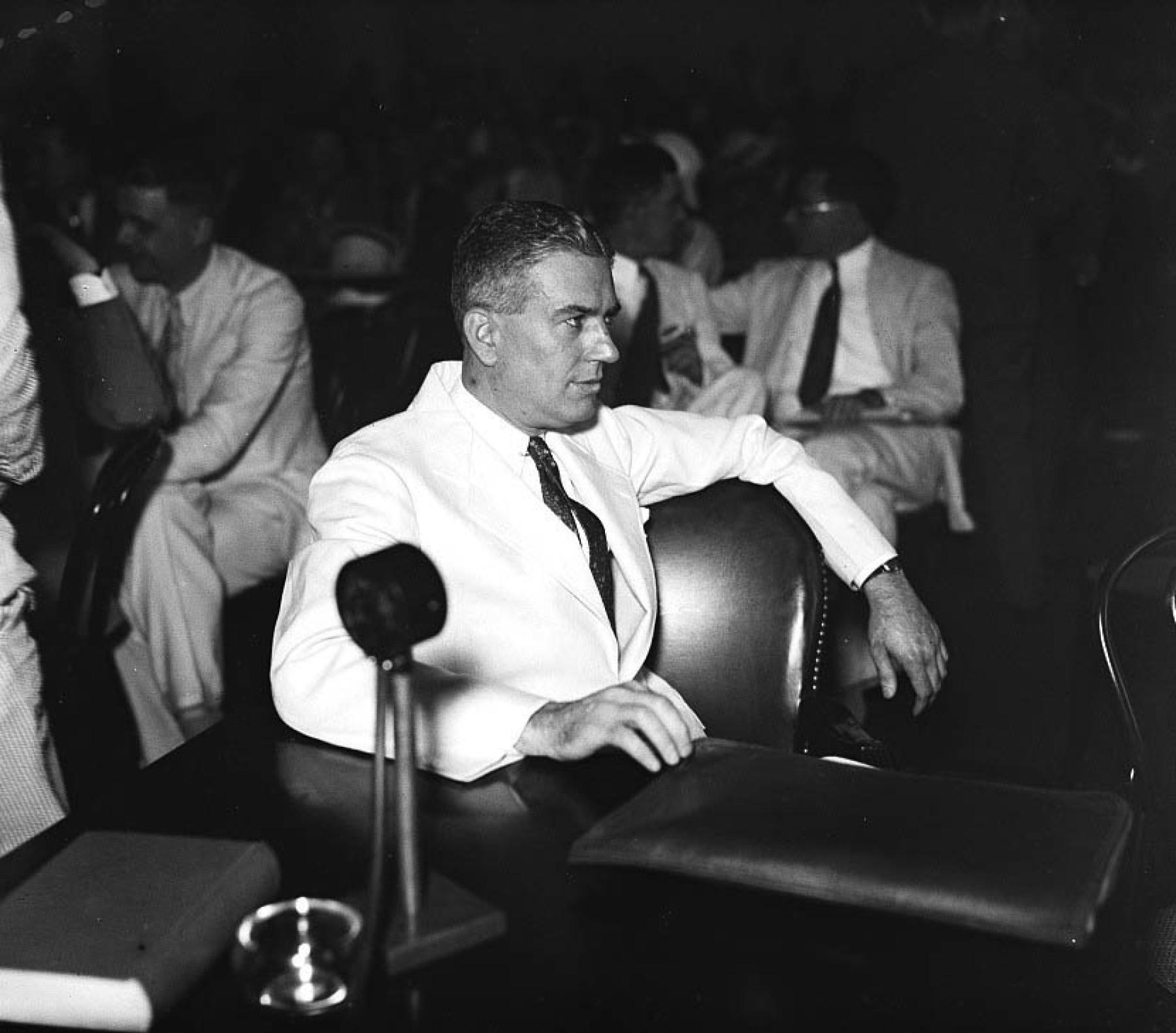
Roosevelt’s energetic Secretary of Agriculture Henry A. Wallace and Rexford Tugwell, who served as Assistant Secretary and then Under Secretary of Agriculture, emphasized planning in the economy. One study cogently describes Tugwell, a member of FDR’s so-called “Brain Trust,” as among the “young prophets of the ‘planned’ economy who were confidently filled with the theorem that agriculture was suffering chiefly from disorganized and uncontrolled production. In this belief they were joined by Secretary Wallace.”2
Tugwell generally disavowed earlier views of agriculture, views he considered sentimental or romantic, views that stressed agriculture as a way of life. Historian Richard Kirkendall, the preeminent scholar of New Deal agricultural policy, argues Tugwell “believed that government should promote the consolidation and rationalization of agriculture, reorganizing it along the lines that industry had followed. The area of land in production should be limited so that the system would include only the most efficient farmers operating the best land, and the cities and factories should absorb a very large number of people from the farms.”3
The goal in all this was a comprehensive planning system for agriculture, which would mean more people than just farmers planning what to grow. It meant a centralized system of planning how much of which commodities should be produced in the nation. There was a key assumption. The fundamental problem facing agriculture in the Depression, according to this approach, was that of overproduction: farmers and ranchers had produced so much that the markets were glutted and the prices they received were thereby pushed down. Some critics, including Senator Huey Long of Louisiana, argued exactly the opposite: that the agricultural sector was in trouble, not because of overproduction, but because of underconsumption; people in the cities did not have the money to buy food and fiber even at depressed prices.4
But the dominant course of the New Deal in agriculture became that of limiting production to create an artificial scarcity of commodities which would then, theoretically, create higher prices in the marketplace. There was nothing particularly socialistic about this approach: Its fundamental goal was to bring private farmers and ranchers higher profits through higher prices. While ranchers and farmers sometimes opposed this, they were usually more worried about the planning aspects, because of the centralized decision-making it represented. Unsurprisingly, people in the cities often opposed it because it meant higher food prices when they were severely pinched for funds. This was a new system for the nation—not just for the farmers and ranchers.
The AAA
Among the dizzying array of alphabet agencies spawned by the New Deal, the AAA—the Agricultural Adjustment Administration—may be the most familiar, at least in the framework for government involvement in agriculture. And the framework lasted well beyond the Supreme Court’s 1936 decision declaring the Agricultural Adjustment Act unconstitutional. The original law was an omnibus measure that included a host of programs, including enticements for farmers to retire some of their land, allowing agreements between farmers and processors to set market prices, and subsidizing farm exports. The fundamental goal was to reduce production and create artificial shortages. The law provided for farmers who produced specified “basic commodities” to voluntarily agree, in actual contracts, to reduce production in exchange for government payments.5
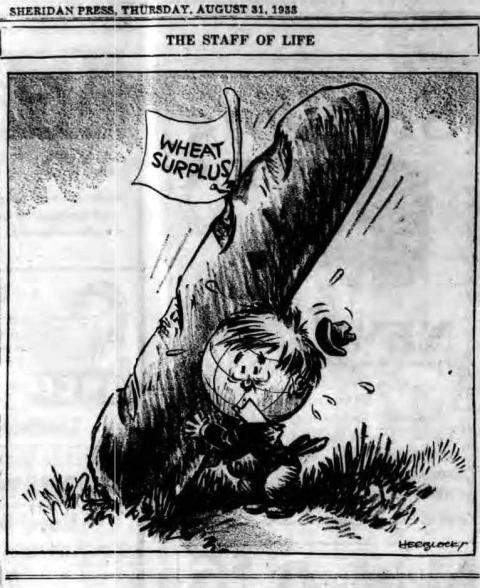
In Wyoming, the AAA was slow to get started. In fact, the main commodities on which AAA actions were focused nationwide—cotton, corn, and pigs—were not important in Wyoming. Cattle and sheep, which were important, were initially left out of the list of basic commodities in the bill that passed. Wheat was on the list, but the wheat crop was already seriously reduced because of the drought-inhibited crop of 1933.
Culling the Herds
Production controls came to Wyoming most systematically and intensively in 1934 when the federal government launched its Drought Relief Program to help farmers and ranchers beset by the clouds of dust, the lack of rain, and the starving condition of their livestock. As with many New Deal programs, this was designed to accomplish several different goals with one action. At its basic level, the Drought Relief Program endeavored to reduce the size of herds of livestock through the purchase of excess amounts and the reduction of crops by taking land out of cultivation. The herd reduction effort would reduce the stress on the land at the time of severe drought, and it would also provide the rancher who sold the cattle some cash. But there was more: The effort also fit within the larger framework of production controls, in which the object was to raise prices by limiting the amount of commodities on the market—again, creating an artificial shortage to push prices up.
It would thus do no good for the government to purchase cattle and then sell them to the packers in Chicago or Omaha; the theory ran that it would just glut the market and depress the prices more. So the livestock that were purchased were either killed and buried on the spot or shipped away with some to be used in relief programs or otherwise used without going on the market. Some of these slaughtered animals were canned and distributed among the needy.6 Senator Robert D. Carey successfully proposed that some be distributed to Native Americans in Wyoming for jerked meat.7 A Cheyenne dispatch reported that between 500,000 and 1,000,000 sheep would be purchased from Wyoming ranges alone, with emaciated animals slaughtered on the spot and the remainder canned for federal relief purposes.8
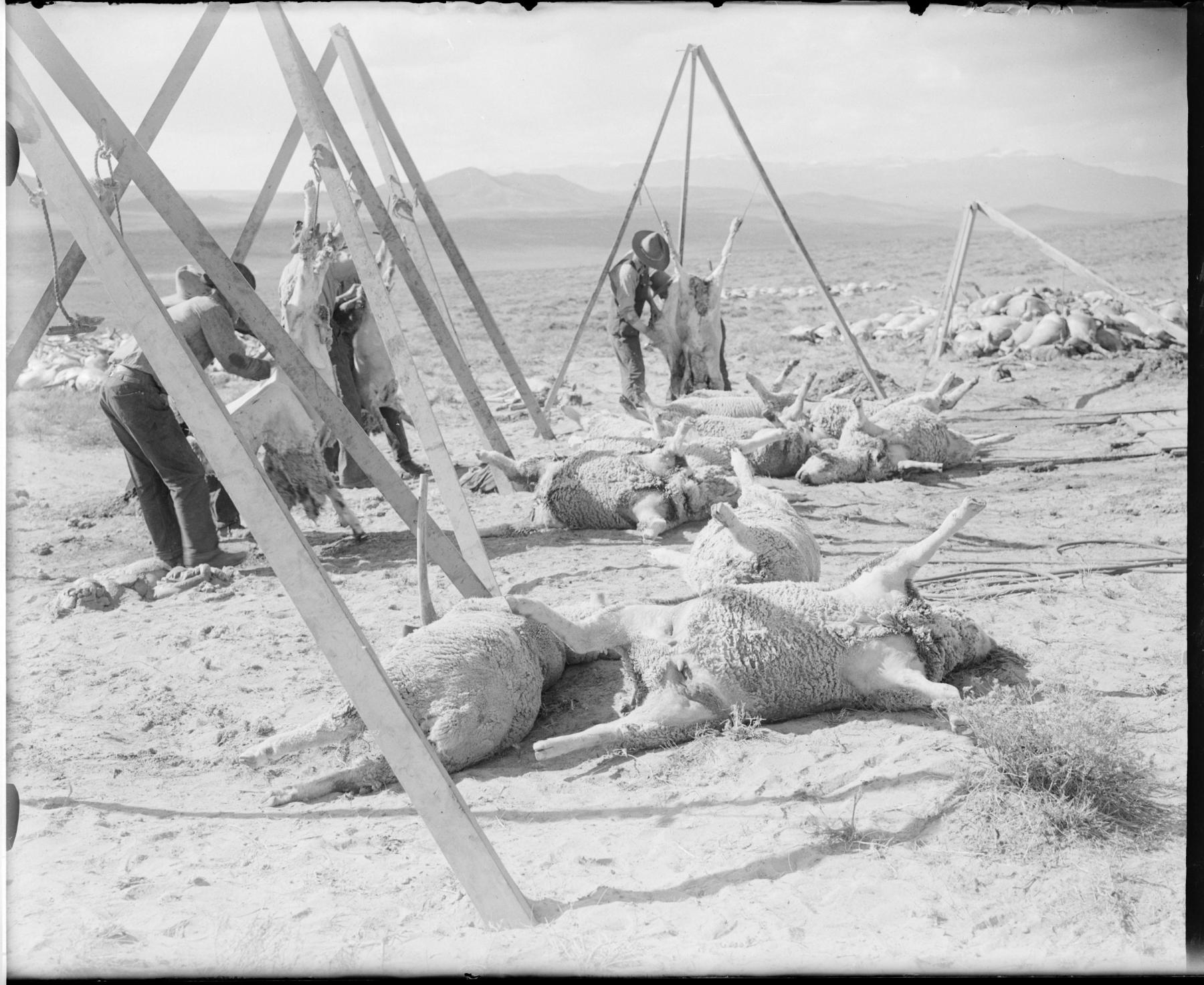
In Sublette County, Dr. W. H. Lee, a veterinarian, was chosen to rank the cattle according to classification to determine whether the cattle were to be killed on the spot, to be shipped away for slaughter to feed the hungry on relief, or to be shipped away to other ranges. The government issued him a .22 rifle to kill those he determined “hopelessly starved or aged.” One report is that in Sublette County, the government purchased 14,000 cattle and killed ten percent of them.9 The actual classification of the cattle determined not only the fate of the individual animal but the amount the rancher received, with “top cows” going for twenty dollars, yearlings for fifteen, calves somewhere between four and eight dollars, “killers” for eight dollars, and diseased for four to six dollars.
The program began in earnest in June 1934 and it presented a stark image of an incongruous situation: the slaughter of beef cattle and sheep in a nation that was hungry. In 1933 a fierce outcry across the nation had accompanied the implementation of AAA production controls in the South when one fourth of the cotton crop was plowed under and millions of pigs were killed. That was largely avoided in 1934, however, when publicity was less widespread and the nation was more accustomed to the images.10 Even so, the sanitized version of the disparity, the image of “breadlines knee deep in wheat,” remained in some eyes the alternate image of the New Deal and its relief for the hungry.11
And memories of the killing of cattle in Wyoming endured for some people as the central, searing image of the Depression in the state. In 1979, Mabel Brown, a well-known and respected figure across Wyoming, recalled the scene in an oral history interview: “Killing the cattle... and just leaving them lay... When we’d drive in from the Osage field to Osage there would be cattle just lying along the road. Bloating in the sun, their legs stiff and up in the air. They’d pay the ranchers $20–$25 and then shoot the cattle and leave them lay there. They wouldn’t let anybody go in and butcher them to use for meat because that would be defeating the purpose of the slaughter of the cattle in the first place. It was to try to make the price go up and reduce the supply.”12 Decades later, it was still difficult for her to reconcile the wasteful slaughter with the crying needs, even though she clearly understood the theory behind it.
And so the herd reduction program proceeded in Wyoming. An AAA official, usually the county extension agent, appraised the cattle, set the price (usually between eight and fifteen dollars a head), paid the owner—and shot the cattle. Sometimes ranchers and farmers were paid a flat amount at the low end of the scale; the Campbell County extension agent appears to have seldom paid more than eight dollars. The Wyoming Stock Growers Association calculated that the average price in the state was “$12.52 per head, or about one-third the cost of producing a weaner calf.”13 Evidently, “one of the officials in Cheyenne” determined that W. H. Lee in Sublette County was paying too much for the cattle. Lee responded, “there are no cattle buyers up here and they are all thieves anyway, but they are not going to make a cattle thief out of me for $15.00 a day.”14
Results
Reports from Crook County in the spring and summer of 1934 illustrate the scale of the crisis. Surveyors estimated that between 50,000 and 60,000 head of cattle were in the county, and that between 15,000 and 20,000 head would need to be moved immediately, with twice that number possibly required if conditions did not improve soon. When the government cattle buying program got underway in late June, approximately 300 head per week were being handled in the county, with marketable cattle turned over to the relief organization for processing and unfit animals slaughtered on the ranch.15 By late November 1934, more than a quarter-million Wyoming cattle had been sold to the government under this program, and when the program closed down shortly afterward, 285,227 head of cattle in the state had been killed or removed from the market.16 Nationally, the Drought Relief Service purchased 8.3 million cattle and about 18 percent were condemned and killed.17
Reducing the Crops
The crop reduction program was less dramatic than the herd reductions, but it shared the same objectives and assumptions. In 1933 the wheat crop had been so low that nowhere in the nation did the fields of wheat get plowed under like cotton had been. The AAA sought to reduce the next year’s harvest of wheat, and keep production down, by offering the wheat producers a three-year program; in return for reducing 1934 and 1935 acres in wheat, the farmers would receive a benefit payment.
[Editor’s Note: Special thanks to the author and to the Wyoming State Historic Preservation Office for making this article available and to the Wyoming Cultural Trust Fund for its ongoing support for this project. Michael Cassity’s historical monograph, Wyoming Will Be Your New Home, from which this article is adapted and excerpted, is one of many historic contexts published by the Wyoming State Historic Preservation Office. These documents are meant to offer a broad background against which historic developments can be better understood as the agency works to preserve properties and places important to an understanding of Wyoming’s past. The contexts also, however, are based on sound research and are full of well-told, vivid stories. With this in mind, WyoHistory.org is collaborating with the SHPO office to bring more of this history to a wider readership. The Cultural Trust has provided the funds to make this collaboration possible. We offer our thanks to all.]
Footnotes
- Paul Conkin, A Revolution Down on the Farm: The Transformation of American Agriculture since 1929 (Lexington: University Press of Kentucky, 2008), 51.
- A. B. Genung, The Agricultural Depression Following World War I and Its Political Consequences: An Account of the Deflation Episode, 1921–1934 (Ithaca, New York: Northeast Farm Foundation, 1954), 89.
- Richard S. Kirkendall, Social Scientists and Farm Politics in the Age of Roosevelt (Columbia: University of Missouri Press, 1966), 44.
- See Michael Cassity, “Huey Long: Barometer of Reform in the New Deal,” South Atlantic Quarterly 72, no. 2 (Spring 1973): 255–269.
- Van L. Perkins, Crisis in Agriculture: The Agricultural Adjustment Administration and the New Deal, 1933 (Berkeley: University of California Press, 1969), 43; Paul K. Conkin, The New Deal (Arlington Heights, Illinois: AHM Publishing Corporation, 1967; repr., 1975), 39–40.
- “Canning Plant Will Preserve All Foods Here,” Sheridan Press, August 6, 1934, 3.
- “Carey Proposes Cattle Be Given to State Indians,” Sheridan Press, August 8, 1934, 3.
- “Million Sheep May Be Bought by U.S. in State,” Sheridan Press, August 9, 1934, 10.
- Ethel Van Dorin Jewett, “Dry and Depressed, 1934,” in Seeds-Ke-Dee Reflections: Historical Lore of Wyoming’s Green River Valley (Big Piney, Wyo.: Sublette County Artists’ Guild, 1985), 21–22.
- It should be noted that no one took joy in this effort. Henry Wallace himself, though he accepted the theory behind the action, lamented “I hope we shall never have to resort to [plowing under the crops] again. To destroy a standing crop goes against the soundest instincts of human nature.” And it was not just human nature. When those crops were plowed under, there was usually the poignant moment where farmers had great trouble getting their mules to walk on the ripening crops. See Arthur M. Schlesinger, Jr., The Age of Roosevelt: The Coming of the New Deal (Boston: Houghton Mifflin Company, 1958), 61.
- See Janet Poppendieck, Breadlines Knee-Deep in Wheat: Food Assistance in the Great Depression (New Brunswick: Rutgers University Press, 1986).
- Mabel (Edwards) Brown, interview by Philip Roberts, May 8, 1979, OH-412, Wyoming State Archives, Cheyenne.
- Agnes Wright Spring, Seventy Years: A Panoramic History of the Wyoming Stock Growers Association ([Cheyenne]: Wyoming Stock Growers Association, c1943), 144.
- Jewett, “Dry and Depressed, 1934,” 23.
- “Crook County Now Facing Worst Drought in History,” Sundance Times, May 24, 1934, 1; “Cattle Buying in County Started on Wed. of This Week,” Sundance Times, June 28, 1934, 1.
- Spring, Seventy Years, 142–143.
- R. C. Lambert, “The Drought Cattle Purchase, 1934–1935: Problems and Complaints,” Agricultural History 45, no. 2 (1971): 85.