Richard’s Post
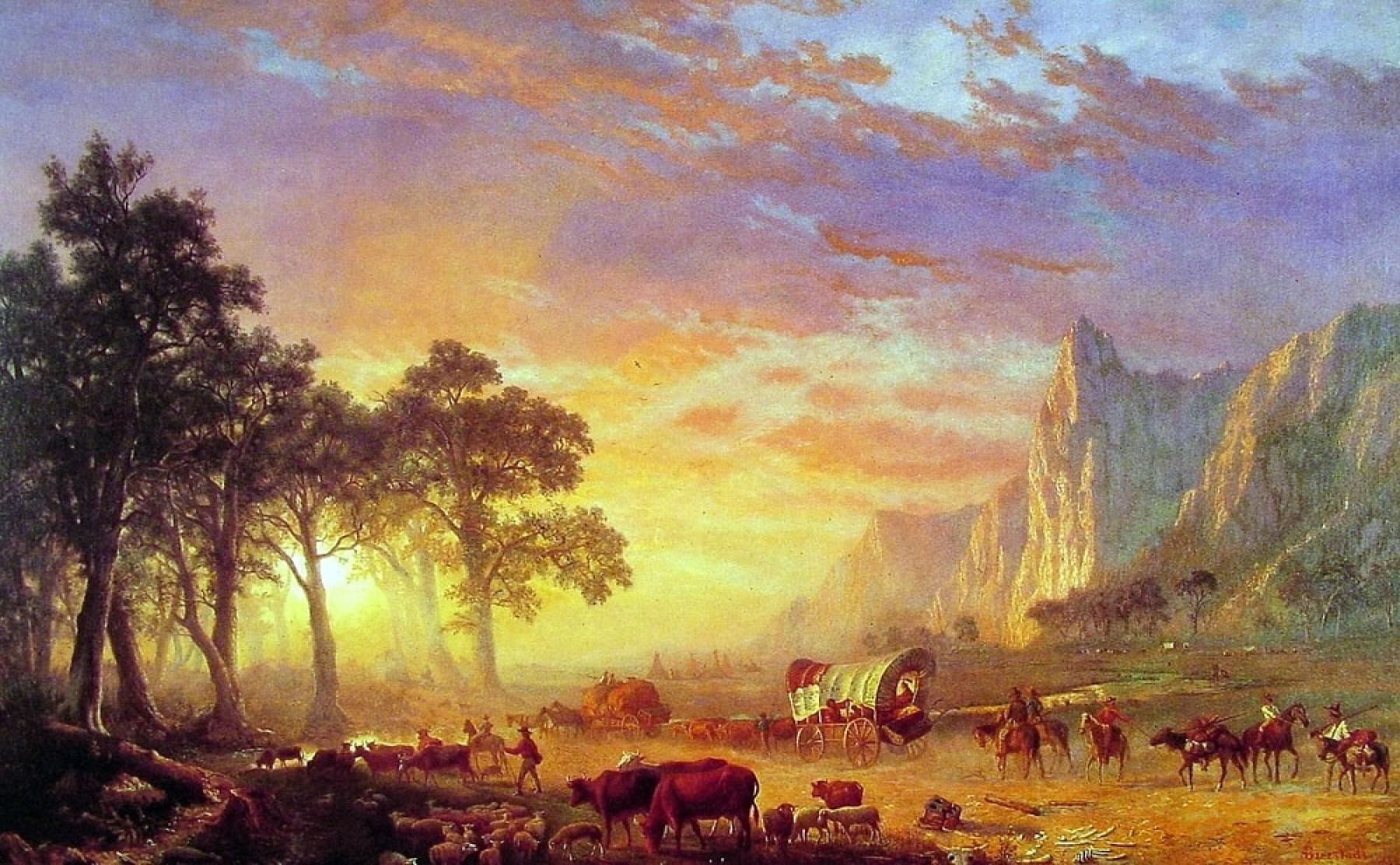
Richard’s Post was a trading establishment and toll bridge operated by John Baptiste Richard on the south bank of the North Platte River near present-day Evansville in Natrona County, Wyoming, from 1853 until 1865. Over its twelve years of operation, the post evolved from a log-and-timber bridgehead trading operation into what one contemporary assessment called “the most important trading post in the vicinity and probably the third largest community in Wyoming.” It served emigrants on the Oregon, California, and Mormon trails; hosted two separate military encampments; competed with and ultimately absorbed Louis Guinard’s rival bridge six miles upstream; and served as a relay station for the overland mail, the Pony Express, and the transcontinental telegraph. Archaeological investigation in 1963 and 1983 confirmed the site’s location and produced an artifact assemblage that has been recommended as eligible for the National Register of Historic Places.1
John Baptiste Richard: Background and Career Before 1853
John Baptiste Richard was born in Missouri around 1810 and entered the fur trade in the early 1840s, first working for Sybille and Adams at Fort Platte on the North Platte River, where contemporary accounts allege he ran whiskey from Taos to the Native trade, a lucrative if illegal sideline. After Fort Platte’s abandonment, Richard partnered with Joseph Bissonette, John Charles Cabanne, and Bernard Pratte Jr. to construct Fort Bernard in 1845, where he managed day-to-day post operations while Bissonette ranged out to trade in Lakota villages. The destruction of Fort Bernard by fire, sometime between the fall of 1846 and the spring of 1847, left Richard without a fixed post, but he remained commercially active in the North Platte region. In 1850 he constructed the Ash Point Post roughly twenty miles below Fort Laramie, which he operated until selling it to Seth Ward and William Guerrier in 1851.2
In 1851 and 1852, Richard attempted two bridge project, one at the mouth of Deer Creek and another near Fort Laramie—but both washed out in the spring floods of 1852 and were not rebuilt. These failures taught Richard valuable engineering lessons about the river, and he applied them in the fall of 1852 when he organized a new and more ambitious bridge project at the California Crossing near present-day Evansville. Because Richard pronounced his surname in the French manner, most English-speaking travelers misheard it as “Reshaw,” and the bridge became permanently associated with that name.3
Construction and Early Operations, 1852–1854
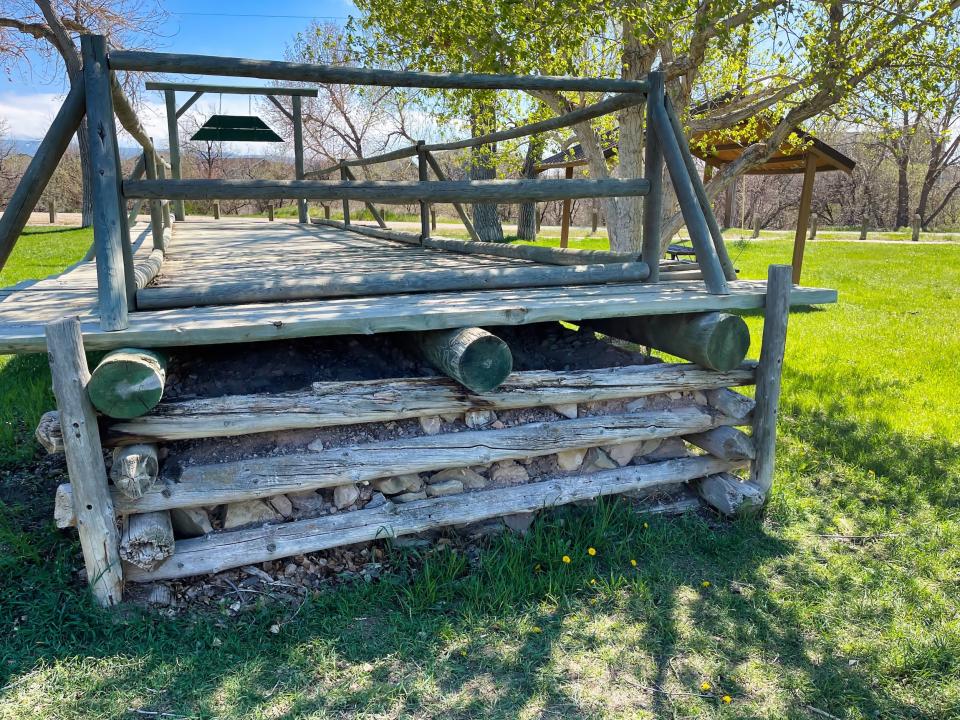
In the fall of 1852, Richard assembled a partnership of six investors—including Joseph Bissonette, Seth Ward, William Guerrier, Charles Bordeaux, Louis Guinard, and William Kenceleur—to construct a substantial timber bridge at the California Crossing, where the Oregon, California, and Mormon trails converged for the crossing of the North Platte. The bridge was built from lumber hewn and hauled from six to ten miles from the mountains, held together with iron bolts, and required twenty-three stone-filled piers to span the river. At over eight hundred feet in length and eighteen feet in width, it was an engineering achievement of the first order for its time and place.4
On the south end of the bridge, Richard constructed a cluster of log buildings serving as residences, a trading house, a grocery, a dry goods store, and a blacksmith shop. The post provided goods to emigrants, charged tolls for bridge crossings, offered blacksmithing services for wagon and equipment repair, traded livestock, and engaged in commerce with the Oglala and Brulé Lakota bands whose territories bordered the North Platte. Richard bought out his partners in 1854, becoming the post’s sole proprietor, and in the peak year of 1853 when some fifty thousand emigrants used the trails. The bridge and post represented the most profitable private enterprise on the upper North Platte.5
The Grattan Crisis, Military Encampments, and Resumed Trade, 1854–1858
The Grattan Fight of August 1854 ended the commercial prosperity of Richard’s first years at the post. Following the fight, Lakota warriors raided his livestock, and General William S. Harney’s subsequent campaign against the Brulé created a general state of hostility that made independent trading on the North Platte dangerous. Richard was ordered to abandon his post and relocate to Fort Laramie. In response to concerns from traders about the security of their properties and the protection of the emigrant trails, Colonel William Hoffman dispatched a small military contingent to Richard’s Post in 1855. This camp was initially designated Fort Clay, from October 1855 until Richard's return to his post in March 1856, which coincided with the garrison's expansion and its redesignation as Camp Davis, a Fort Laramie sub-post under Captain Henry HethHenry Heth and reassigned as a sub-post of Fort Laramie.6
The military abandoned Camp Davis in November 1856 over Richard’s protests, which reflected not a perceived security need but rather his desire to maintain the revenue stream that the soldiers’ presence and supply requirements provided. Richard compensated for the loss through increased revenues from the developing overland mail route and growing freight traffic. The relocation of the Upper Platte Indian Agency to Deer Creek in 1857, only thirty miles east, allowed him to expand his Native trade further. A second military post—the post at Platte Bridge, also called Camp Payne—was established at Richard’s location in 1858 to protect the freight lines from Mormon militia during the Utah War. This post should not be confused with the later Platte Bridge Station, which was located at Guinard’s Bridge upstream; the two have been conflated in some sources. The Utah War ended in the summer of 1858, and this second military establishment was abandoned in April 1859.7
Expansion, the Denver Gold Rush, and Guinard’s Competition, 1858–1864
The years around 1858 were a period of commercial expansion at Richard’s Post despite the difficulties of the preceding four years. Increased trade from the agency relocation and the mail and freight routes funded new adobe construction, including a new blacksmith shop. Richard also moved opportunistically to capitalize on the discovery of gold near Pikes Peak: he and his brother constructed a ferry and trading post at Cherry Creek, Colorado, in 1858–1859, one of the first permanent buildings in the settlement that would grow into Denver.8
The most significant commercial challenge of Richard’s later years came not from Lakota raiders or military complications but from Louis Guinard, who in 1859–1860 constructed a new and better-engineered bridge across the North Platte approximately six miles upstream, which became known as Guinard’s Bridge or the Upper Platte Bridge, as distinct from Richard’s “Lower Platte Bridge.” Guinard’s Bridge, sited at a slightly different river crossing, quickly drew a large share of the emigrant traffic and trade that had been Richard’s near-monopoly. A military garrison—Platte Bridge Station—was established at Guinard’s Bridge in 1862, further concentrating commercial activity upstream. However, Guinard sold his bridge to Richard by 1864, following the death of his son and the mounting pressures of Native hostility, and Richard briefly controlled both crossings.9
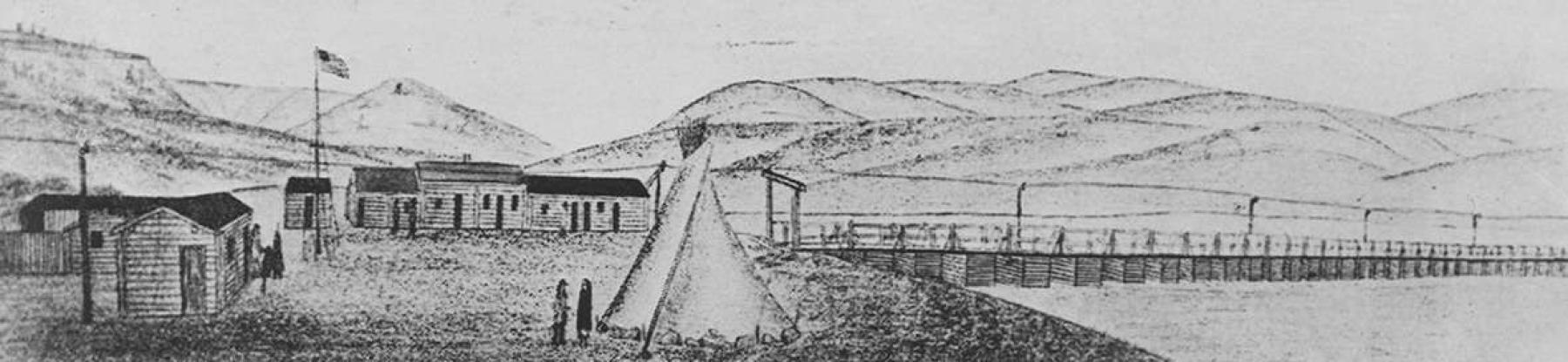
Through the early 1860s, Richard remained commercially active at his North Platte post. Increased Native hostilities created expanded demand for arms and munitions, which Richard supplied to the tribes. The overland stage, the Pony Express, and the transcontinental telegraph all brought new business to the post, and it served as an assembly and departure point for wagon trains heading north on the Bozeman and Bridger trails into Montana. The post had by this point grown into one of the most substantial private commercial complexes on the upper North Platte, combining trading, freighting, blacksmithing, livestock exchange, and military supply under one operation.10
Closure and the Transition to Fort Caspar, 1865
By 1865, a combination of escalating Native hostility and legal disputes with the United States military made continued operation at his North Platte post untenable for Richard. He sold his interests in the region and relocated to Rock Creek on the Overland Trail. The military purchased the site, and Fort Caspar was established near Guinard’s Bridge by November 1865. During the winter of 1865–1866, Richard’s bridge was dismantled by the military for firewood. The fate of the post buildings is unknown, though they may also have been dismantled or burned. Local tradition holds that Guinard’s Bridge was burned by Lakota warriors after the site was abandoned in October 1867, though this account has been disputed by some historians who suggest the troops may instead have stripped the useable timbers when salvaging other materials from the site. Richard himself died violently on a trading trip to the Sioux in late 1875, killed at the Niobrara River crossing under circumstances that were never fully resolved.11
The Post and Its Archaeological Record
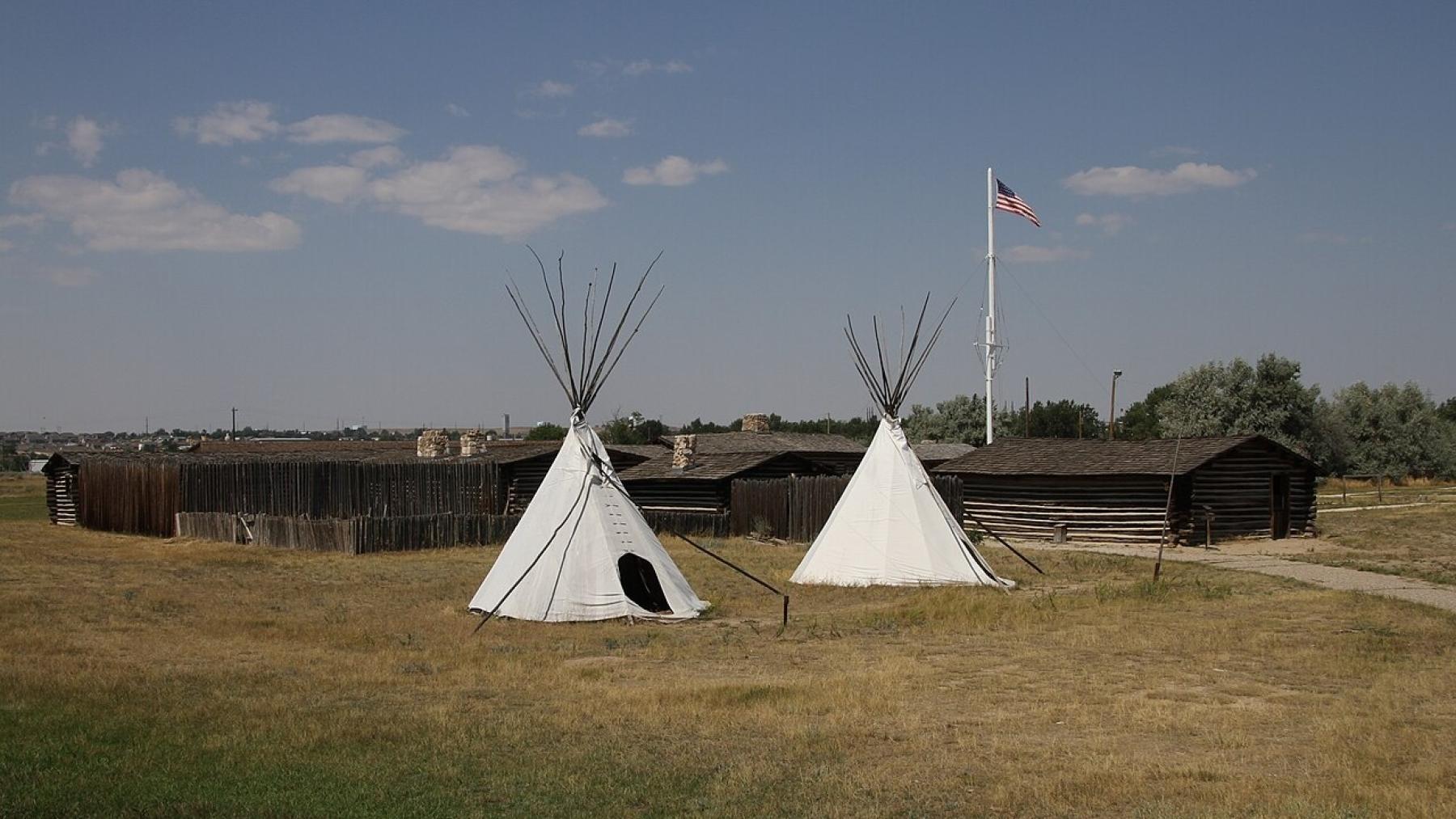
Richard’s Post was built of logs, with adobe structures added in 1858. At its fullest extent it contained fifteen to twenty buildings including residences, a trading house, a grocery, a dry goods store, a blacksmith shop, and corrals. The layout is not recorded in surviving documents. Excavations in 1963 uncovered building remains and bridge piers, prompting the city of Evansville to protect the site. A more formal investigation in 1983 recovered trade beads, domestic artifacts, and other nineteenth-century materials consistent with a busy mixed-use trading post and recommended the site as eligible for the National Register of Historic Places. Unfortunately, road construction destroyed much of the site before more comprehensive work could be undertaken.12
Significance
Richard’s Post represents one of the most consequential private commercial enterprises in the history of what is now Wyoming. Over twelve years, it served as the primary river crossing for hundreds of thousands of westbound emigrants; hosted military garrisons that were among the precursors to Fort Caspar; provided commercial infrastructure for the overland mail, the Pony Express, and the transcontinental telegraph; and supported a mixed-heritage community—Richard had an Oglala Lakota wife and mixed-race family—whose commercial and diplomatic activities connected the Euro-American trading world to the Native nations whose territories bordered the North Platte. The post’s physical record, though extensively disturbed by road construction, retains sufficient integrity to yield information about the emigrant era that few other sites in the Wyoming trading-post study can match. Jefferson Glass’s 2014 biography Reshaw: The Life and Times of John Baptiste Richard, published by High Plains Press and winner of a Western Writers of America Spur Award, is the most comprehensive modern account of Richard’s career and the post’s history.13
[Editor’s Note: Special thanks to the author and to the Wyoming State Historic Preservation Office for making this article available, and to the Wyoming Cultural Trust Fund for its ongoing support for this project. Greg Pierce’s historical monograph, Negotiating the West: A History of Wyoming Trading Posts, from which this article is adapted and excerpted, is one of many historic contexts published by the Wyoming State Historic Preservation Office. These documents are meant to offer a broad background against which historic developments can be better understood as the agency works to preserve properties and places important to an understanding of Wyoming’s past. The contexts also, however, are based on sound research and are full of well-told, vivid stories. With this in mind, WyoHistory.org is collaborating with the SHPO office to bring more of this history to a wider readership. The Cultural Trust has provided the funds to make this collaboration possible. We offer our thanks to all.]
Footnotes
-
Western Interpretive Services, Class I Historic Resource Inventory of the Casper District, Wyoming, Bureau of Land Management: Vol. I (Cheyenne: Wyoming State Historic Preservation Office, 1978), 50; David Eckles, Report of Archaeological Investigations at Richard’s Trading Post (Cheyenne: Wyoming State Historic Preservation Office, 1983), 31; Greg Pierce, Trading Posts in Wyoming, Multiple Property Documentation Form, National Register of Historic Places, Wyoming State Historic Preservation Office, State Parks and Cultural Resources, Cheyenne, Wyoming, 2012, Section E, 67–69.
-
John D. McDermott, “John Baptiste Richard,” in The Mountain Men and the Fur Trade of the Far West, ed. LeRoy R. Hafen, vol. 2 (Glendale, California: Arthur H. Clark, 1965), 289–291; Eckles, Archaeological Investigations at Richard’s Trading Post, 6–8; Pierce, Trading Posts in Wyoming, Section E, 67.
-
Charles E. Hanson Jr., “Joseph Bissonette,” Museum of the Fur Trade Quarterly 27, no. 3 (Fall 1991): 4; John D. Unruh Jr., The Plains Across: The Overland Emigrants and the Trans-Mississippi West, 1840–1860 (Urbana: University of Illinois Press, 1993), 279; Eckles, Archaeological Investigations at Richard’s Trading Post, 7; McDermott, “John Baptiste Richard,” 289–291; Robert A. Murray, “Trading Posts, Forts, and Bridges of the Casper Area: Unraveling the Tangle on the Upper Platte,” Annals of Wyoming 47, no. 1 (Spring 1975), 8; Jefferson Glass, “Reshaw’s Bridge,” WyoHistory.org, https://www.wyohistory.org/encyclopedia/reshaws-bridge.
-
Murray, “Trading Posts, Forts, and Bridges,” 8; Pierce, Trading Posts in Wyoming, Section E, 68.
-
McDermott, “John Baptiste Richard,” 289; Eckles, Archaeological Investigations at Richard’s Trading Post, 8, 11; Murray, “Trading Posts, Forts, and Bridges,” 12; Pierce, Trading Posts in Wyoming, Section E, 67–68.
-
Murray, “Trading Posts, Forts, and Bridges,” 13–16; McDermott, “John Baptiste Richard,” 289–292; Sioux Expedition Letters, Record Group 98, National Archives, Washington, D.C., cited in Pierce, Trading Posts in Wyoming, Section E, 67–68; Colonel William Hoffman to Major Winship, October 15, 1855, Sioux Expedition Letters Received, Record Group 98, National Archives, Washington, D.C., cited in Pierce, Trading Posts in Wyoming, Section E, 68.
-
Murray, “Trading Posts, Forts, and Bridges,” 14–18; McDermott, “John Baptiste Richard,” 292–300; Pierce, Trading Posts in Wyoming, Section E, 68–69.
-
Eckles, Archaeological Investigations at Richard’s Trading Post, 14–16; McDermott, “John Baptiste Richard,” 295–296; Murray, “Trading Posts, Forts, and Bridges,” 16.
-
Eckles, Archaeological Investigations at Richard’s Trading Post, 18–21; McDermott, “John Baptiste Richard,” 296–301; Murray, “Trading Posts, Forts, and Bridges,” 19–21; Deposition of Louis Richard, May 30, 1887, file 7868–123, Indian Claims Commission files, National Archives, Washington, D.C., cited in Pierce, Trading Posts in Wyoming, Section E, 69.
-
Eckles, Archaeological Investigations at Richard’s Trading Post, 22–24; Brian Jones, “Those Wild Reshaw Boys,” in Sidelights on the Sioux Wars (London: English Westerners’ Society, Special Publication 2, 1967), 19; Danny N. Walker, Wyoming’s Historic Military Sites: A Context Study (Cheyenne: Wyoming State Historic Preservation Office, 2009), 35; David B. Weaver, “Captain Townsend’s Battle on Powder River,” Contributions to the Historical Society of Montana 8 (1910), 75; Western Interpretive Services, Class I Historic Resource Inventory, 50; Pierce, Trading Posts in Wyoming, Section E, 68–69.
-
Eckles, Archaeological Investigations at Richard’s Trading Post, 27; Thomas A. Nicholas, letter to Chief, Historical Division, Wyoming Recreation Commission, December 6, 1978, on file, Office of the Wyoming State Archaeologist, Laramie, Wyoming; Western Interpretive Services, Class I Historic Resource Inventory, 50; Murray, “Trading Posts, Forts, and Bridges,” 20–21, 27–28; Pierce, Trading Posts in Wyoming, Section E, 69. Murray disputes the tradition that Guinard’s Bridge was burned by Lakota warriors, suggesting instead that troops stripped the useable superstructure when salvaging other materials from the site in 1867. See Murray, “Trading Posts, Forts, and Bridges,” 27–28.
-
Eckles, Archaeological Investigations at Richard’s Trading Post, 11, 16, 31; McDermott, “John Baptiste Richard,” 289, 291; Murray, “Trading Posts, Forts, and Bridges,” 9, 11, 20, 27; Thomas A. Nicholas, “Historian Fills Void in Fort Casper’s Past,” Casper Star-Tribune, December 17, 1972, vertical file, Wyoming State Archives, Cheyenne; Pierce, Trading Posts in Wyoming, Section E, 67–69.
-
Western Interpretive Services, Class I Historic Resource Inventory, 50; Jefferson Glass, Reshaw: The Life and Times of John Baptiste Richard, Extraordinary Entrepreneur and Scoundrel of the Western Frontier (Glendo, Wyoming: High Plains Press, 2014); Pierce, Trading Posts in Wyoming, Section E, 67–69.