Guinard’s Sweetwater River Post
Louis Guinard, a French-Canadian trader who had already spent more than a decade in the region, moved to the Sweetwater River in 1857 and constructed a bridge and trading post.1 The post was constructed below Independence Rock, primarily to capitalize on traffic from the Utah War.2 Guinard was related to the Shoshone through marriage and likely also engaged in trading activities with the tribe. Contemporaries noted the contrast with John Baptiste Richard, the trader who would become his rival on the North Platte and whose own trading network and family ties ran instead to the Sioux, a divide would leave Guinard’s later post dangerously exposed.3
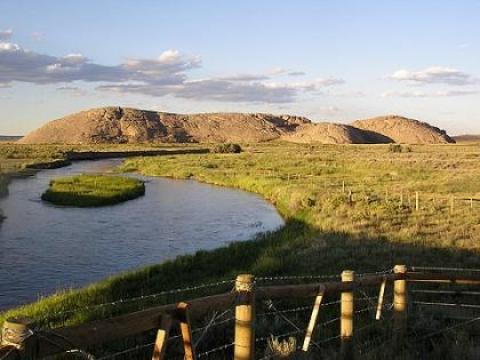
Guinard’s post was large and surrounded by a substantial stockade.4 He operated the post and bridge until 1859, when he used the profits from his operation to construct a new bridge compound on the North Platte, roughly six miles upstream from a bridge and post John Richard had already run for years near present-day Evansville, Wyoming, in Natrona County.5 Rather than run both sites at once, Guinard shifted his business entirely to the new location, abandoning the Sweetwater River Bridge and Post.6 A stage line, mail station, Pony Express station, telegraph station, and a military post subsequently occupied the site. The Pony Express station was closed in 1861; the stage line ceased activity in 1862; and the post was eventually abandoned in 1867 when the telegraph station and military post were removed.7
Guinard’s new post on the North Platte proved less secure than the one he had left behind. On October 5, 1860, Sioux raiders killed one of Guinard’s sons, who had been out herding horses; Upper Platte Indian Agent Thomas Twiss reported that the boy’s body was found and “bore unmistakable signs that he was shot with arrows, being also much cut and mangled.”8 Sir Richard Burton, who had visited that August—two months before the boy’s death—already described Guinard as “downcast about his temporal prospects,” a mood one historian has attributed to the exposed position Guinard’s Shoshone ties left him in, surrounded by the Sioux visitors who frequented Richard’s nearby post.9
While the Sweetwater River site was occupied for ten years, the trading post itself was only in operation for two years. Few historic documents reference the post while it was active. The location of the post is known, but its design, layout, and daily trading activities remain a mystery. Neither the bridge site nor the post site has seen intensive archaeological excavation, though both have been surveyed and mapped, turning up a small amount of material on the surface of the post site.10 The original footings of the bridge are visible on both sides of the Sweetwater River.11
The ground at the post site still shows physical traces of what once stood there—depressions, rock alignments, and scattered debris spanning centuries, from prehistoric use through the modern era—that may mark where former buildings stood.12 With so much unknown about the post, further investigation is needed to understand its design and the trading activities that took place there, including its connections to the Shoshone and to Utah War traffic.
[Editor’s Note: Special thanks to the author and to the Wyoming State Historic Preservation Office for making this article available, and to the Wyoming Cultural Trust Fund for its ongoing support for this project. Greg Pierce’s historical monograph, Negotiating the West: A History of Wyoming Trading Posts, from which this article is adapted and excerpted, is one of many historic contexts published by the Wyoming State Historic Preservation Office. These documents are meant to offer a broad background against which historic developments can be better understood as the agency works to preserve properties and places important to an understanding of Wyoming’s past. The contexts also, however, are based on sound research and are full of well-told, vivid stories. With this in mind, WyoHistory.org is collaborating with the SHPO office to bring more of this history to a wider readership. The Cultural Trust has provided the funds to make this collaboration possible. We offer our thanks to all.]
Footnotes
-
John D. McDermott, Frontier Crossroads: The History of Fort Caspar and the Upper Platte Crossing (Casper, WY: City of Casper, 1997), 23; Robert A. Murray, “Trading Posts, Forts, and Bridges of the Casper Area: Unraveling the Tangle on the Upper Platte,” Annals of Wyoming 47, no. 1 (1975): 18–19.
-
McDermott, Frontier Crossroads, 23; Murray, “Trading Posts, Forts, and Bridges,” 19.
-
Murray, “Trading Posts, Forts, and Bridges,” 18, 20.
-
Murray, “Trading Posts, Forts, and Bridges,” 19; O’Neill, O. M., n.d., Journal in the records of the Fort Kearney, South Pass, Honey Lake Wagon Road, in Interior Department Records, on file National Archives, Washington, DC.
-
Murray, “Trading Posts, Forts, and Bridges,” 8, 18–19.
-
David Eckles, Report of Archaeological Investigations at Richard’s Trading Post (Cheyenne: Wyoming State Historic Preservation Office, 1983), 18; McDermott, Frontier Crossroads, 23–24; Murray, “Trading Posts, Forts, and Bridges,” 19.
-
Robert A. Murray, Military Forts of Wyoming (Fort Collins, CO: The Old Army Press, 1974), 1.
-
Letters, Thomas Twiss, Upper Platte Indian Agency, to A. M. Robinson, Superintendent of Indian Affairs, October 10 and October 11, 1860, Upper Platte Agency Letters, National Archives, Washington, DC, quoted in Murray, “Trading Posts, Forts, and Bridges,” 20.
-
Richard Burton, quoted in Murray, “Trading Posts, Forts, and Bridges,” 19–20.
-
Greg Pierce, Trading Posts in Wyoming, Multiple Property Documentation Form, National Register of Historic Places, Wyoming State Historic Preservation Office, State Parks and Cultural Resources, Cheyenne, Wyoming, 2012, Section E, 71.
-
Brian Waitkus, 48NA565: Independence Rock Site Form, Project WY-35-89, prepared for the Wyoming State Historic Preservation Office, on file at the Wyoming State Historic Preservation Office, Laramie, Wyoming, 1989.
-
Pierce, Trading Posts in Wyoming, Section E, 71.