“Lifting as We Climb”: DeMarge Toliver and the Searchlight Club
A Black History Month feature on one woman’s five decades of leadership in Wyoming’s African American community
By Leslie Waggener
On December 4, 1904, a group of African American women gathered in Cheyenne to form the Searchlight Club—an organization dedicated to strengthening community bonds through social, intellectual, and charitable work. Among the charter members was 28-year-old DeMarge Toliver, reportedly the first Black child born on record in Wyoming Territory in 1875. She would dedicate nearly half a century to the club’s mission.
The club emerged at a time when Wyoming’s small African American population faced both isolation and danger. Just over a year earlier, Joe Martin—an African American man accused of attacking a white woman—had been dragged from the Laramie jail by a mob and lynched. Against this backdrop, the club’s founding members articulated a vision of mutual support and collective advancement. As club president Sudie Smith Rhone later explained in 1969, they formed the organization “feeling the need of a systematic effort along social, charitable and intellectual lines, in order to elevate our people, to help others as well as ourselves.” That 1904 founding marked the beginning of an organization that would operate for more than 80 years, becoming one of the longest-running Black women’s organizations in Wyoming history.
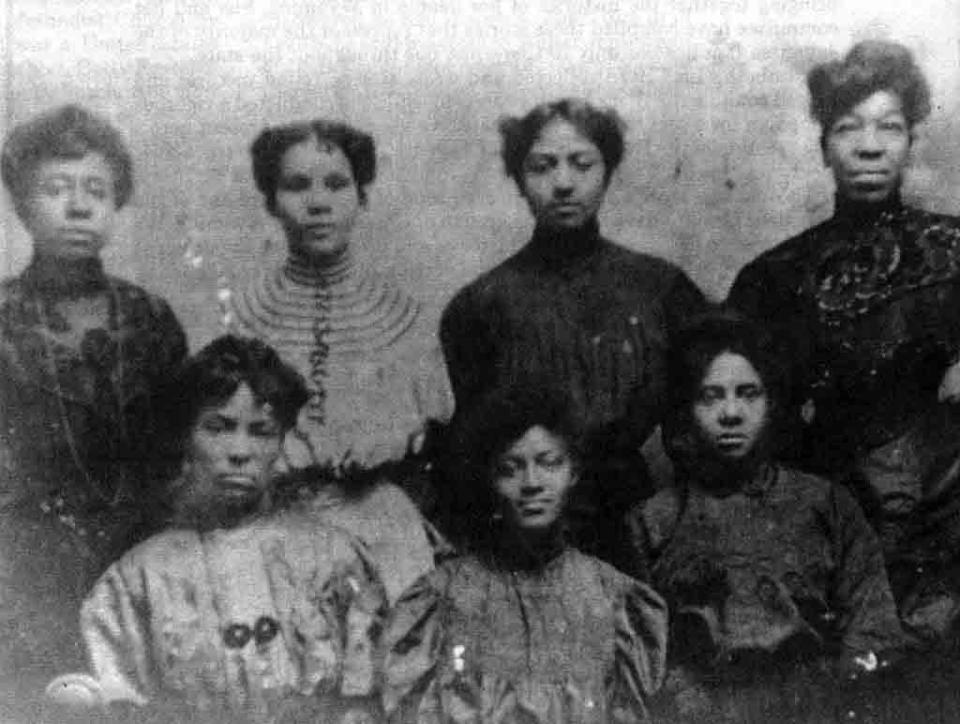
Their motto captured both aspiration and reality: “Lifting as we climb to the stars through difficulties.”
In an era when Wyoming’s entire African American female population numbered only in the hundreds, DeMarge helped create space for intellectual life and community support. Club meetings featured papers on Shakespeare, musical programs with performers like noted Black violinist Clarence Cameron White, and debates about “Heredity vs. Environment.” The women donated to churches, organized fundraising dinners, and, in 1921, collected clothing for victims of the Tulsa Race Massacre.
By 1920, DeMarge had risen to club president. Her presidential address revealed both her understanding of how precarious Black life remained in Wyoming and her vision for mutual support: “Our deportment means much to our standing as citizens,” she told members. “We form a body of colored women who stand for civic pride in our city.” At the same time, she called for solidarity, urging members to “help each other climb” and warning them to “be careful what you say” when things went wrong. Individual actions could be seen as reflecting on an entire community—respectability and mutual support were strategies for survival as much as advancement.
DeMarge’s organizational work extended beyond Cheyenne. In 1921, she was elected corresponding secretary of the Colorado and Wyoming State Federation of Women’s Clubs. By 1926, when Wyoming established its own state federation, she served as recording secretary at the inaugural convention in Casper. She also held leadership positions in the Order of the Eastern Star and served on the all Colorado-Wyoming committee for the national conference of the National Association for the Advancement of Colored People in Denver.
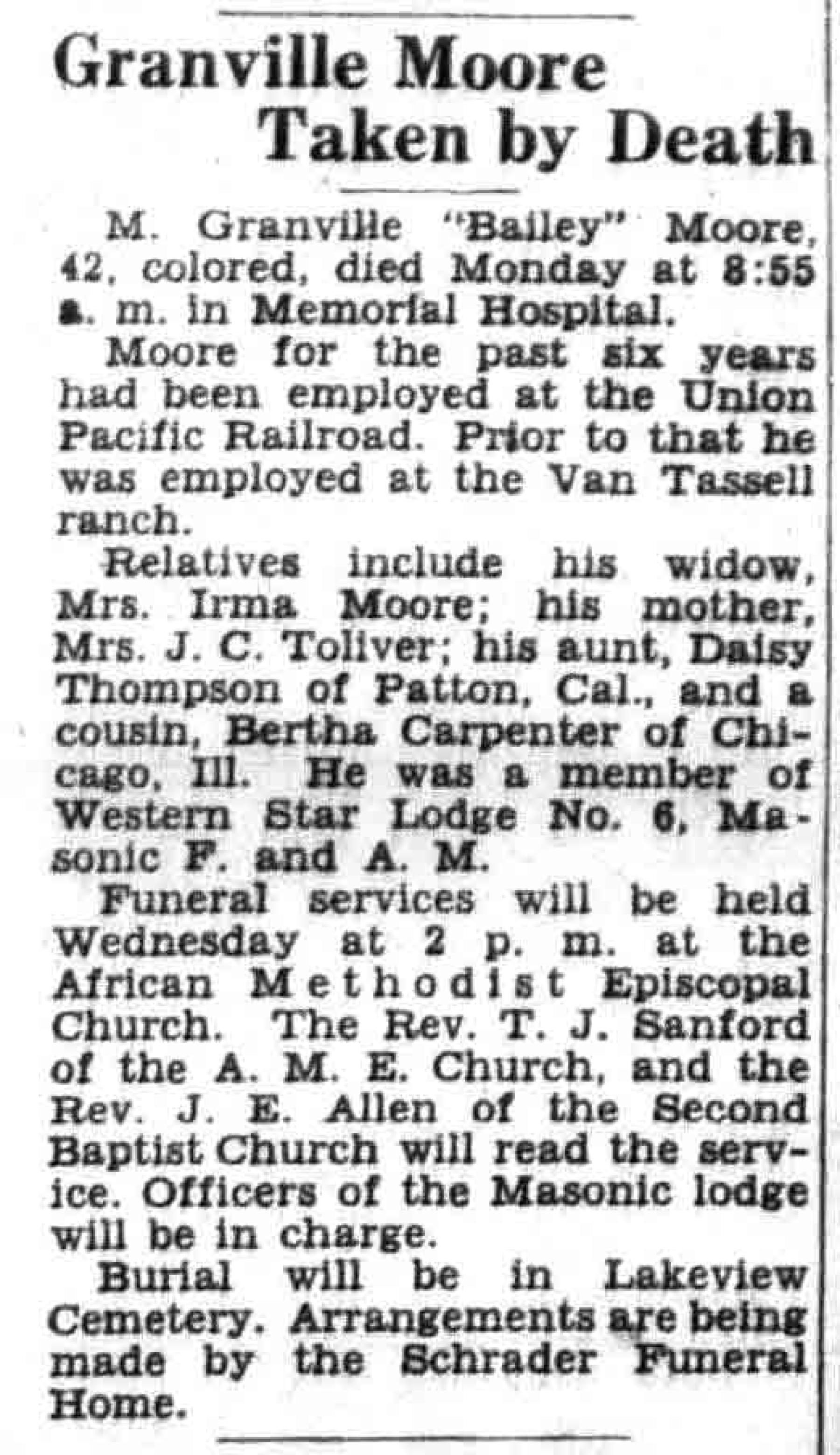
This sustained work was remarkable given the personal tragedies marking DeMarge’s life. She grew up in a household scarred by domestic violence. She married four times: her first husband deserted her, leading to divorce; her second died of pneumonia at age 36; her third disappeared from her life without explanation; only her fourth and final husband outlived her. Most devastatingly, she lost both children: her daughter Alberta died of bronchitis at 15 months old in 1906, and her son Granville died following appendicitis surgery in 1935 at age 44.
Yet through these losses, DeMarge continued showing up for her community. She presented papers at meetings, hosted fundraising dinners, and maintained leadership roles across multiple organizations. Her persistence embodied the club’s founding principle: that individual advancement and collective uplift were inseparable.
When DeMarge Toliver died on July 21, 1947, at age 71, she had lived in Cheyenne for 70 years. Her more than 40 years of club work show how African American women created networks of support and spaces for leadership even where they constituted a tiny fraction of the population. The Searchlight Club was more than a social organization: it was a lifeline, a platform, and a declaration that Black women in Wyoming deserved opportunities for intellectual growth, cultural enrichment, and civic influence.
DeMarge’s story is one of many that reveal the complexity of Black life in early Wyoming. From the first Black women who voted in 1870, to legislators like William Jefferson Hardin, to ranchers who built lives far from population centers, African Americans carved out space in a territory and state where they were always a tiny minority. Their stories—including the violence they faced, the institutions they built, and the communities they sustained— reveal a Wyoming far more diverse and complex than popular memory suggests.
A longer article exploring DeMarge Toliver’s life is forthcoming on WyoHistory.org.
For more about Black history in Wyoming, see WyoHistory.org’s articles:
- Fort Halleck and the Overland Trail
- The Frontier Index: ‘Press on Wheels’ in a Partisan Time
- Could Women of Color Vote in the 1870 Election?
- “Then I breathed freely”: Black Women Vote in Wyoming, 1870”
- “William Jefferson Hardin: Wyoming’s First Black Legislator”
- “Buffalo Soldiers in Wyoming and the West”
- “Making a Home in Empire, Wyo.”
- “Mathew Campfield: Barber, Coroner and Pioneer Survivor”
- The Forgotten Town of Dana, Wyo.: A Story of Black Legacy and Miners’ Rights
- “Who was Lucretia Marchbanks? From Slavery to Ranch Life in the Black Hills”
- “Carrie Burton Overton, First African-American Female Student at UW”
- “Breaking a Stereotype: Black Rancher Alonzo Stepp”
- “The Lynching of Joe Martin”
- “The Lynching of Edward Woodson, 1918”.
- “A Lynching in Rock Springs”
- “This Great Struggle: African-American Churches in Rock Springs”
- James Reeb of Casper, Martyr to Civil Rights
- “1968: Wyoming Reacts to the King Assassination”
- The Black 14: Race, Politics, Religion and Wyoming Football
- Dr. Willie Black, Chancellor of the Black Student Alliance, on the Black 14
- Former University of Wyoming Football Player Mel Hamilton on His Life and the Black 14
- Liz Byrd, First Black Woman in Wyoming’s Legislature