Seminoe’s Post
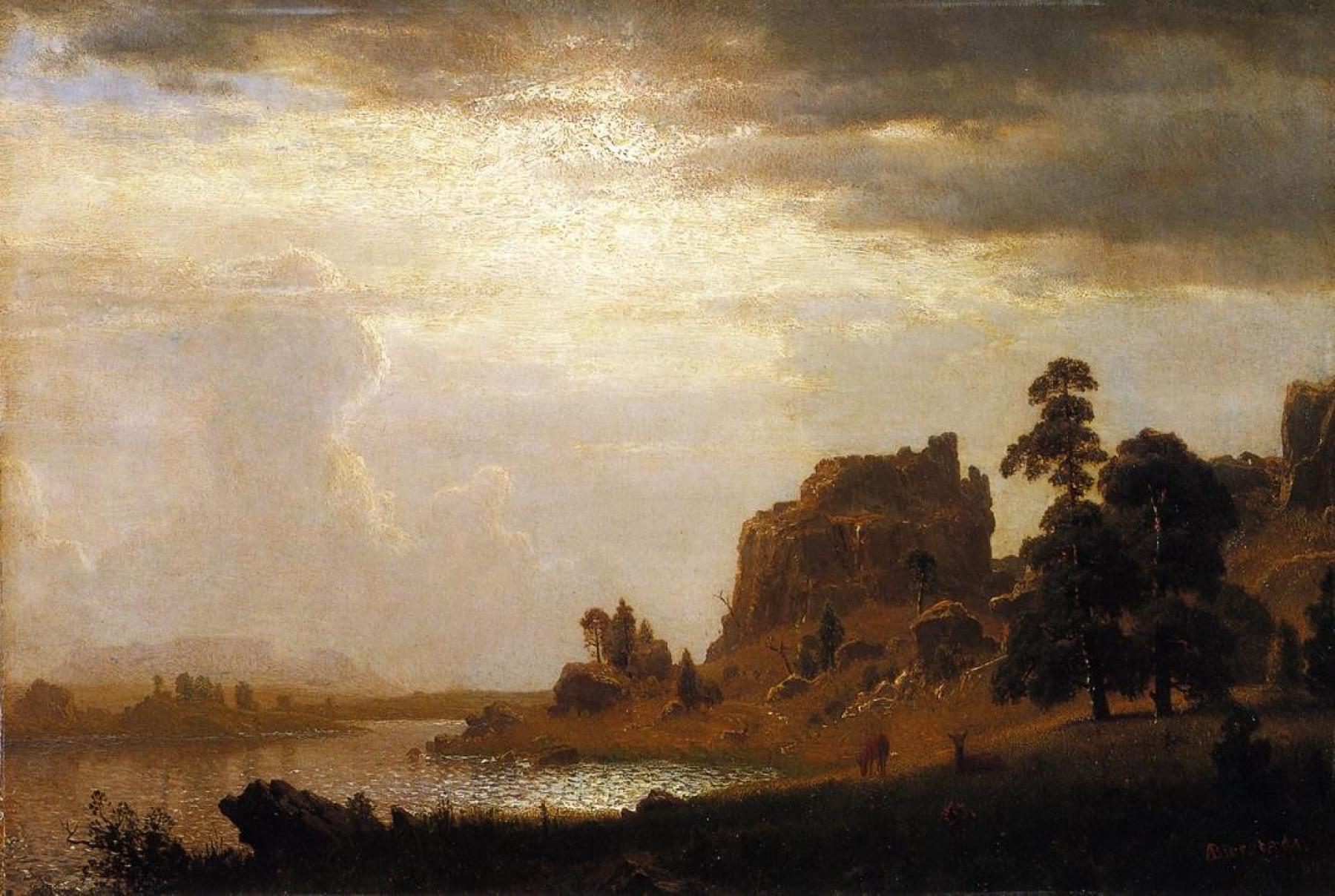
Seminoe’s Post was a log trading compound established in 1852 on the Sweetwater River near Devil’s Gate in what is now southwestern Natrona County, Wyoming. Operating for roughly four years at the height of the Oregon Trail emigrant era, it served travelers on the Oregon, California, and Mormon trails, conducted trade with the Eastern Shoshone and other Native peoples of the Sweetwater Valley, and employed a small community of French-Canadian and mixed-heritage traders and their families. The site was lost to memory for nearly a century and a half before archaeological investigations in 2001 rediscovered it. Today a reconstructed post stands near its original location as part of The Church of Jesus Christ of Latter-day Saints’ Martin’s Cove Visitor Center.1
Charles Lajeunesse and the Founding of the Post
The post takes its name from Charles Lajeunesse, the Franco-Canadian fur trader who led its construction and early operation. Lajeunesse had been active in the Rocky Mountain fur trade since at least 1827, working at various times for Pierre Chouteau Jr. and the American Fur Company, for William Sublette and Robert Campbell, and in the latter part of his fur-trade career as a minor partner in Jim Bridger’s Green River operations. Contemporary travelers and correspondents knew him variously as Little Simon, Simono, or Seminoe—the last a corruption of Simonot, his French Catholic baptismal name—and it is from this nickname that the post, and later the Seminoe Mountains and Seminoe Reservoir in Carbon County, Wyoming, take their names.2
Lajeunesse’s partners in the enterprise were August Archambault, Hubert Papin, and Moses and Charley Perat, all of whom had connections to the same network of French-Canadian and mixed-heritage traders who had worked the Wyoming region for decades.3 Like many of their contemporaries in the regional trade, these men commonly formed unions with Native women; Lajeunesse’s own sons—Mich, Noel, and Ed—were half Shoshone, reflecting the bicultural world the traders inhabited.4
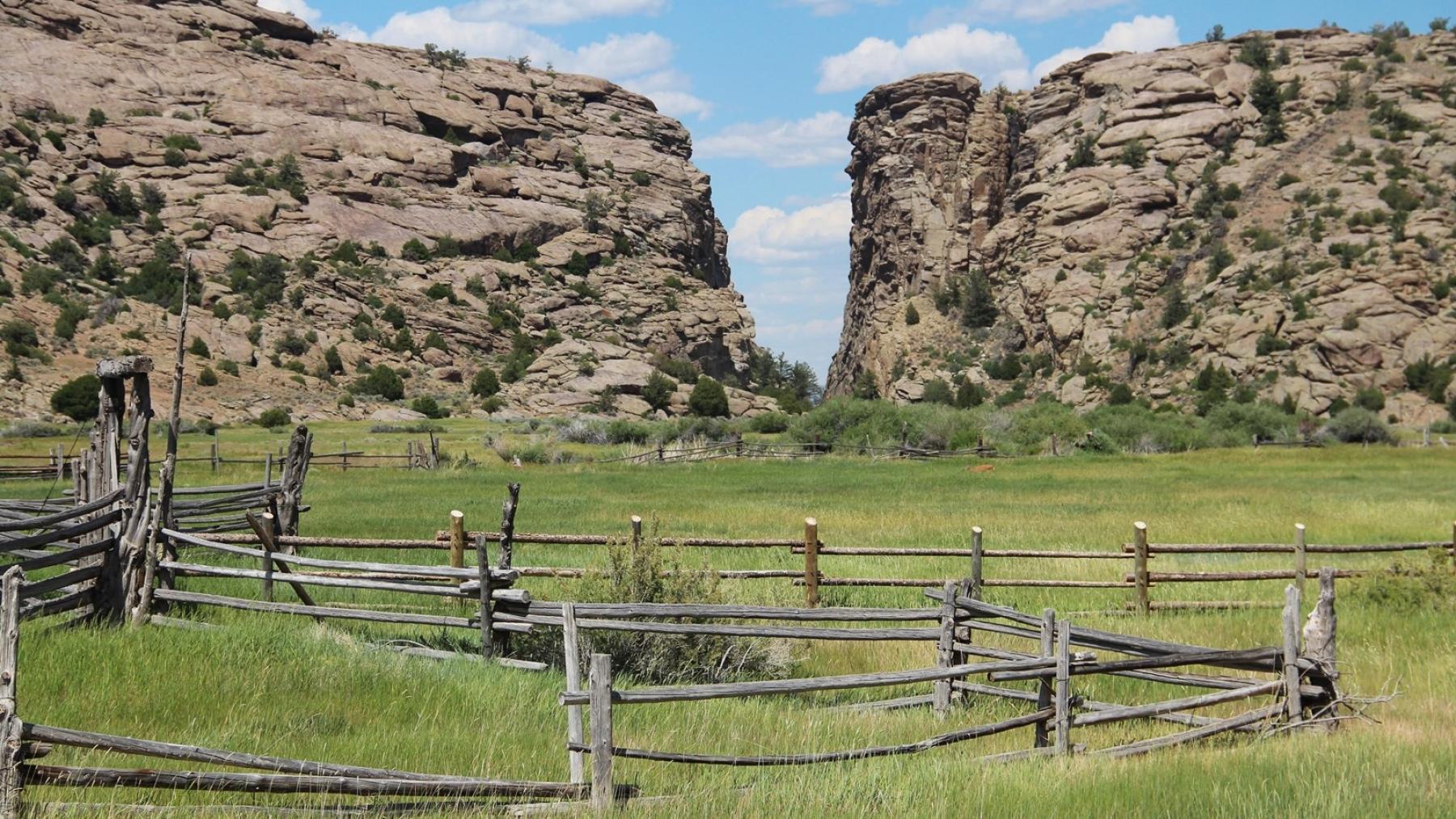
The choice of Devil’s Gate as the post’s location was deliberate and strategically shrewd. The narrow granite gorge through which the Sweetwater River passes was impassable to wagons, which meant all emigrants following the Sweetwater Valley, regardless of their destination, were funneled past a single point on one side of the river. Lajeunesse recognized that a post placed at this natural chokepoint could capture the entire emigrant trade through the region. In May or June of 1852, the partners arrived at the site and began trading immediately from their wagons while constructing the post itself.5
Physical Form and Operations
The finished post was a substantial structure for its time and location. Contemporary accounts describe it as a ten-room stockaded facility built of hewn logs with a sod roof, forming a 120-foot square compound approximately three-quarters of a mile south of Devil’s Gate. The main gate opened directly onto the Oregon Trail. The post included corrals, a cattle yard, and a blacksmith shop, and employed a cook, stock tenders, hunters, and a clerk in addition to the traders themselves. A cemetery containing both Euro-American and Native American burials is also associated with the post, reflecting the mixed community that lived and traded there.6
Commerce at Seminoe’s Post operated on two parallel tracks. The primary and most lucrative trade was with the emigrant trains filing past from spring through late summer: travelers purchased provisions, hardware, and cloth goods, exchanged worn-out livestock for fresh animals, and paid for blacksmithing services on damaged wagons and equipment. In the peak year of 1852, an estimated seventy thousand westbound travelers crossed what is now Wyoming, and Lajeunesse’s well-chosen location captured a substantial share of their custom.7 The Sweetwater Valley also supported a Native trade, with the Eastern Shoshone and other groups bringing robes, furs, and horses to the post in exchange for manufactured goods. By the early 1850s numerous French-speaking trading families with Shoshone and other Native wives occupied the valley, making Seminoe’s Post the most prominent of a cluster of small establishments serving both emigrant and Indigenous commerce.8
In 1853, the partnership also constructed a bridge across the Sweetwater where the trail met the river, approximately seven miles from the post. This created a management problem—splitting the small crew between two locations—and the following year Archambault built a separate, less elaborate trading facility near the bridge. This second establishment, which came to be known as Archambault’s Post and later as Sweetwater Station, gradually eclipsed Seminoe’s in emigrant traffic because of its more easterly position on the trail.9
Decline, Abandonment, and Destruction
The years 1854 and 1855 brought a sharp contraction in the post’s commercial environment. Emigrant traffic through the region dropped from a peak of approximately seventy thousand travelers in 1852 to roughly twenty-one thousand in 1854 and only about sixty-six hundred in 1855, partly because of cholera fears and partly because of the spreading violence on the Northern Plains following the Grattan Fight of August 1854. Although the Sweetwater Valley remained calmer than the North Platte corridor to the east, Native raiding reached Seminoe’s Post by 1855: livestock and horses were taken in several incidents, and the security of the enterprise became increasingly difficult to maintain.10
As tensions escalated in 1856, General William S. Harney issued orders for the Platte River traders to relocate to Fort Laramie. Harney’s decree named the Devil’s Gate traders as well, but Lajeunesse initially remained at his post. By the fall of 1856, a combination of declining trade and mounting Native hostilities had become untenable, and Seminoe’s Post was abandoned. The precise date is unknown, but the site is confirmed as vacated by July 1856.11
That October, members of the Mormon Martin Handcart Company, caught by an early winter storm while crossing Wyoming late in the season, sought shelter in the abandoned trading compound. Too weak from hunger and cold to continue, the company camped at Devil’s Gate for several days; twenty men stayed through the winter to guard wagon-train goods, and the handcarters burned portions of the post for fuel. The Martin Company’s ordeal at Devil’s Gate, in which an estimated 135 to 150 of the company’s approximately 576 members died before reaching Utah, became one of the most studied catastrophes on the emigrant trails.12
The post was later used as a mail express station into 1857. When Mormon militia burned property in the region during the Utah War as United States troops advanced toward Salt Lake City, the remaining post structures were destroyed. By the early twentieth century the site’s precise location had been forgotten entirely.13
Rediscovery and Reconstruction
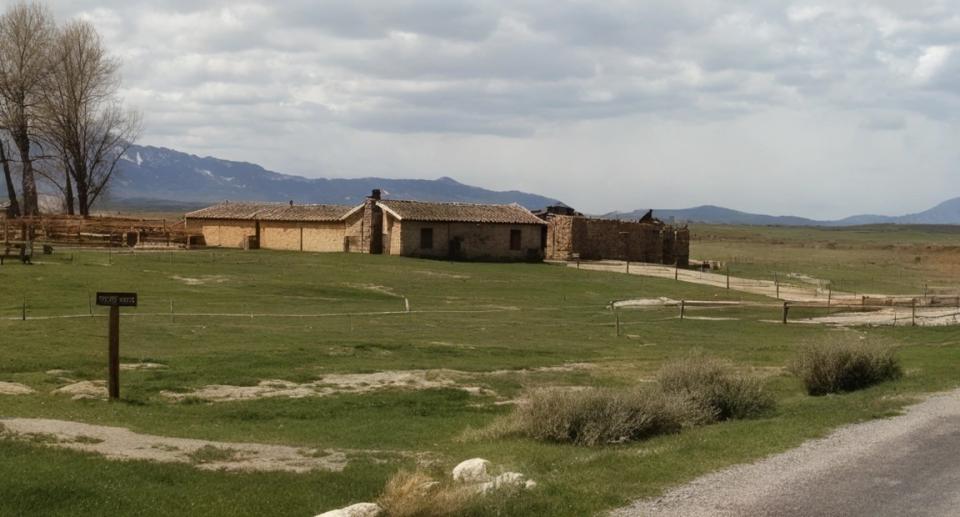
In 2001, the National Park Service commissioned archaeological investigations to locate the post, whose precise position had been lost for generations. Working from historical journals and a mid-nineteenth-century survey map of the Devil’s Gate area, investigators identified the site and confirmed through excavation that the historical accounts of its location, design, and layout were substantially accurate. The findings provided the data needed to reconstruct the compound. A replica of Seminoe’s Post was subsequently built near the original location, protecting surviving buried deposits from visitor impact while making the site publicly accessible. Artifacts recovered during excavation are displayed in a museum within the reconstructed post, and the site forms part of the LDS Martin’s Cove Visitor Center on Wyoming Highway 220 approximately sixty miles southwest of Casper.14
Significance
Seminoe’s Post is significant on several counts. It represents one of the few trading posts from the peak emigrant era in Wyoming that has been both located and substantially investigated archaeologically, making it a rare case study in which the historical and material records can be directly compared. That comparison showed the post’s physical remains to be largely consistent with contemporary descriptions, a degree of documentary accuracy unusual among post-era sites where the historical record is often fragmentary or unreliable.15
The post’s intersection with the Martin Handcart Company disaster of 1856 gives it an additional layer of historical significance that few Wyoming trading posts share. The events at Devil’s Gate in October and November of that year are among the most thoroughly documented episodes in the history of the Mormon emigration, and Seminoe’s abandoned compound—transformed into a winter shelter, fuel source, and supply depot—played a direct material role in the response to that disaster. The post’s second life as a mail station and its final destruction during the Utah War tie it to two further episodes, in the late 1850s, that shaped the political and commercial history of the region that would become Wyoming.16
The post’s French-Canadian founders and their Eastern Shoshone trading partners also illustrate the multicultural character of the Sweetwater Valley trading community. Lajeunesse and his associates were part of a distinctive social world—French-speaking, often with Indigenous wives and mixed-heritage children, fluent in the languages and customs of the Native peoples they traded with—that the nominally English-speaking emigrant era has often obscured.17 After the post’s abandonment, the Lajeunesse family remained embedded in the region: in 1868, Lajeunesse’s half-Shoshone sons, Mich, Noel, and Ed, escorted their pregnant sister Louisa and her family from Fort Laramie toward South Pass, the wagon train coming under attack by Lakota Sioux raiders near Split Rock, an episode that illuminates both the dangers and the social complexity of the mixed-heritage community that posts like Seminoe’s had anchored for more than a decade.18 The cemetery at the site, with its mixed Euro-American and Native American burials, stands as tangible evidence of that community.19
[Editor’s Note: Special thanks to the author and to the Wyoming State Historic Preservation Office for making this article available, and to the Wyoming Cultural Trust Fund for its ongoing support for this project. Greg Pierce’s historical monograph, Negotiating the West: A History of Wyoming Trading Posts, from which this article is adapted and excerpted, is one of many historic contexts published by the Wyoming State Historic Preservation Office. These documents are meant to offer a broad background against which historic developments can be better understood as the agency works to preserve properties and places important to an understanding of Wyoming’s past. The contexts also, however, are based on sound research and are full of well-told, vivid stories. With this in mind, WyoHistory.org is collaborating with the SHPO office to bring more of this history to a wider readership. The Cultural Trust has provided the funds to make this collaboration possible. We offer our thanks to all.]
Footnotes
-
Greg Pierce, Trading Posts in Wyoming, Multiple Property Documentation Form, National Register of Historic Places, Wyoming State Historic Preservation Office, State Parks and Cultural Resources, Cheyenne, Wyoming, 2012, Section E, 60–62; Danny N. Walker, Archeological Investigations at Seminoe’s Trading Post, 48NA288, Natrona County, Wyoming, prepared for the Wyoming State Historic Preservation Office (Laramie: Wyoming State Historic Preservation Office, 2009), 1, 95, 100.
-
“Seminoe vs. Seminole,” Annals of Wyoming 6, no. 2 (1929), 237; J. Cecil Alter, Jim Bridger (Norman: University of Oklahoma Press, 1962), 205–212; Walker, Archeological Investigations at Seminoe’s Trading Post, 1, 14–15; Pierce, Trading Posts in Wyoming, Section E, 60.
-
Walker, Archeological Investigations at Seminoe’s Trading Post, 21–22; Pierce, Trading Posts in Wyoming, Section E, 60.
-
Rebecca Hein, “Three Mixed-race Families and a Wagon Train Attack: A Story of Frontier Survival,” WyoHistory.org, November 11, 2015, https://www.wyohistory.org/encyclopedia/wagon-train-attack-story-frontier-survival; Tom Rea, Devil’s Gate: Owning the Land, Owning the Story (Norman: University of Oklahoma Press, 2006), 39, 64–77.
-
Walker, Archeological Investigations at Seminoe’s Trading Post, 21; Lodisa Frizzell, in Best of Covered Wagon Women, ed. Kenneth L. Holmes (Norman: University of Oklahoma Press, 1997), 53; Pierce, Trading Posts in Wyoming, Section E, 60.
-
Margaret Booth, ed., “Overland from Indiana to Oregon: The Dinwiddie Journal,” in John W. Hakola, ed., Frontier Omnibus (Helena: Montana State University Press, 1962), 187; Donald J. Spinelli, Report on the Sweetwater Valley Segment of the Oregon Trail, report for the Lander Resource Area, Bureau of Land Management (on file, Lander Field Office, Wyoming Bureau of Land Management, 1976), 25; Walker, Archeological Investigations at Seminoe’s Trading Post, 9–10, 22; Pierce, Trading Posts in Wyoming, Section E, 61.
-
John Unruh, The Plains Across: The Overland Emigrants and the Trans-Mississippi West, 1840–60 (Chicago: University of Illinois Press, 1993), 85; Walker, Archeological Investigations at Seminoe’s Trading Post, 22; Pierce, Trading Posts in Wyoming, Section E, 61.
-
Wyoming State Historic Preservation Office, “Devil’s Gate,” WyoHistory.org, January 2, 2015, https://www.wyohistory.org/encyclopedia/devils-gate; Pierce, Trading Posts in Wyoming, Section E, 60.
-
Magloire Mousseau, statement recorded by Judge Eli S. Ricker, October 30, 1906, notebook 28, 16–17, Nebraska State Historical Society, Lincoln, Nebraska, cited in Pierce, Trading Posts in Wyoming, Section E, 60–61.
-
Walker, Archeological Investigations at Seminoe’s Trading Post, 26–29; Pierce, Trading Posts in Wyoming, Section E, 61.
-
Walker, Archeological Investigations at Seminoe’s Trading Post, 1, 27–29; Andrew Galloway, “A Brief Record of the First Handcart Company,” Utah Genealogical and Historical Magazine 18 (1927), 54; LeRoy R. Hafen and Ann W. Hafen, Handcarts to Zion (Glendale, California: Arthur H. Clark, 1955), 211; Pierce, Trading Posts in Wyoming, Section E, 61.
-
Tom Rea, “Journey to Martin’s Cove: The Mormon Handcart Tragedy of 1856,” WyoHistory.org, https://www.wyohistory.org/encyclopedia/journey-martins-cove-mormon-handcart-tragedy-1856; Galloway, “A Brief Record,” 347–349; Walker, Archeological Investigations at Seminoe’s Trading Post, 27–28; Pierce, Trading Posts in Wyoming, Section E, 61–62.
-
Walker, Archeological Investigations at Seminoe’s Trading Post, 54; Pierce, Trading Posts in Wyoming, Section E, 62; Annette Hein, “The Martin’s Cove Controversy,” WyoHistory.org, https://www.wyohistory.org/encyclopedia/martins-cove-controversy.
-
Walker, Archeological Investigations at Seminoe’s Trading Post, 38, 42, 50, 54, 95, 100; Pierce, Trading Posts in Wyoming, Section E, 61–62.
-
Pierce, Trading Posts in Wyoming, Section E, 60–62; Walker, Archeological Investigations at Seminoe’s Trading Post, 95.
-
Rea, “Journey to Martin’s Cove,” WyoHistory.org; Hein, “The Martin’s Cove Controversy,” WyoHistory.org; Pierce, Trading Posts in Wyoming, Section E, 61–62.
-
Walker, Archeological Investigations at Seminoe’s Trading Post, 21–22; Rea, Devil’s Gate, 39, 64–77; Wyoming State Historic Preservation Office, “Devil’s Gate,” WyoHistory.org, https://www.wyohistory.org/encyclopedia/devils-gate.
-
Hein, “Three Mixed-race Families and a Wagon Train Attack,” WyoHistory.org; Rea, Devil’s Gate, 100.
-
Spinelli, Report on the Sweetwater Valley Segment, 25; Walker, Archeological Investigations at Seminoe’s Trading Post, 9–10.