Merchant and Williams Trading Post
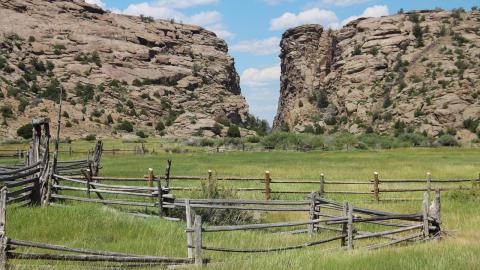
In the winter or spring of 1861, traders identified only by the surnames Merchant and Williams constructed a trading post near Devil’s Gate.1 The landmark was already well known to emigrants. Charles Lajeunesse—also known as Simono or Seminoe, for whom the nearby Seminoe Mountains and Seminoe Reservoir are named—and his partner August Archambault ran a trading post at Devil’s Gate beginning in 1852; the following year, the same partnership built a second post, known as Archambault’s Post [link when published], a few miles away near Independence Rock.2 Both ventures ended in 1856, when declining trade and rising tensions with Native groups forced their abandonment. In October, a late-starting company of Mormon handcart emigrants under Edward Martin found Devil’s Gate deserted and burned part of the old post for warmth, sheltering nearby at what became known as Martin’s Cove. Archambault twice tried to reoccupy his post—in September 1856, when Sioux warriors drove him off and left an arrow in the door as a warning, and again the following spring—before abandoning the site for good.3 The Merchant and Williams venture, five years later, was a distinct undertaking rather than a reoccupation of either earlier post. No further trading post is documented at the site until Thomas de Beau Soleil (Tom Sun), a French-Canadian frontiersman, established a ranch there in 1872 that later anchored what is now the Mormon Handcart Historical Center.4
The Merchant and Williams post rose amid a new wave of tension on the frontier: with federal troops withdrawn to fight the Civil War, Native raids destroyed several mail stations between Fort Bridger and Fort Laramie over the following year.5 One year after construction, the Merchant and Williams post was destroyed by fire, reportedly set ablaze by Native Americans.6
On April 26, 1862, Congressman Milton Latham of California proposed that President Lincoln ask Brigham Young to raise troops to protect the Overland Trail; two days later the War Department telegraphed Young, authorizing him to raise one company of cavalry for ninety days’ federal service, specifically to protect mail and telegraph property “in or about Independence Rock, where depredations have been committed.”7 The company was mustered within two days under Capt. Lot Smith and departed Salt Lake City on May 1, reaching Independence Rock after a 26-day march. In June 1862, Smith’s company built a corral and houses at Devil’s Gate itself, work Smith reported in a letter to Young.8 This is very likely the event behind the post’s reported reconstruction, though it is not certain the structures Smith’s men built were the same ones Merchant and Williams had raised the year before, rather than new construction nearby. The company returned to Salt Lake City on August 15 and was discharged the next day.
Whatever role the post played in these events, the historical record around it stays thin. Contemporary references to the Merchant and Williams post are scant, limited to the Mormon militia journal entries reproduced in Margaret Fisher’s compiled history of Utah during the Civil War.9 Because of this, the nature of the trading activities at the post, the layout and post components, and the length of time the post was in operation are unknown.
The exact location of the Merchant and Williams Trading Post remains unconfirmed, based on descriptions in the militia journal entries and scattered surface artifacts found nearby.10 Further archaeological investigation will be needed to determine the post’s precise location. Additional historical and archaeological investigations could aid in the location of the post as well as provide information relating to size and layout. Excavation could provide information on design and on trading activities near Devil’s Gate in the 1860s, as well as Mormon involvement in trading activities during this period.
Footnotes
- Robert A. Murray, Site 48NA291 site form, submitted to the Wyoming State Historic Preservation Office, State Parks and Cultural Resources, Cheyenne, Wyoming, 1979.
- Greg Pierce, Trading Posts in Wyoming, Multiple Property Documentation Form, National Register of Historic Places, Wyoming State Historic Preservation Office, State Parks and Cultural Resources, Cheyenne, Wyoming, 2012, Section E, 60–63.
- Pierce, Trading Posts in Wyoming, Section E, 64; Wyoming State Historic Preservation Office, “Devil’s Gate,” WyoHistory.org, January 2, 2015, https://wyohistory.org/encyclopedia/devils-gate; Annette Hein, “The Martin’s Cove Controversy,” WyoHistory.org, November 8, 2014, https://wyohistory.org/encyclopedia/martins-cove-controversy.
- “Tom Sun Ranch National Historic Landmark,” Wyoming State Historic Preservation Office, accessed September 5, 2026, https://wyoshpo.wyo.gov/index.php/programs/national-register/wyoming-listings/view-full-list/713-tom-sun-ranch-national-historic-landmark; “The Martin’s Cove Controversy,” WyoHistory.org.
- “Chapter Thirty: The Civil War Period,” Church History in the Fulness of Times Student Manual (Salt Lake City: The Church of Jesus Christ of Latter-day Saints, 2003), 381–91, https://www.churchofjesuschrist.org/study/manual/church-history-in-the-fulness-of-times/chapter-thirty.
- Pierce, Trading Posts in Wyoming, Section E, 74.
- Kenneth L. Alford and Joseph R. Stuart, “The Lot Smith Cavalry Company: Utah Goes to War,” in Civil War Saints, ed. Kenneth L. Alford (Provo, UT: Religious Studies Center; Salt Lake City: Deseret Book, 2012), 128–133, quoting L. Thomas to Brigham Young, April 28, 1862, in The War of the Rebellion: A Compilation of the Official Records of the Union and Confederate Armies, series 3, vol. 2, 27.
- Alford and Stuart, “The Lot Smith Cavalry Company,” 137–138, quoting Lot Smith to Brigham Young, June 16, 1862, and citing the Harvey Coe Hullinger Journal, June 6–20, 1862.
- Margaret M. Fisher, ed., Utah and the Civil War: Being the Story of the Part Played by the People of Utah in that Great Conflict, with Special Reference to the Lot Smith Expedition and the Robert T. Burton Expedition (Salt Lake City: Deseret Book, 1929).
- Ross Hillman, “Site 48NA291,” submitted to the Wyoming State Historic Preservation Office, State Parks and Cultural Resources, Cheyenne, Wyoming, 2004.