Fort John
Fort John was an adobe trading post constructed in 1841 at the confluence of the Laramie and North Platte rivers in present-day Goshen County, Wyoming, on the site of its predecessor Fort William. Built by the American Fur Company to replace the rapidly deteriorating log stockade of Fort William and to meet the competitive threat posed by the nearby Fort Platte, Fort John served as the primary trading post for the North Platte region through the peak years of overland emigration. It was the structure tens of thousands of Oregon-, California-, and Mormon-bound emigrants associated with Fort Laramie during the 1840s, and its sale to the United States Army in 1849 launched one of the most significant military installations in the American West.1
Construction and Origins
From its purchase of Fort William in 1836 until 1841, the American Fur Company had faced no serious competition at the Laramie–Platte confluence. That changed when Lancaster Lupton, a former Fort William employee, constructed Fort Platte within a mile of the aging post.2 The cottonwood logs of Fort William had deteriorated badly in less than seven years, and the post’s shabby appearance was not good for business. The sudden appearance of a well-built rival provided the American Fur Company with both the incentive and the urgency to replace Fort William with a larger, more impressive facility.3 The new post was named Fort John, after John Sarpy, a partner in the company.4
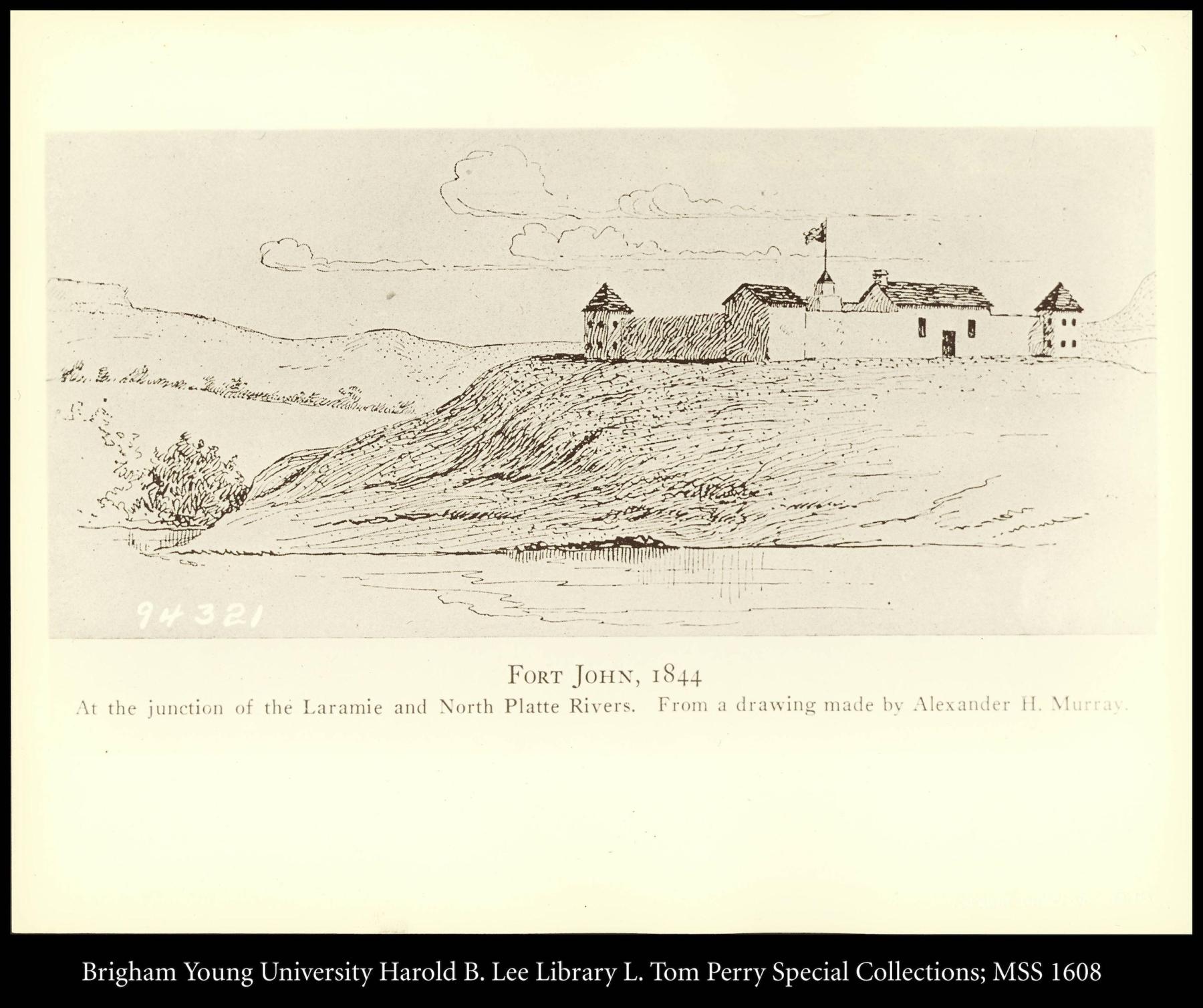
Unlike Fort William, which had been constructed of logs, Fort John was built of adobe. Adobe posts had been in use on the South Platte for more than a decade, and the technique’s advantages over log construction were well understood: the arid climate of the region made adobe more durable than log, and adobe was also more fire resistant and provided better insulation.5 To build it, the American Fur Company reportedly brought skilled workers from the American Southwest, where adobe construction was common. According to local tradition documented near the site, these workers settled near the post after its completion, raising vegetables in the river bottom to sell to traders and emigrants.6
Physical Description
Fort John was constructed on the west side of the Laramie Fork, about two miles from its confluence with the North Platte.7 Less than a mile to the east, toward the Platte, sat the rival Fort Platte. The relationship of Fort John’s location to that of Fort William has not been definitively established. It was initially believed Fort John was constructed about a mile further west from the Laramie than Fort William, though more recent analysis has proposed the two posts may have occupied the same site.8
The post’s walls were two feet thick and twelve to fifteen feet high, topped with pickets or spikes. Writer and traveler Joel Palmer, who passed through in 1845, described gates in both the northern and southern walls, and an interior lined with storage rooms, residences, offices, a blacksmith shop, and a carpenter’s shop. The interior was a large open square, a portion of which was partitioned as a corral. Outside the post was a four-acre plot set aside for growing corn.9 Francis Parkman, a young Boston writer whose 1846 journey to Fort John produced one of the most vivid firsthand accounts of the post, described two blockhouses at opposite corners of the fort, with a third above the main gate.10
A Mormon emigrant party measured and sketched the post in 1847, providing the most precise surviving record of its dimensions. They found it to be 167 feet by 121 feet in size, containing stables and eighteen rooms used as dwellings, stores, and a blacksmith shop.11 Fort John presented a far more imposing appearance to approaching travelers than Fort William had. Because so many more emigrants sketched and described Fort John than its predecessor, the post is much better documented visually, and it was Fort John that most contemporaries meant when they spoke of Fort Laramie.12
Operations and the Emigrant Trade
The American Fur Company operated Fort John from 1841 to 1849, trading with Native Americans, travelers, and the rapidly growing stream of overland emigrants.13 The post was ideally positioned to serve this new clientele. The Oregon, California, and Mormon trails all converged along the North Platte, and Fort John sat at the first major way station west of the Missouri frontier. It was the only significant post for the 800-mile span between Fort Kearney in present Nebraska and Fort Bridger in present southwestern Wyoming.14 To accommodate their expanding clientele, the post provided not only trade goods but additional services: artisans manufactured goods for sale to emigrants, worn-out livestock was exchanged for fresh animals, and the post served as a rest stop, mail collection point, and information hub for the trails west.15
Parkman’s 1846 visit left a detailed portrait of the post at the height of its operations. He found the compound crowded with traders, trappers, and Lakota Sioux, and recorded the sight of dozens of Oglala lodges pitched outside the walls, their inhabitants drawn in by the trading opportunities the fort offered.16 The post also maintained an uneasy relationship with rival traders. Competition from Fort Platte and, after 1845, from Fort Bernard, required constant commercial vigilance. The American Fur Company’s investment of $10,000 in Fort John’s construction reflected its confidence that the emigrant and robe trade would sustain the post’s dominance, a confidence that proved justified.17
Sale to the Military and Transition to Fort Laramie
As westward emigration increased through the late 1840s, the United States military began establishing a system of posts along the trails to protect strategic locations and emigrant parties. As part of this effort, the military purchased Fort John in June of 1849 from the American Fur Company.18 The adobe post was too small for military use and was occupied only temporarily while construction of a new, larger military post was undertaken on the same site. Initial construction was concluded in the fall of 1850. The Fort John structure continued to be used by the military until the early 1860s, when it was dismantled.19 The military installation established on the site became officially known as Fort Laramie—the name by which the location had long been known informally—and it remained in service until 1890.20
Fort John Today
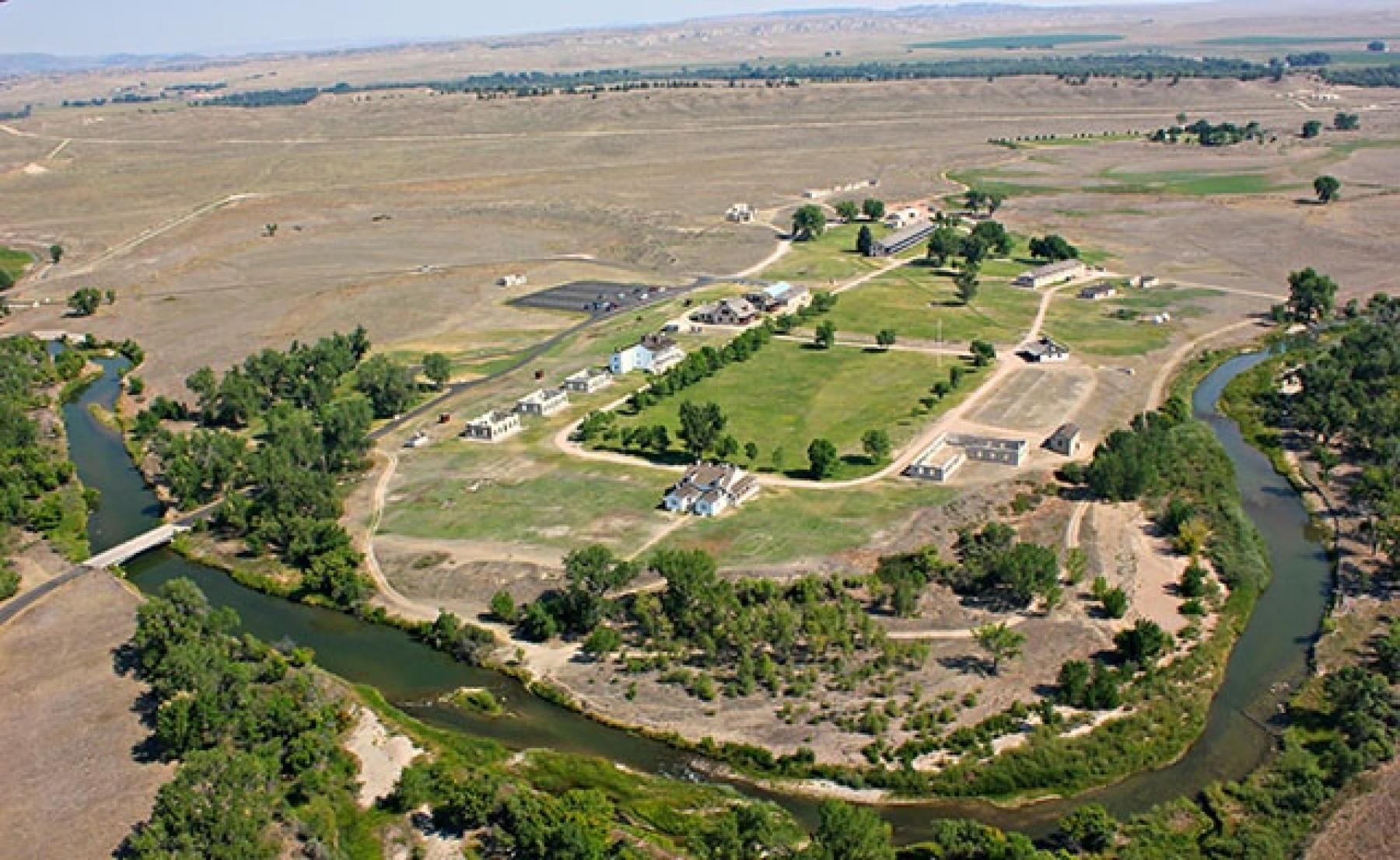
No surface traces of Fort John survive. The site lies within what is now Fort Laramie National Historic Site, absorbed into the landscape of the later military post that replaced it. Historical photographs and past investigations have established that Fort John stood just west of the military fort’s parade grounds, though the exact boundaries of the post remain uncertain.21 The same ground may also hold the remains of the earlier Fort William, meaning that future work at the site could shed light on both posts at once.22 Much of Fort John’s story—the character of the fur and robe trade, the day-to-day life of the post, its role in supplying the tens of thousands of emigrants who passed through during the peak years of overland migration—remains to be uncovered, and the site has strong potential to yield those answers.23
[Editor’s Note: Special thanks to the author and to the Wyoming State Historic Preservation Office for making this article available, and to the Wyoming Cultural Trust Fund for its ongoing support for this project. Greg Pierce’s historical monograph, Negotiating the West: A History of Wyoming Trading Posts, from which this article is adapted and excerpted, is one of many historic contexts published by the Wyoming State Historic Preservation Office. These documents are meant to offer a broad background against which historic developments can be better understood as the agency works to preserve properties and places important to an understanding of Wyoming’s past. The contexts also, however, are based on sound research and are full of well-told, vivid stories. With this in mind, WyoHistory.org is collaborating with the SHPO office to bring more of this history to a wider readership. The Cultural Trust has provided the funds to make this collaboration possible. We offer our thanks to all.]
Footnotes
-
Wyoming State Historic Preservation Office, “Fort Laramie,” WyoHistory.org, November 8, 2014, accessed March 28, 2026, https://www.wyohistory.org/encyclopedia/fort-laramie; Greg Pierce, Trading Posts in Wyoming, Multiple Property Documentation Form, National Register of Historic Places, Wyoming State Historic Preservation Office, State Parks and Cultural Resources, Cheyenne, Wyoming, 2012, Section E, 49.
-
Barton H. Barbour, A Special History Study: The Fur Trade at Fort Laramie National Historic Site (Santa Fe: National Park Service, 2000), 53; Merrill J. Mattes, Fort Laramie Park History, prepared for the Rocky Mountain Regional Office, National Park Service, U.S. Department of the Interior (1980), IV.
-
Wyoming State Historic Preservation Office, “Fort Laramie.”
-
Ibid.
-
David J. Wishart, The Fur Trade of the American West, 1807–1840: A Geographical Synthesis (Lincoln: University of Nebraska Press, 1979), 91; R. G. Roberson, Competitive Struggle: America’s Western Fur Trading Posts 1764–1865 (Boise: Tamarack Books, 1999), 13.
-
Randy Brown, “Mexican Hill, a Steep Descent on the Oregon Trail,” WyoHistory.org, accessed March 28, 2026, https://www.wyohistory.org/encyclopedia/mexican-hill-steep-descent-oregon-trail.
-
Joel Palmer, “Journal of Travels over the Rocky Mountains” (Worcester, Massachusetts: Readex Microprint Corporation, 1966), 27; Mattes, Fort Laramie Park History, IV.
-
Danny N. Walker, Searching for Fort William: An 1834 Trading Post at Fort Laramie National Historic Site, Wyoming, prepared for Fort Laramie National Historic Site (Laramie: Office of Wyoming Archaeologist, Department of Anthropology, University of Wyoming, 2004), 14–16; Mattes, Fort Laramie Park History.
-
Palmer, “Journal of Travels,” 27–28.
-
Francis Parkman, The Oregon Trail (New York: Oxford University Press, 2008), 94–95.
-
LeRoy R. Hafen and Francis Marion Young, Fort Laramie and the Pageant of the West (Glendale, California: Arthur H. Clark Company, 1938), 125–126.
-
Wyoming State Historic Preservation Office, “Fort Laramie.”
-
Hafen and Young, Fort Laramie, 124–125; Roberson, Competitive Struggle, 147.
-
Wyoming State Historic Preservation Office, “Fort Laramie.”
-
Pierce, Trading Posts in Wyoming, Section E, 28–30.
-
Parkman, Oregon Trail, 94–95.
-
Wyoming State Historic Preservation Office, “Fort Laramie.”
-
Hafen and Young, Fort Laramie, 124–125; Roberson, Competitive Struggle, 147.
-
Roberson, Competitive Struggle, 147.
-
Wyoming State Historic Preservation Office, “Fort Laramie.”
-
Danny N. Walker and Steven L. De Vore, Archaeological and Geophysical Investigations at Fort Laramie National Historic Site, 2002–2005, prepared for Fort Laramie National Historic Site (Laramie: Office of Wyoming Archaeologist, Department of Anthropology, University of Wyoming, 2008), 361.
-
Ibid.
-
Pierce, Trading Posts in Wyoming, Section E, 50.