Moncravie House
The Moncravie House was a small trading establishment constructed in 1856 on the Laramie River approximately twelve miles upstream from Fort Laramie, in what is now Goshen County, Wyoming. It was owned and operated by Jean Baptiste Moncravie, a French immigrant whose decades-long career in the Upper Missouri and North Platte fur trade made him one of the more experienced yet least-remembered figures operating in the Fort Laramie region during the post–American Fur Company era.1
The post was short-lived—Moncravie had relocated to eastern Nebraska by 1858—and left almost no documentary record of its physical form or commercial operations, and its exact location remains unknown. The post’s most distinctive historical feature is the treaty by which Moncravie secured the land on which he built it: a formal conveyance from the Oglala Lakota that was unusual in the North Platte trading world of the 1850s and that placed a substantial tract of the Laramie River Valley within his claimed property.2
Jean Baptiste Moncravie: Career and Background
Jean Baptiste Moncravie came west as a soldier during the 1820s, part of the generation of French-speaking men, often immigrants or the sons of French-Canadian families long established in Missouri who entered American military service and then gravitated into the fur trade as their enlistments ended. By 1833, his military service complete, Moncravie had registered as a clerk at Fort Union, the American Fur Company’s great trading post at the confluence of the Missouri and Yellowstone rivers in present-day North Dakota.3
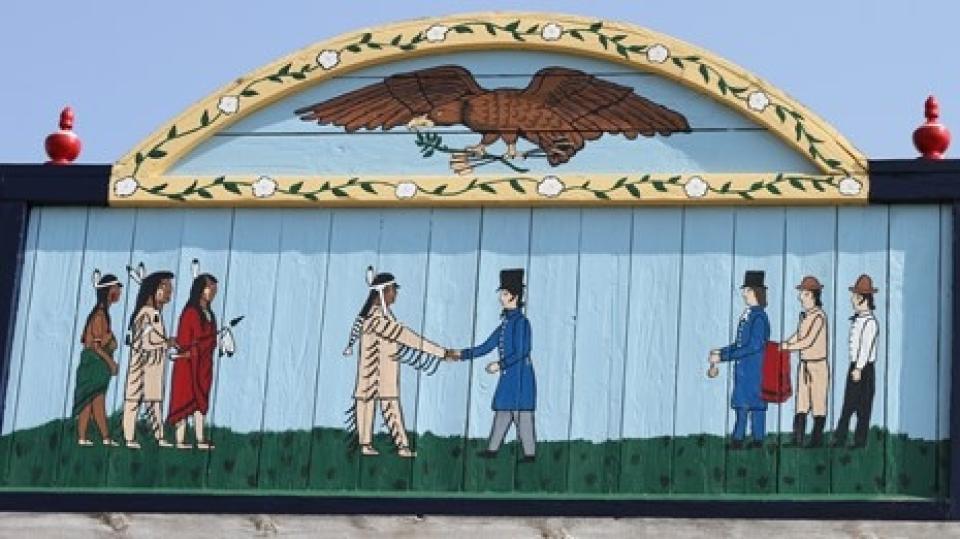
The biographical essay on Moncravie by LeRoy R. Hafen in French Fur Traders and Voyageurs in the American West identifies him as a “trader and raconteur,” a characterization that suggests his social gifts were as commercially useful as his practical skills. He was also a talented artist: during his years at Fort Union, he created a mural above the south gate depicting the 1831 treaty negotiations between the Assiniboine and Blackfeet tribes brokered by Fort Union’s manager Kenneth McKenzie, an achievement that opened the beaver-rich Blackfeet territory to American Fur Company trade. That mural, completed sometime between 1833 and 1846, survives today and is on view at the Fort Union Trading Post National Historic Site.4 He worked as a clerk and boatman in the Missouri River region through at least 1849, his presence confirmed in multiple sources including the Audubon and Coues journals from 1897, Annie Heloise Abel’s edition of the Fort Clark journals, and the Fort Pierre Letterbook reproduced in South Dakota Historical Collections in 1918.5
When Pierre Chouteau Jr.’s firm sold Fort John to the United States Army in 1849, the company—reorganized as P. Chouteau Jr. and Company—constructed a successor trading post in the North Platte region, probably to maintain its commercial presence in the robe trade outside the military-controlled Fort Laramie garrison. Moncravie aided in the construction of this post and was hired as its clerk, remaining there until at least 1852. The post and its relationship to the larger Chouteau network placed Moncravie in the Fort Laramie corridor during the peak emigrant years, giving him time to build the personal ties, including his marriage into the Oglala Lakota bands, that would later underpin his independent venture on the Laramie River.6
The Oglala Land Treaty and Founding of the Post
In 1856, Moncravie took the unusual step of formalizing his tenure on the Laramie River through a treaty with the Oglala Lakota, to whom he was connected by marriage, that conveyed to him a tract of approximately forty-nine square miles encompassing both branches of the Laramie River and the headwaters of LaBonte Creek. A copy of the treaty is held by the National Archives in Kansas City. Moncravie also provided the government with a sketch map showing the location of his house on the property, placing it on the right bank of the Laramie River twelve miles upstream from Fort Laramie. A Whetstone Agency letter notes that Moncravie had also constructed a small trading house in the Fort Laramie vicinity at around the same time.7
The Oglala land treaty was an unusual instrument in the North Platte trading world of the 1850s. Most traders operated on the basis of informal relationships with Native bands, licensed trading privileges granted by the federal government, or simply occupation of sites that no Euro-American authority had yet formally claimed. Moncravie’s decision to seek a formal conveyance from the Oglala suggests a degree of legal sophistication, or perhaps a desire for security in an environment where traders’ property rights were increasingly contested, that set him apart from many of his contemporaries. Whether the Oglala signatories understood the transaction as a permanent land transfer in the Euro-American legal sense, or as a more flexible expression of permission and alliance of the kind that had characterized trade relationships on the northern Plains for generations, is not clear from the surviving record.8
Operations and Abandonment
Very little is documented about the trading activities Moncravie conducted at the Laramie River post. No surviving account describes the post’s size, construction materials, or layout beyond the bare fact of a house on the right bank of the Laramie. A Whetstone Agency letter notes only that a “small trading house” was present at the site. Given Moncravie’s long experience in the fur trade and his Oglala connections, it is reasonable to assume that Native robe and hide trade was among his activities, and that emigrant provisioning played some role given the post’s proximity to the Oregon Trail corridor. But these inferences cannot be confirmed from the surviving record.9
Moncravie’s time on the Laramie was brief. By 1858 he had left the region and established a farm and stock ranch in eastern Nebraska in the Blue River Valley. No document explains the reasons for his departure, and no reference to the Laramie River post appears in surviving sources after his relocation. It is unknown whether he sold the property, abandoned it, or made some informal transfer to another occupant. There is also no indication that any member of his family continued to operate the post after he left.10
Physical Evidence
The sketch Moncravie provided the government showing his house on the right bank of the Laramie twelve miles upstream from Fort Laramie provides the most specific locational information available. It is held at the National Archives in Kansas City. A careful review of the sketch and treaty might narrow the search area for the site. If the post is ever found, it is unlikely that any structural remains survive above ground; however, artifact assemblages could illuminate the nature of trading activities at the post and the material culture of the mixed-heritage community that occupied the Laramie River valley in the mid-1850s. The treaty references a “Bissonette House” on the left bank of the Laramie at the same general location, which might help investigators locate Bissonette’s otherwise unknown Upper Platte Post, which is a second lost site whose rediscovery would depend in part on the same archival inquiry that could relocate the Moncravie House. The two sites thus form a paired research problem, each potentially illuminating the other.11
Significance
The Moncravie House is a little-documented site in Wyoming. Its interest lies less in what it achieved commercially than in the singular character of its founding instrument. The Oglala land treaty of 1856 is a document that sits at the intersection of multiple historical forces: the informal kinship economy of the North Platte trading world, in which marriage alliances between Euro-American traders and Lakota women created networks of mutual obligation and commercial access; the escalating pressure on Oglala territorial sovereignty in the years after the Grattan Fight of 1854; and the federal government’s ambivalent recognition of such informal property arrangements at a moment when its own land-tenure system was only beginning to reach the upper North Platte.12
Moncravie himself represents a type that appears across the fur-trade record but rarely enters the historical foreground: the long-serving clerk-turned-independent operator, fluent in the languages and customs of the Missouri River trade, connected by marriage to the Native communities whose commercial participation sustained that trade, and ultimately marginal to the larger forces—military consolidation, the decline of the robe trade, the rise of stage and telegraph infrastructure—that ended the independent trading era. The mural he created at Fort Union is a reminder that such figures were not merely commercial functionaries but men of skill and creative intelligence whose contributions to the material and visual record of the fur trade have been largely overlooked. His brief tenure on the Laramie River, followed by a withdrawal to Nebraska, traces that arc in miniature.13
Footnotes
-
Janet Lecompte, “Jean Baptiste Moncravie,” in French Fur Traders and Voyageurs in the American West, ed. LeRoy R. Hafen (Lincoln: University of Nebraska Press, 1997), 74–79; Greg Pierce, Trading Posts in Wyoming, Multiple Property Documentation Form, National Register of Historic Places, Wyoming State Historic Preservation Office, State Parks and Cultural Resources, Cheyenne, Wyoming, 2012, Section E, 66–67.
-
Lecompte, “Jean Baptiste Moncravie,” 78–79; Letters Received by the Office of Indian Affairs from the Whetstone Agency, Record Group 75, National Archives, Kansas City, Missouri, letter 1 (hereafter Whetstone Agency Letters).
-
Lecompte, “Jean Baptiste Moncravie,” 74; Annie Heloise Abel, ed., Chardon’s Journal at Fort Clark, 1834–1839 (Pierre: Department of History, State of South Dakota, 1932), note 127; John James Audubon and Elliott Coues, eds., Audubon and His Journals, vol. 2 (New York: Charles Scribner’s Sons, 1897), 138; “Fort Tecumseh and Fort Pierre Journal and Letter Books,” South Dakota Historical Collections 9 (1918), 220–231.
-
Lecompte, “Jean Baptiste Moncravie,” 74–75; Abel, ed., Chardon’s Journal at Fort Clark, note 127; National Park Service, “Moncravie Painting,” Fort Union Trading Post National Historic Site, https://www.nps.gov/places/moncravie-painting.htm.
-
Abel, ed., Chardon’s Journal at Fort Clark, note 127; Audubon and Coues, eds., Audubon and His Journals, 138; “Fort Tecumseh and Fort Pierre Journal and Letter Books.”
-
Lecompte, “Jean Baptiste Moncravie,” 75–77; “Fort Tecumseh and Fort Pierre Journal and Letter Books”; Pierce, Trading Posts in Wyoming, Section E, 66.
-
Lecompte, “Jean Baptiste Moncravie,” 78–79; Whetstone Agency Letters, letter 1; Whetstone Agency Letters, letter 2; Pierce, Trading Posts in Wyoming, Section E, 66–67.
-
Lecompte, “Jean Baptiste Moncravie,” 78–79; Pierce, Trading Posts in Wyoming, Section E, 66–67.
-
Whetstone Agency Letters, letter 2; Lecompte, “Jean Baptiste Moncravie,” 78–79; Pierce, Trading Posts in Wyoming, Section E, 67.
-
Lecompte, “Jean Baptiste Moncravie,” 79; Pierce, Trading Posts in Wyoming, Section E, 66-67.
-
Pierce, Trading Posts in Wyoming, Section E, 66–67; National Archives, Kansas City, Missouri, Moncravie treaty document and sketch map, cited in Pierce, Trading Posts in Wyoming, Section E, 66-67.
-
Lecompte, “Jean Baptiste Moncravie,” 74–79; Pierce, Trading Posts in Wyoming, Section E, 66–67; Douglas R. Cubbison, “The Grattan Fight: Prelude to a Generation of War,” WyoHistory.org, https://www.wyohistory.org/encyclopedia/grattan-fight-prelude-generation-war.
-
Lecompte, “Jean Baptiste Moncravie,” 74–79; National Park Service, “Moncravie Painting,” Fort Union Trading Post National Historic Site, https://www.nps.gov/places/moncravie-painting.htm.