Fort William
Fort William, built in 1834 at the confluence of the Laramie and North Platte rivers in present-day Goshen County, Wyoming, was the second trading post constructed in what is now Wyoming and the first permanent one. While Fort Bonneville, built two years earlier on the upper Green River, was used only briefly and seasonally, Fort William was designed for sustained operation at one of the most strategically valuable locations in the central Rocky Mountain West. The confluence of those two rivers commanded supply routes to a vast area of the central Rockies and the bison ranges of the Great Plains, and the site would remain continuously occupied for more than half a century.1
Fort William/John/Laramie, as the successive posts on this site came to be known, remains the longest continuously occupied Euro-American location in Wyoming.2 The post’s position at the junction of major waterways also anticipated an emerging pattern: by the late 1830s and early 1840s, Wyoming’s trading posts were increasingly relocating to major waterways and emigrant trail systems to capture both the growing bison robe trade and the rising traffic of overland emigrants, a development that made Fort William’s original siting remarkably prescient.3
Construction and Builders
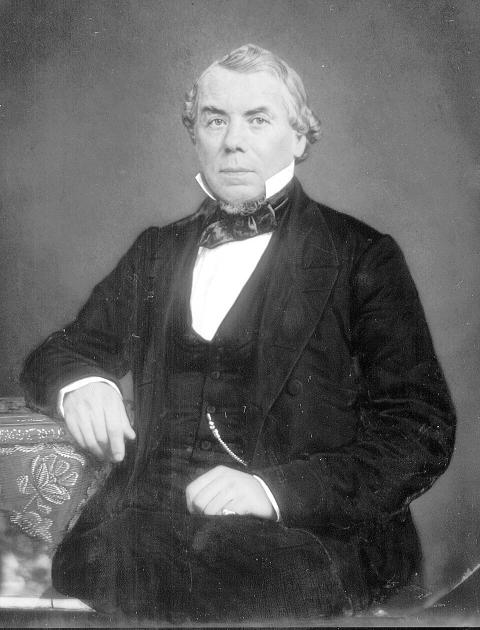
The post was built by William Patton and a crew of fourteen men for fur traders William Sublette and Robert Campbell.4 The pair had spent the early 1830s working to establish control of the Rocky Mountain fur trade, exerting influence on the Rocky Mountain Fur Company as its principal debt holders and challenging the American Fur Company on the Upper Missouri by building rival posts. After protracted negotiations in the summer of 1834, the American Fur Company bought out the Sublette and Campbell Upper Missouri interests, and the partners turned their focus to the Rockies and the High Plains of Wyoming.5 Sending a supply train to the summer rendezvous, they allowed part of the crew to stay behind at the junction of the Laramie and Platte rivers to construct the post.6
The construction crew made a vivid impression on at least one contemporary. On June 1, 1834, Massachusetts merchant Nathaniel Wyeth and his caravan crossed the Laramie River heading for the summer rendezvous and found, to their surprise, about a dozen men building the fort by cutting cottonwood logs, dragging them into position with horses, and digging holes to set the logs in to make a stockade.7 According to the journal of William Marshall Anderson, also traveling the area that year, a dispute arose over what to name the new post. Anderson proposed “Fort Sublette,” while his companion suggested “Fort Anderson.” A compromise was reached—a bottle of champagne opened in its honor—and the fort was christened Fort William, combining the first names of Patton, Sublette, and Anderson himself.8 Construction began with the laying of the log foundations in May 1834, and the post was finished and open for trading by fall.9
Physical Description
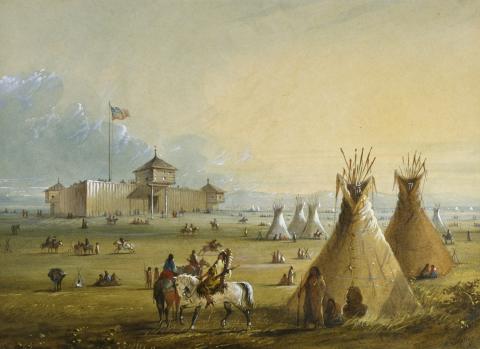
The fifteen-man crew constructed the post on the left bank of the Laramie River about one mile from its confluence with the Platte.10 The post was surrounded by a cottonwood palisade thirteen to fifteen feet high, at least eighty by one hundred feet in size and possibly as large as one hundred fifty feet square.11 The palisade was accompanied by three defensive towers or blockhouses, two placed on diagonal corners and a third above the gate.12 The gate itself was built of blocks. Lining the inside of the palisade were residences, a blacksmith shop, and a storage building. The central courtyard was open, with the exception of a corral.13 The post was sketched and later painted by artist Alfred Jacob Miller in 1837, providing the most complete visual record of its appearance.14
Ownership and Operations
Fort William was operated by Sublette and Campbell for only a year. In the spring of 1835, they sold the post to the remnants of the Rocky Mountain Fur Company, which was the firm of Fontenelle, Fitzpatrick, and Company. Its partners were Thomas Fitzpatrick, Milton Sublette, Jim Bridger, Lucien Fontenelle, and Andrew Drips.15 The post may have been referred to by some as Fort Lucien during this period.16 As early as the fall of 1835, the American Fur Company had made overtures to purchase the post. Those aspirations were realized at the Rendezvous of 1836, when title to Fort William was transferred to Joshua Pilcher of the American Fur Company.17 The acquisition removed a major competitor, provided the company direct access to Sioux buffalo robes, and opened a direct supply line to the Rocky Mountain Rendezvous.18
The American Fur Company traded with Native peoples, trappers, and travelers alike from this location until 1841. By that point the cottonwood logs of the post had begun to deteriorate, and the construction of a rival post, Fort Platte, built by Lancaster Lupton just north of Fort William, persuaded the American Fur Company that a larger, newer facility was needed.19 A new adobe post called Fort John was constructed, and Fort William was abandoned.20 The location of Fort John in relation to Fort William has not yet been definitively determined.21
Legacy: Fort John, Fort Laramie, and the National Historic Site
Fort John was later sold to the U.S. military in 1849. The Army established Fort Laramie at this location and occupied the site until 1890, when the property was sold to homesteaders at public auction. The State of Wyoming purchased the site in 1937, with Civilian Conservation Corps archaeological investigation beginning that fall. The site was turned over to the National Park Service in 1938, expanded in 1960, and designated the Fort Laramie National Historic Site in 1961.22 The National Park Service immediately began restoring the site, and archaeological investigations have been conducted there every decade since.23
The Location of Fort William
Despite its historical significance as Wyoming’s first trading post built to be lasting, multi-year operation—as opposed to Fort Bonneville, occupied only briefly in 1832–33—the exact location of Fort William remains unknown. Most research at Fort Laramie National Historic Site has focused on the military period, though investigators have recovered useful information about the fur trade era as well. Investigations conducted between 2002 and 2005 used remote sensing and test excavations to inventory military-era, homestead-era, and fur trade-era subsurface deposits, and this work revealed the relative locations of Fort John and the military-era Ward and Guerrier trading post.24 Unfortunately, projects attempting to locate the remains of Fort William itself have been unsuccessful.25 Should the site be found, it would likely contain materials capable of providing valuable information regarding the interpretation of Fort Laramie history and events related to the early fur trade.26
[Editor’s Note: Special thanks to the author and to the Wyoming State Historic Preservation Office for making this article available, and to the Wyoming Cultural Trust Fund for its ongoing support for this project. Greg Pierce’s historical monograph, Negotiating the West: A History of Wyoming Trading Posts, from which this article is adapted and excerpted, is one of many historic contexts published by the Wyoming State Historic Preservation Office. These documents are meant to offer a broad background against which historic developments can be better understood as the agency works to preserve properties and places important to an understanding of Wyoming’s past. The contexts also, however, are based on sound research and are full of well-told, vivid stories. With this in mind, WyoHistory.org is collaborating with the SHPO office to bring more of this history to a wider readership. The Cultural Trust has provided the funds to make this collaboration possible. We offer our thanks to all.]
Footnotes
-
Wyoming State Historic Preservation Office, “Fort Laramie,” WyoHistory.org, November 8, 2014, accessed March 28, 2026, https://www.wyohistory.org/encyclopedia/fort-laramie; Jim Hardee, “The Fur Trade in Wyoming,” WyoHistory.org, November 8, 2014, accessed March 28, 2026, https://www.wyohistory.org/encyclopedia/fur-trade-wyoming.
-
Wyoming State Historic Preservation Office, “Fort Laramie.”
-
Greg Pierce and Mark E. Miller, “In Search of the Fraeb Battlefield and Trading Post, August 1841,” Plains Anthropologist 60, no. 235 (2015): 224.
-
LeRoy R. Hafen, The Mountain Men and the Fur Trade of the Far West, vol. 1 (Spokane, Washington: Arthur H. Clark Company, 2000), 143.
-
Barton H. Barbour, A Special History Study: The Fur Trade at Fort Laramie National Historic Site (Santa Fe: National Park Service, 2000), 23–25; Hafen, Mountain Men, vol. 1, 137.
-
Barbour, Special History Study, 26; Hafen, Mountain Men, vol. 1, 137.
-
Tom Rea, “Road to Rendezvous: The Rocky Mountain Fur Trade in 1834,” WyoHistory.org, November 8, 2014, accessed March 28, 2026, https://www.wyohistory.org/encyclopedia/road-rendezvous-rocky-mountain-fur-trade-1834.
-
Dale L. Morgan and Eleanor Towles Harris, eds., The Rocky Mountain Journals of William Marshall Anderson: The West in 1834 (San Marino, California: The Huntington Library, 1967), cited in Wyoming State Historic Preservation Office, “Fort Laramie.”
-
Barbour, Special History Study, 26–27.
-
Hiram Martin Chittenden, The American Fur Trade of the Far West (Lincoln: University of Nebraska Press, 1935), 940–941.
-
Danny N. Walker and Steven L. De Vore, Archaeological and Geophysical Investigations at Fort Laramie National Historic Site, 2002–2005, prepared for Fort Laramie National Historic Site (Laramie: Office of Wyoming Archaeologist, Department of Anthropology, University of Wyoming, 2008), 15; F. A. Wislizenus, A Journey to the Rocky Mountains in the Year 1839 (Glorieta, New Mexico: Rio Grande Press, 1969), 67–68.
-
Wislizenus, Journey to the Rocky Mountains, 67; Walker and De Vore, Archaeological and Geophysical Investigations, 15.
-
Wislizenus, Journey to the Rocky Mountains, 67–68.
-
Greg Pierce, Trading Posts in Wyoming, Multiple Property Documentation Form, National Register of Historic Places, Wyoming State Historic Preservation Office, State Parks and Cultural Resources, Cheyenne, Wyoming, 2012, Section E, 45.
-
Barbour, Special History Study, 28–29; Hafen, Mountain Men, vol. 1, 145–146.
-
Charles Jr. Hanson and Sue Walters, “The Early Fur Trade in Northwestern Nebraska,” Nebraska History 53, no. 7 (1976): 297; R. G. Roberson, Competitive Struggle: America’s Western Fur Trading Posts 1764–1865 (Boise: Tamarack Books, 1999), 144.
-
Barbour, Special History Study, 31; Hafen, Mountain Men, vol. 1, 155.
-
Barbour, Special History Study, 35–36.
-
Danny N. Walker, Searching for Fort William: An 1834 Trading Post at Fort Laramie National Historic Site, Wyoming, prepared for Fort Laramie National Historic Site (Laramie: Office of Wyoming Archaeologist, Department of Anthropology, University of Wyoming, 2004), 8; David W. Lupton, “Fort Platte, Wyoming, 1841–1845: Rival of Fort Laramie,” Annals of Wyoming 49, no. 1 (1977): 84.
-
Lupton, “Fort Platte,” 84; Merrill J. Mattes, Fort Laramie Park History, prepared for the Rocky Mountain Regional Office, National Park Service, U.S. Department of the Interior (1980), IV; David J. Wishart, The Fur Trade of the American West, 1807–1840: A Geographical Synthesis (Lincoln: University of Nebraska Press, 1979), 91.
-
Walker, Searching for Fort William, 14.
-
Walker and De Vore, Archaeological and Geophysical Investigations, 30; Walker, Searching for Fort William, 14.
-
Walker and De Vore, Archaeological and Geophysical Investigations, 32.
-
Ibid., 361–362.
-
Walker, Searching for Fort William, n.p. [title page verso / introductory summary].
-
Ibid., ii.