Lock and Randolph Company
The trading post of Lock, Randolph and Company is among the most obscure entries in Wyoming’s fur trade record. Established in 1841 near the confluence of the Laramie and North Platte rivers in present-day Goshen County, Wyoming, it operated for only a year or two at most and left almost no documentary trace. Its exact location is unknown, no physical description survives beyond the identification of log construction, and the names of the men behind it—Lock and Randolph—have not been further documented. The post is known primarily through a single passing reference in David Adams’s journal of November 1841, which records that Lock and Randolph had to borrow two axes to begin building it, an inauspicious start that proved characteristic of the venture as a whole.1
A Saturated Market
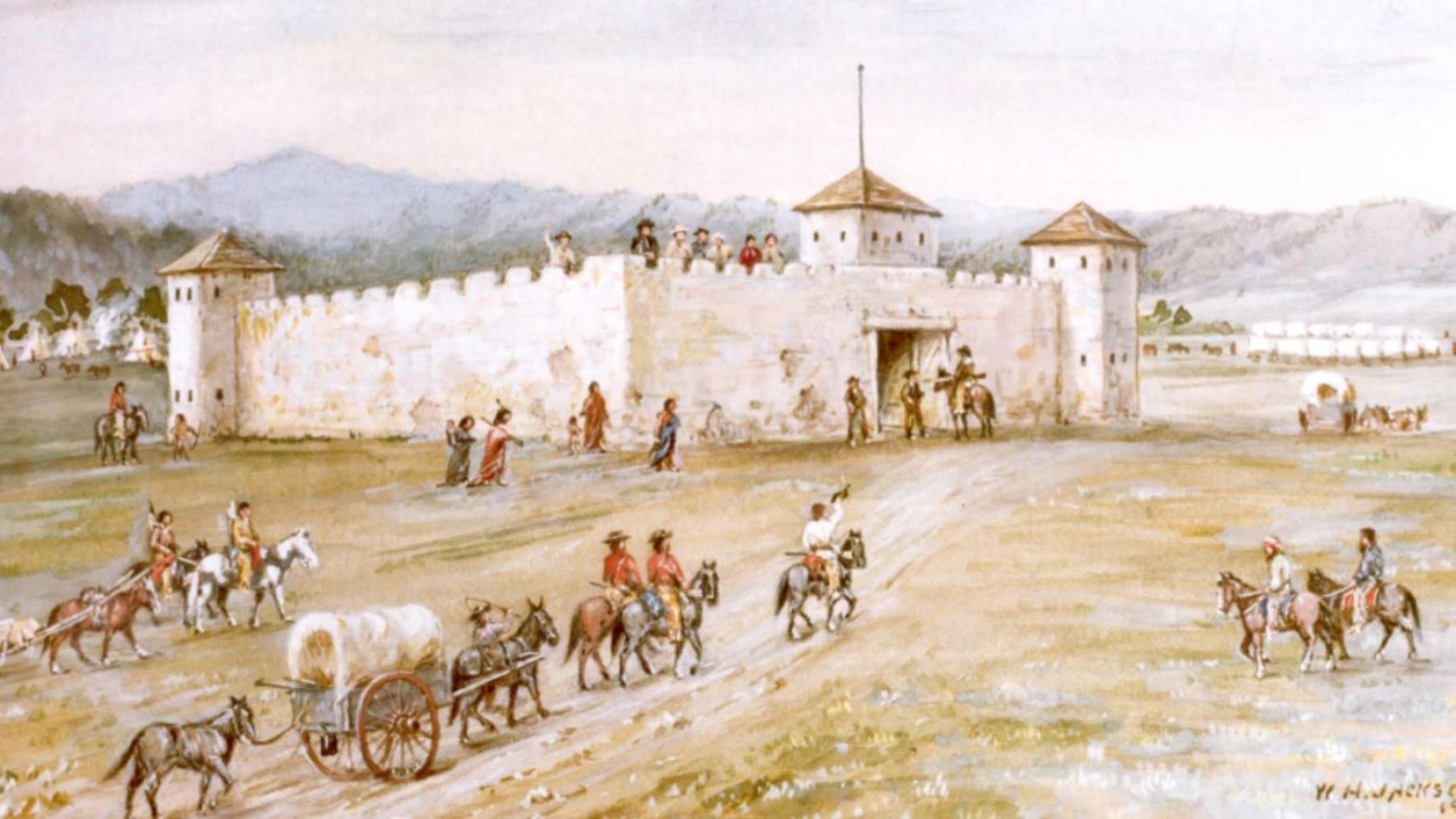
Lock and Randolph arrived at the North Platte during one of the most intensely competitive moments in Wyoming fur trade history. By the fall of 1841, at least four commercial establishments were operating within a few miles of the Laramie–Platte confluence: the American Fur Company’s new Fort John, Lancaster Lupton’s Fort Platte, and the newly established Fort Adams of Sybille, Adams, and Company, all competing for the same combination of Lakota bison robes and emigrant trail trade.
The Lock and Randolph post was built approximately two miles from Fort Adams, making it the most peripheral and least-resourced entrant in an already saturated market.2 In this environment, small independent operators had little realistic prospect of success. Trade on the North Platte was dominated by large, well-capitalized firms with established Native American trading relationships and the infrastructure to stock goods in volume. The American Fur Company in particular held advantages in financing, supply chains, and long-standing connections with the Lakota that independent traders could not easily match.3
Operations and Departure from the North Platte
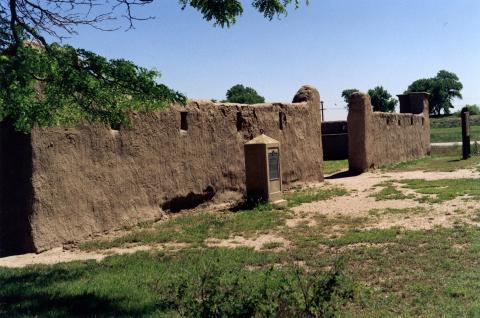
Beyond the detail about borrowed axes, the activities of Lock and Randolph on the North Platte are not documented. The post was constructed of logs—the only physical characteristic noted in the historical record—and appears to have operated for roughly a year before the partners abandoned the venture.4 Their departure from the North Platte is associated with the acquisition of Fort Vasquez, the adobe trading post on the South Platte River in present-day Colorado that had been built by Louis Vasquez and Andrew Sublette in 1835 and was sold when competition from three neighboring posts made it unprofitable. Multiple sources place the Lock and Randolph purchase of Fort Vasquez around 1840 to 1842, though the precise timing in relation to their North Platte activity is not entirely clear from the surviving record.5 Their tenure at Fort Vasquez fared no better than their North Platte venture. The firm went bankrupt, lost horse and mule herds to Native Americans, and abandoned Fort Vasquez without paying Vasquez and Sublette the $800 owed for the purchase.6
Historical Status
Lock and Randolph represent one of the thinnest documentary records among Wyoming’s nineteenth-century trading posts. The firm’s principals are not identified by first name in any known source, no description of their post’s layout or dimensions has been located, and its position on the landscape remains entirely unknown. The possibility that the structures were constructed so hastily and with such limited materials that little or nothing remains archaeologically cannot be excluded.7
Nevertheless, the Lock and Randolph post, like Fort Adams, was in operation during the precise transitional moment when the North Platte trade was shifting from a focus on Native American robes to one increasingly oriented toward emigrant supply. A post at this location and time, however brief its occupation, would have participated in both economies. Should the site ever be identified and found to contain undisturbed deposits, it would offer evidence of the activities of the smaller, independent traders—poorly capitalized, undersupplied, and ultimately unsuccessful—who nevertheless played a part in the commercial history of Wyoming’s most consequential trading corridor.8
Footnotes
-
David Adams, Journal, November 1841, David Adams Papers, Missouri Historical Society, St. Louis, Missouri; Greg Pierce, Trading Posts in Wyoming, Multiple Property Documentation Form, National Register of Historic Places, Wyoming State Historic Preservation Office, State Parks and Cultural Resources, Cheyenne, Wyoming, 2012, Section E, p. 53.
-
Charles Jr. Hanson and Sue Walters, “The Early Fur Trade in Northwestern Nebraska,” Nebraska History 53, no. 7 (1976): 298; David W. Lupton, “Fort Platte, Wyoming, 1841–1845: Rival of Fort Laramie,” Annals of Wyoming 49, no. 1 (1977): 86.
-
Pierce, Trading Posts in Wyoming, Section E, pp. 28–30; Greg Pierce and Mark E. Miller, “In Search of the Fraeb Battlefield and Trading Post, August 1841,” Plains Anthropologist 60, no. 235 (2015): 224.
-
R. G. Roberson, Competitive Struggle: America’s Western Fur Trading Posts 1764–1865 (Boise: Tamarack Books, 1999), 151; Pierce, Trading Posts in Wyoming, Section E, p. 53.
-
Pierce, Trading Posts in Wyoming, Section E, p. 53; Hanson and Walters, “Early Fur Trade,” 298. The timing of the Fort Vasquez acquisition relative to the North Platte venture is uncertain: Pierce 2012 places the Fort Vasquez purchase in 1842, but other sources, including the Colorado Encyclopedia’s Fort Vasquez article, suggest the sale occurred as early as 1840. The discrepancy has not been resolved in the available literature.
-
Colorado Encyclopedia, “Fort Vasquez,” https://coloradoencyclopedia.org/article/fort-vasquez.
-
Pierce, Trading Posts in Wyoming, Section E, p. 53.
-
Ibid.