Fort Bonneville
Fort Bonneville, constructed in 1832 near the confluence of Horse Creek and the Green River in present-day Sublette County, Wyoming, was the first trading post built in what is now Wyoming. Its builder, Captain Benjamin Louis Eulalie de Bonneville, was a French-born U.S. Army officer who graduated from West Point in 1815 and gained his first knowledge of the West while serving at Fort Gibson in present-day Oklahoma.1
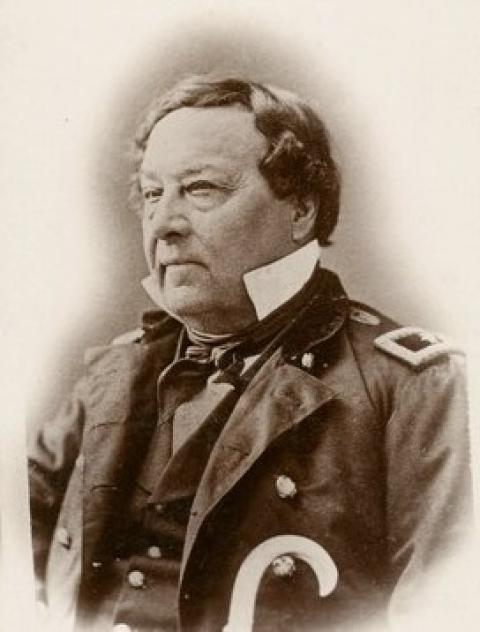
In 1831 he obtained a military leave of absence, officially to examine the topography of the West and to study the trading practices of Native tribes, though his expedition also appears to have served a military intelligence purpose of gauging the extent of British influence in the Green River region, then claimed by both nations.2 Backed by fur-trade financiers John Jacob Astor and Alfred Seton, he departed Fort Osage, Missouri, in May 1832 with 100 men and twenty wagons, leading the first wagon train to cross the Continental Divide at South Pass, a feat that helped demonstrate the feasibility of overland wagon travel and foreshadowed the great emigrant migrations to come.3
Construction and Physical Description
After crossing South Pass, the party moved northwest to the confluence of Horse Creek and the Green River, where construction began. The resulting structure was a log fort surrounded by a fifteen-foot-high square palisade with two blockhouses positioned on diagonal corners. Secondary historical accounts describe the interior as including a bourgeois house, an office and clerk’s quarters, barracks for the engagés, storehouses, a fur press, and a blacksmith shop, though the archaeological record suggests the actual post may not have matched this description fully. The post was located three hundred yards from the Green River on the west and two miles from Horse Creek on the east.
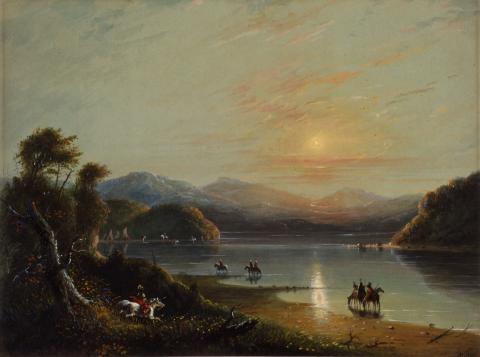
Alfred Jacob Miller traveled the Green River Valley in 1837 as the hired artist of Sir William Drummond Stewart, a Scottish sportsman who had come west for hunting and adventure. He sketched the same landscape that Fort Bonneville had occupied five years before, and this finished watercolor, produced from those field sketches two decades later, is the closest eyewitness record of the scene. Alfred Jacob Miller, Green River, Oregon, 1858–60. Walters Art Museum, Baltimore. CC0.
The location was well suited for summer trade—offering access to water, available grazing land, and a naturally defensible topography—but poorly chosen for year-round occupation. The high altitude made the region effectively uninhabitable during winter months, and contemporaries who knew the country well were quick to say so.7 The post earned the nicknames “Fort Nonsense” and “Bonneville’s Folly” among the mountain men who recognized the folly of its siting, though Bonneville himself described it in his report to his commanding officer simply as a “picket work.”8
Some scholars have questioned whether the bastioned fort as traditionally described actually existed in that form. Fur trade historian O. Ned Eddins has argued that Warren Angus Ferris, an American Fur Company employee who kept a journal of his time in the Rocky Mountains from 1830 to 1835, was the only contemporary rendezvous participant to describe a fortified structure at the site using those terms, and that the lack of physical evidence and the absence of verifiable artifacts warrant skepticism about the received account.9 Bonneville spent only a few weeks building and occupying the fort before moving his camp to the headwaters of the Salmon River in present-day Idaho for the winter. Before departing, he decided his wagons had gone far enough and buried them, along with caches of supplies, at the Green River site.10
Purpose and Operations
The nature of Bonneville’s operations at the post remains murky. Fort Bonneville sat at the center of some of the most productive beaver country in the Rocky Mountain West, and the Horse Creek–Green River confluence was already well established as a hub of the annual fur trade rendezvous system, gatherings at which trappers, traders, and Native peoples exchanged furs, goods, and supplies each summer.11 The Green River Valley was also claimed by both the British and Americans at the time, and it has been suggested that construction of the fort was intended not only to facilitate trade with Native Americans but to establish a symbolic permanent United States presence in the region.12 Regardless of military intent, Bonneville did engage in trading activities at the post. Numerous contemporaries provide accounts of Native trade there, including a June 1833 report of fifty to sixty lodges of Shoshone trading at the fort.13
After the initial construction in 1832, Bonneville moved his party to the Salmon River for winter quarters, and activity at the fort had lasted only from July through August 22 of that year.14 His men trapped the Rockies in early 1833 and returned to Horse Creek for the summer rendezvous held in the vicinity. Bonneville visited the post as late as October 1833, then moved south and west before eventually wintering on the Portneuf River in present Idaho.15 By August 1835 he was back in Missouri, and by the fall of 1836 had resumed an active military role, ending his fur trading activities in the West.16 There is no indication Bonneville or any member of his party revisited the post on Horse Creek after October 1833, nor that it was permanently reoccupied after that time. However, as a number of summer rendezvous were held in the vicinity in following years, the post likely saw some level of use through the last rendezvous in 1840.17
Remains and Recognition
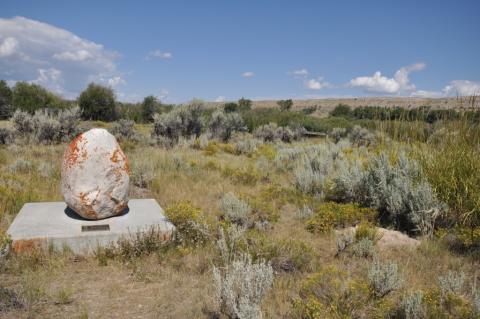
After abandonment, the fort deteriorated or was destroyed, leaving only an archaeological signature by the twentieth century. The site is marked today by a monument erected by the Daughters of the American Revolution in 1915 bearing the inscription “Site of Fort Bonneville, 1832–1915.” Fort Bonneville is listed on the National Register of Historic Places and sits on a combination of public and private lands in Sublette County.18
The post was initially excavated by Dr. George Frison of the University of Wyoming in 1968. In 1989, Western Wyoming College conducted further archaeological investigations with the primary goal of defining the nature and extent of historic deposits and locating the palisade walls.19 The blacksmith shop appears to have been used to repair broken metal goods, possibly for traders or Native Americans.20 The palisade was constructed of cottonwood pickets without a foundation, backfilled with dirt, clay, and gravel, a technique bearing similarities to late eighteenth and early nineteenth-century Canadian fur trade posts.21 Habitation areas revealed evidence of domestic and cooking activity as well as food preparation and storage.22 Excavations provided details about fur trading activities and post life in the early nineteenth-century Rocky Mountains often omitted from historical accounts, including domestic activity, trade, blacksmith work, and post construction methods. To date, only a portion of the post has been surveyed and excavated, leaving open the possibility that future research could expand upon this work and provide tighter dates as to when the site was in use.23
[Editor’s Note: Special thanks to the author and to the Wyoming State Historic Preservation Office for making this article available, and to the Wyoming Cultural Trust Fund for its ongoing support for this project. Greg Pierce’s historical monograph, Negotiating the West: A History of Wyoming Trading Posts, from which this article is adapted and excerpted, is one of many historic contexts published by the Wyoming State Historic Preservation Office. These documents are meant to offer a broad background against which historic developments can be better understood as the agency works to preserve properties and places important to an understanding of Wyoming’s past. The contexts also, however, are based on sound research and are full of well-told, vivid stories. With this in mind, WyoHistory.org is collaborating with the SHPO office to bring more of this history to a wider readership. The Cultural Trust has provided the funds to make this collaboration possible. We offer our thanks to all.]
Footnotes
-
Edgeley W. Todd, “Benjamin L. E. Bonneville,” in Mountain Men and the Fur Trade of the Far West, vol. 4, ed. LeRoy R. Hafen (Spokane, Washington: Arthur H. Clark Company, 2002), 46.
-
Washington Irving, The Adventures of Captain Bonneville (Portland, Oregon: Binford’s & Mort, 1961), xxv–xxvi; Hiram Martin Chittenden, The American Fur Trade of the Far West (Lincoln: University of Nebraska Press, 1935), 421–434.
-
Jett B. Conner, “The Wyoming Adventures of Captain Bonneville,” WyoHistory.org, January 16, 2024, https://www.wyohistory.org/encyclopedia/wyoming-adventures-captain-bonneville; Todd, “Benjamin L. E. Bonneville,” 49; A. Dudley Gardner, David E. Johnson, and David Vlcek, Archaeological Investigations at Fort Bonneville (Rock Springs, Wyoming: Archaeological Services, Western Wyoming College, 1991), 22.
-
Warren Angus Ferris and Paul C. Phillips, Life in the Rocky Mountains: A Diary of Wanderings on the Sources of the Rivers Missouri, Columbia, and Colorado from February, 1830, to November, 1835 (Denver: Old West Publishing, 1940), 275.
-
Chittenden, American Fur Trade, 46–47; Gardner, Johnson, and Vlcek, Archaeological Investigations, 1.
-
Ferris and Phillips, Life in the Rocky Mountains, 274.
-
Ferris and Phillips, Life in the Rocky Mountains, 274–275; Gardner, Johnson, and Vlcek, Archaeological Investigations, 29; Chittenden, American Fur Trade, 398–399.
-
Gardner, Johnson, and Vlcek, Archaeological Investigations, 28; Conner, “Wyoming Adventures.”
-
O. Ned Eddins, “Was Fort Bonneville Simply Nonsense,” Rocky Mountain Fur Trade Journal 5 (2011), 21-33.
-
Gardner, Johnson, and Vlcek, Archaeological Investigations, 29; Conner, “Wyoming Adventures.”
-
Jim Hardee, “The Fur Trade in Wyoming,” WyoHistory.org, November 8, 2014, https://www.wyohistory.org/encyclopedia/fur-trade-wyoming.
-
Gardner, Johnson, and Vlcek, Archaeological Investigations, 28; Todd, “Benjamin L. E. Bonneville,” 48; Chittenden, American Fur Trade, 421–434.
-
Gardner, Johnson, and Vlcek, Archaeological Investigations, 31; Ferris and Phillips, Life in the Rocky Mountains, 274.
-
Chittenden, American Fur Trade, 398–399; Gardner, Johnson, and Vlcek, Archaeological Investigations, 29.
-
Todd, “Benjamin L. E. Bonneville,” 53.
-
Irving, Adventures of Captain Bonneville, 381.
-
Gardner, Johnson, and Vlcek, Archaeological Investigations, 29.
-
Bill Barnhart, “Fort Bonneville,” National Register of Historic Places Inventory—Nomination Form (Washington, DC: National Park Service, 1970).
-
Gardner, Johnson, and Vlcek, Archaeological Investigations, 1.
-
Ibid., 59–60.
-
Ibid., 63, 54–56.
-
Ibid., 122.
-
A. Dudley Gardner, personal communication to Greg Pierce, 2012, cited in Greg Pierce, Trading Posts in Wyoming, Multiple Property Documentation Form, National Register of Historic Places, Wyoming State Historic Preservation Office, State Parks and Cultural Resources, Cheyenne, Wyoming, 2012.