The Portuguese Houses
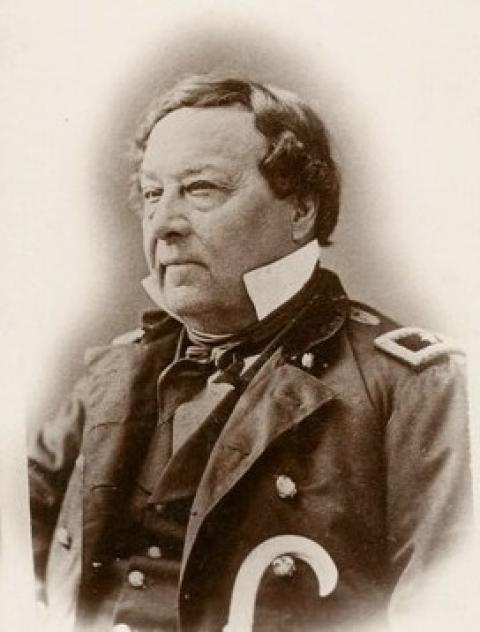
The Portuguese Houses were a trading post constructed in 1834 on the north bank of the Middle Fork of the Powder River in present-day Johnson County, Wyoming, about eleven miles east of present-day Kaycee. Built by Antonio Montero at the direction of Captain Benjamin Bonneville, the post was one of Wyoming’s earliest Euro-American structures and the first trading post in the Powder River country. Its location, far from the main trade and emigrant routes of the day, made it an isolated and ultimately troubled venture.1
Antonio Montero and the Post’s Origins
In the summer of 1834, Captain Bonneville sent Antonio Montero into the Powder River country to trade with the Crow.2 Montero, whose Portuguese heritage gave the post its informal name, was directed to work the region during the summer but decided as fall approached to stay and encourage trade with the Crow rather than return to the company’s winter camp.3 The Crow’s unusual warmth toward Montero reflected mutual benefit: Montero’s supply of European goods, including firearms, helped the Crow compete against their Blackfeet rivals, who were being supplied by the Hudson’s Bay Company. In turn, this trade gave Montero and Bonneville access to additional furs procured by the Crow.4 The Portuguese Houses were built in the fall of 1834 and active trading there effectively ended after the winter of 1836–1837.5
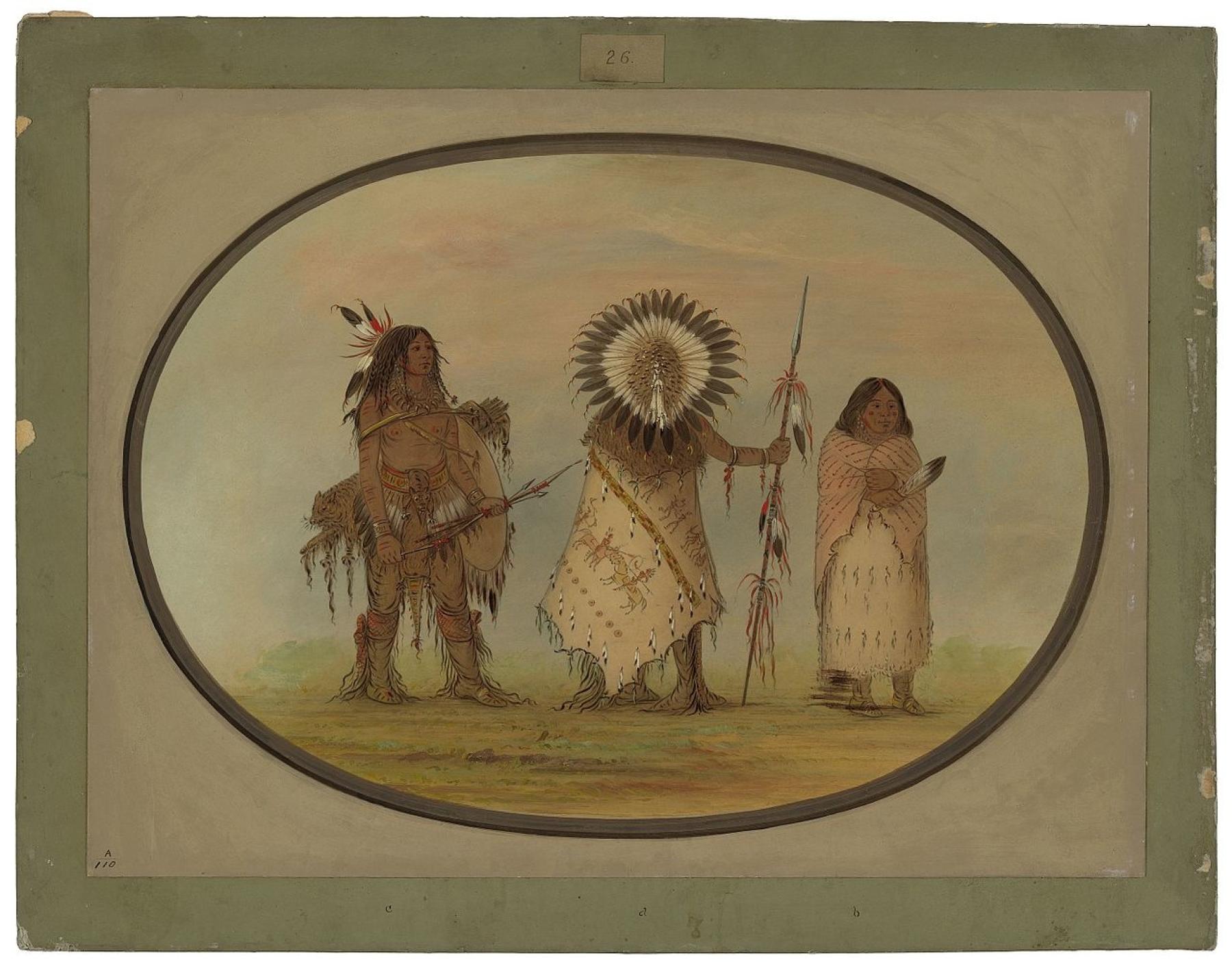
The site was an unusual choice for a trading post, lying off any primary trade, water, or transportation route and east of the Bighorn Mountains.6 No rendezvous were ever held at or near the Portuguese Houses, and from the limited documentary record, trade at the outpost was not tremendously profitable.7 The Powder River country was, however, squarely within Crow territory, and the Crow were among the most active Native trading partners of the era.8
Physical Description
The post was constructed of hewn logs and surrounded by a stockade approximately 200 feet square and eight to ten feet high, though geophysical surveys have since confirmed the enclosure was not quite square.9 The palisade was likely built of cottonwood, which grows abundantly along the nearby riverbank. Traces of the palisade trench survive, particularly at the southwestern corner, where it measures roughly four feet wide and eighteen inches deep.10
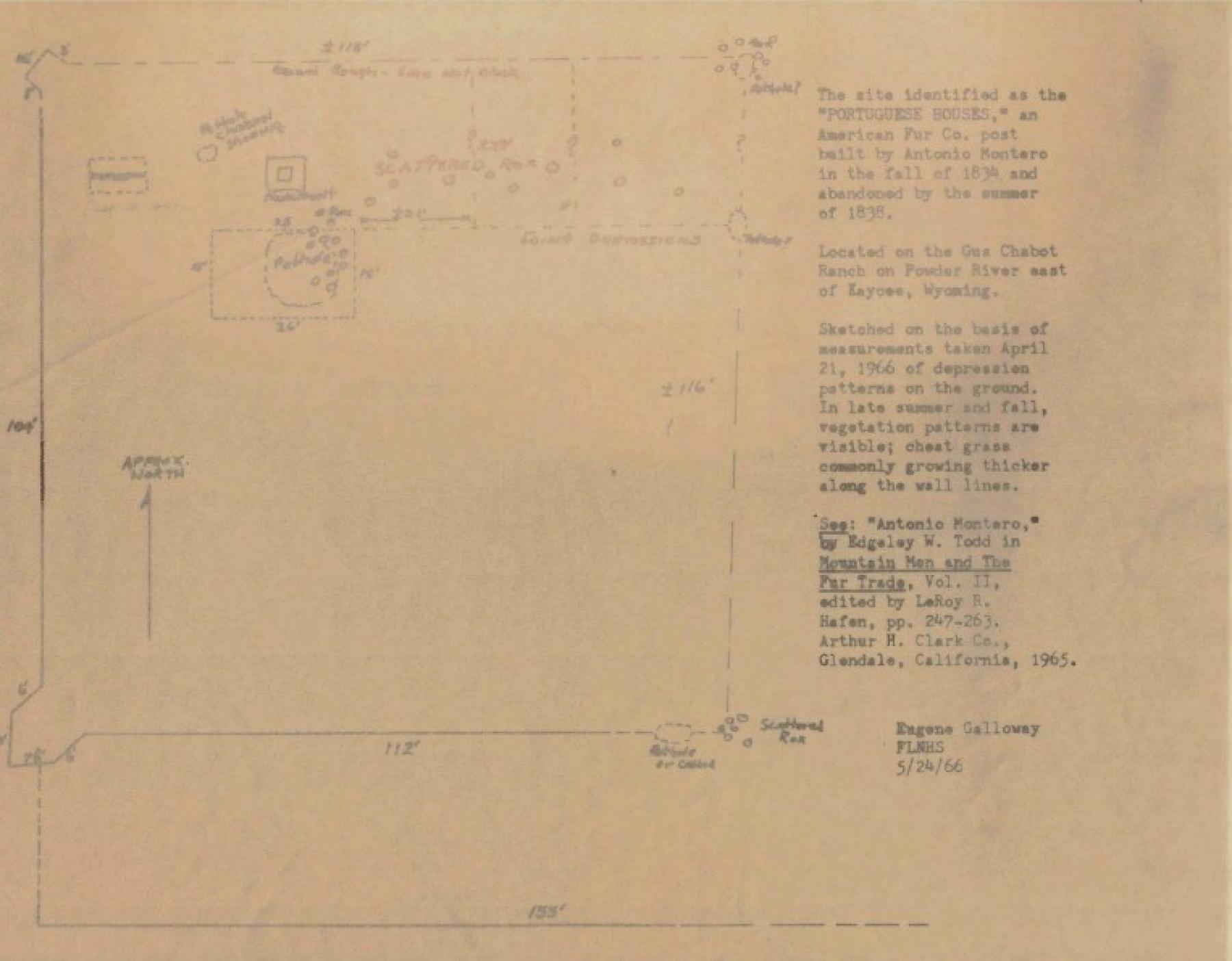
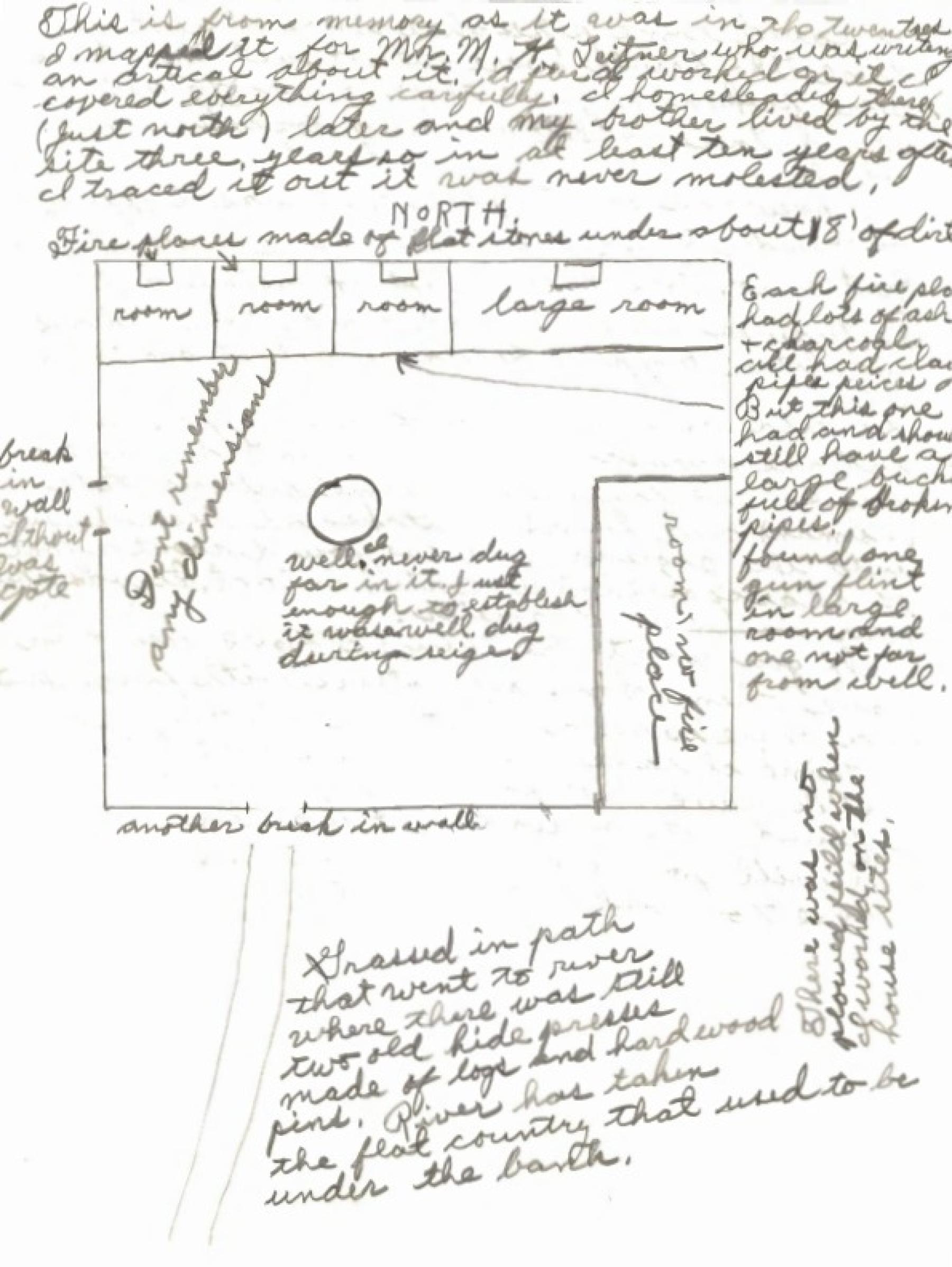
A note in the Don Grey Collection, recording an unidentified homesteader’s recollection of the site’s appearance in the 1920s, describes four rooms along the interior of the north palisade wall, each with fireplaces made of flat stones, along with a fifth room along the east wall that appears to have served as storage.11 A well was dug in the center of the compound during the troubled winter of 1836–1837.12 Historic documents also mention a corral or animal pen, and subsurface survey has confirmed the presence of what appears to be a palisaded animal enclosure extending from the western edge of the compound.13
Difficulties: Blackfeet, Rivals, and Montero’s Reputation
From its opening, the post faced serious obstacles. The Blackfeet were a constant threat, conducting repeated attempts at horse theft that kept Montero’s men in a state of vigilant watch.14 The post was also plagued by harassment and theft from rival trappers, and the trappers managed to agitate the Crow, causing them at times to join in the thefts.15
The most serious threat came in the winter of 1836–1837, when Jim Bridger and a large party of some 300 trappers working for Fontenelle, Fitzpatrick, and Company—one of the era’s major fur trading firms—wintered nearby and competed aggressively for Crow customers, nearly eliminating the beaver supply. The fur trader Joe Meek described the outcome: by the return of spring, Montero had very little remaining of the property belonging to the fort, nor anything to show for it.16 Meek’s account indicates that some in Bridger’s company acted partly out of a desire to repay Bonneville for his treatment of trapper and guide Joe Walker, whom Bonneville had sent to California in 1833 to scout routes and gather information, and later blamed for the mistreatment of Native Americans and Mexicans encountered on the expedition.17 A letter from Milton Sublette to Pratte, Chouteau, and Company in December 1836 corroborates Meek’s account: rather than help a Bonneville man, Sublette refused to exchange Montero’s pelts for supplies at Fort William.18
Montero’s own reputation complicated his position. The trapper Osborne Russell recorded that the fur trade captain Lucien Fontenelle visited the Portuguese Houses and, with some reluctance from Montero, recovered stolen pelts from his warehouse, goods Montero had traded for knowing they belonged to Russell’s company.19 When Montero returned to St. Louis in 1838, the Superintendent of Indian Affairs, Joshua Pilcher, denied him a permit to continue in the fur trade, describing him as “a man notoriously of bad character, and one capable of inciting the Indians to acts of mischief.”20 Montero eventually returned west with a permit in hand for the season of 1839–1840 but by spring 1841 had left the area for Taos, finally retiring his outpost on the Powder River.21
What Remains
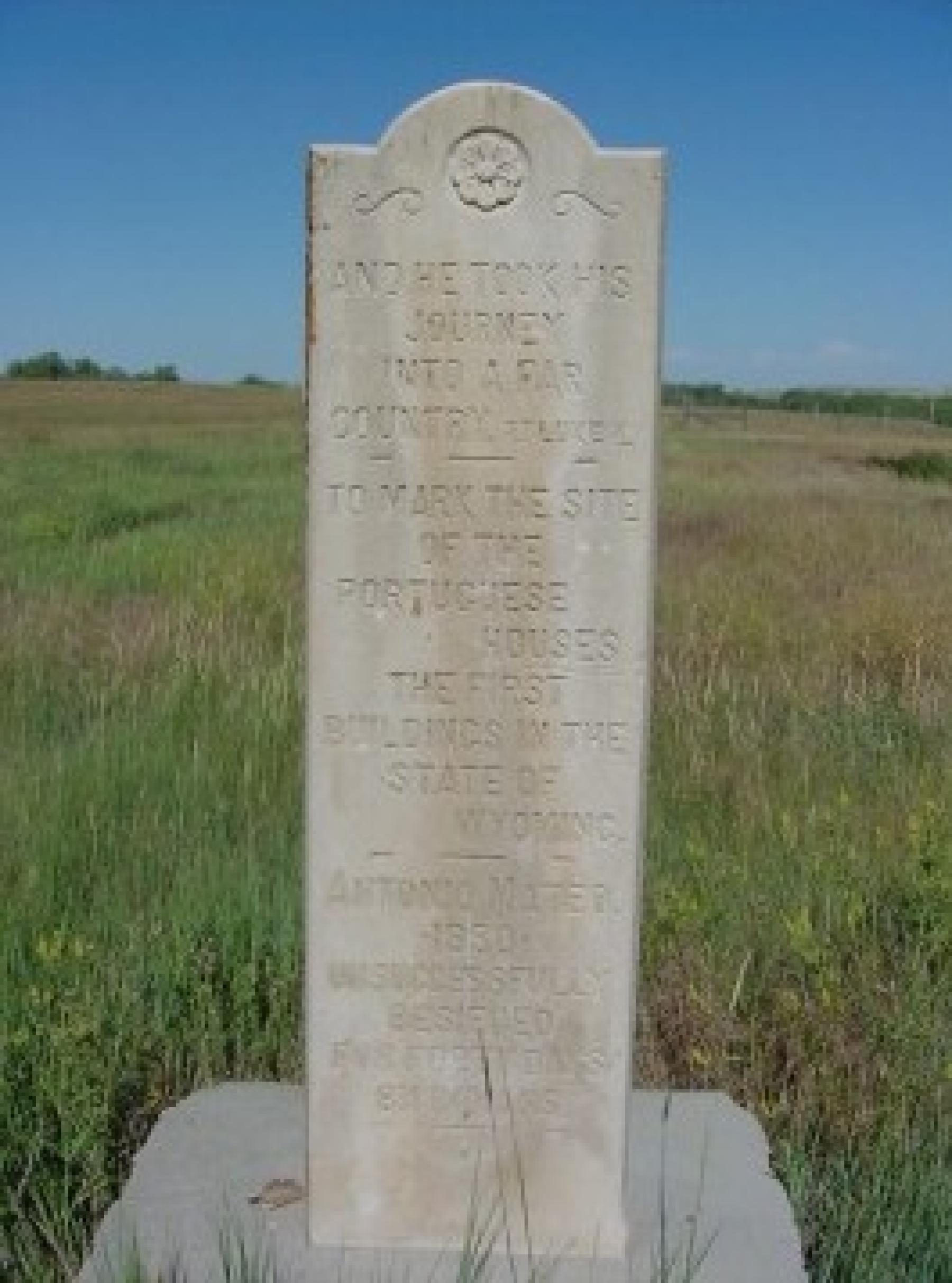
After abandonment, the Portuguese Houses left no surface remains, and the property has been used as a hayfield since at least the early twentieth century. A marker was placed at the site in 1928 by the Wyoming Historic Landmarks Commission.22 The site sits on private land in Johnson County, and the landowners asked that no digging take place.23
Unlike many Rocky Mountain fur trade posts, the Portuguese Houses were never subjected to secondary use by later occupants such as the military, homesteaders, or The Church of Jesus Christ of Latter-day Saints, the kind of reoccupation that at sites like Fort Laramie and Fort Bridger blurred or destroyed the original fur trade signature. That makes the Portuguese Houses an unusually intact window into the Rocky Mountain fur trade.24
Subsurface surveys conducted in 2007 and 2011 confirmed that the physical record of the post survives below the hayfield surface.25 The surveys traced the outline of the palisade trench, consistent with the post’s documented dimensions, and identified what appear to be interior room arrangements matching the 1920s sketch map shown in Figure 4. The animal enclosure mentioned in historic documents also registered in the survey results.26
The 2007 survey also identified two clusters of weak magnetic anomalies east of the trading post, designated Cluster 1 and Cluster 2, which may represent the remnants of Native American or Euro-American campsites located just outside the palisade walls. Further investigations are needed to confirm this interpretation.27 On a hilltop north of the post—the best tactical position from which to besiege it—surveyors found a semi-circular pattern of buried metal objects distinctly different from the general scatter of agricultural debris in the surrounding field. Its origin remains uncertain; it may be connected to Bridger’s encampment during the winter of 1836–1837, but further work would be needed before any interpretation can be made.28
The surveys suggest the site holds significant potential to shed light on the post’s layout, the events of that troubled winter, and the nature of trade between Euro-American traders and the Crow.29
Footnotes
-
Rory J. Becker, “Portuguese Houses: Non-invasive Investigations at a No-Dig Fur Trade Site,” Plains Anthropologist 63, no. 246 (2018): 175–176; Brodie Farquhar, “Johnson County, Wyoming,” WyoHistory.org, November 8, 2014, https://www.wyohistory.org/encyclopedia/johnson-county-wyoming; Greg Pierce, Trading Posts in Wyoming, Multiple Property Documentation Form, National Register of Historic Places, Wyoming State Historic Preservation Office, State Parks and Cultural Resources, Cheyenne, Wyoming, 2012, Section E, 46.
-
Becker, “Portuguese Houses,” 177.
-
Ibid.; Washington Irving, The Adventures of Captain Bonneville (Portland, Oregon: Binford’s & Mort, 1961), 487.
-
Becker, “Portuguese Houses,” 177.
-
Ibid., 177–178.
-
Ibid., 175.
-
Ibid.
-
Farquhar, “Johnson County, Wyoming.”
-
Hiram Martin Chittenden, The American Fur Trade of the Far West (Lincoln: University of Nebraska Press, 1935), 941; Sandra Todd, “Wyoming Archaeological Survey Site Report Form: 48JO96 the Portuguese Houses,” manuscript on file, Wyoming Cultural Records Office, University of Wyoming, Laramie, 1977, 1; Becker, “Portuguese Houses,” 181.
-
Becker, “Portuguese Houses,” 181.
-
Unidentified correspondent to Don Grey, handwritten note recalling the site’s 1920s appearance, n.d., Don Grey Collection, UWAR, Department of Anthropology, University of Wyoming; Becker, “Portuguese Houses,” 181–182.
-
Becker, “Portuguese Houses,” 181–182.
-
Irving, Adventures of Captain Bonneville, 354; Becker, “Portuguese Houses,” 183.
-
Irving, Adventures of Captain Bonneville, 492; Becker, “Portuguese Houses,” 177–178.
-
Pierce, Trading Posts in Wyoming, Section E, 46; Francis F. Victor, River of the West (Hartford, Connecticut: R. W. Bliss, 1870), 223–224.
-
Victor, River of the West, 223–224; Becker, “Portuguese Houses,” 178–179; Farquhar, “Johnson County, Wyoming.”
-
Becker, “Portuguese Houses,” 179; Victor, River of the West, 225; Jett B. Conner, "The Wyoming Adventures of Captain Bonneville," WyoHistory.org, January 16, 2024, https://www.wyohistory.org/encyclopedia/wyoming-adventures-captain-bonneville; Joseph Walker," Museum of the Mountain Man, https://museumofthemountainman.com/joseph-walker/.
-
LeRoy R. Hafen, French Fur Traders and Voyagers in the American West (Spokane, Washington: Arthur H. Clark Company, 1995), 258; Becker, “Portuguese Houses,” 179.
-
Osborne Russell, Journal of a Trapper, 1834–1843, ed. Aubrey L. Haines (Lincoln: University of Nebraska Press, 1965), 212; Becker, “Portuguese Houses,” 179–180.
-
Hafen, French Fur Traders, 259; Becker, “Portuguese Houses,” 179–180.
-
Hafen, French Fur Traders, 261; Becker, “Portuguese Houses,” 180.
-
Pierce, Trading Posts in Wyoming, Section E, 46; Todd, “Wyoming Archaeological Survey Site Report Form.”
-
Becker, “Portuguese Houses,” 176.
-
Ibid., 175–176.
-
Ibid., 180.
-
Ibid., 180–183.
-
Ibid., 183–185.
-
Ibid., 185–186.
-
Ibid., 186–187.