Ward and Guerrier’s Sand Point Post
Ward and Guerrier’s Sand Point Post was a trading establishment operated from approximately 1852 to 1861 on the North Platte River near Register Cliff, nine miles west of Fort Laramie in what is now Goshen County, Wyoming. Founded by Seth Ward and William Guerrier—two of the most commercially successful traders operating along the overland trails in the 1850s—the post occupied the first campsite west of Fort Laramie and captured emigrant trade at the earliest possible point after travelers left the fort. Sand Point served simultaneously as a trading post, livestock exchange, mail station, and Pony Express stop, and its operators played a significant if underappreciated role in the early history of Wyoming’s cattle industry. It is the only post in the Ward and Guerrier commercial enterprise that operated outside the immediate Fort Laramie military reservation.1
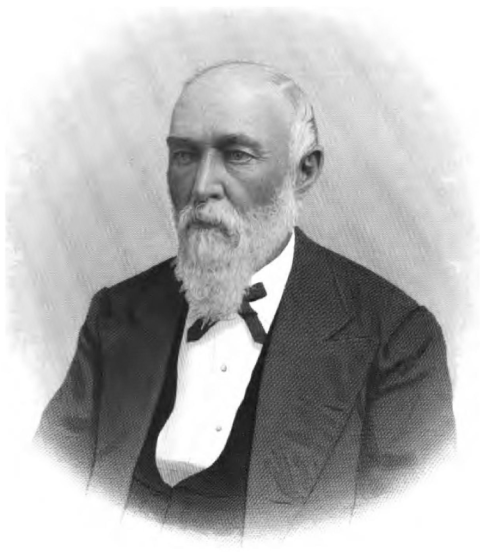
Seth Ward and William Guerrier: Background and Partnership
Seth Ward was a Virginian who had entered the western trade in the late 1830s, initially as a buffalo hunter and general trader working the country around Fort Laramie. By the early 1840s he was a recognized figure in the North Platte trading community. Merrill J. Mattes, who wrote the biographical essay on Ward in LeRoy R. Hafen’s The Mountain Men and the Fur Trade of the Far West, describes Ward as a man of exceptional commercial instincts who accumulated wealth steadily through the emigrant era and left the region one of the most prosperous traders to have operated along the Fort Laramie corridor. Ward’s wealth, recorded at $10,000 in the 1860 census, reflected the cumulative profits of a decade of commercial activity that ranged from emigrant provisioning to livestock exchange to the cattle-wintering innovation that would later be credited, however uncertainly, with founding Wyoming’s range cattle industry.2
William Guerrier’s career before Sand Point was more varied than Ward’s. Known by the anglicized name “Bill Garey” in early accounts, he worked as an interpreter at Bent’s Fort in 1845 and traded at Hardscrabble, which is present-day Pueblo, Colorado. In 1846 he partnered with Joseph B. Doyle to take six wagons of goods to the upper Arkansas for the Native American trade. Two years later he formed his lasting partnership with Seth Ward at Westport, Missouri: in 1848 the two men took five large wagons to the upper Arkansas and returned with some six thousand buffalo robes. By 1851 they were established in the Platte Valley, operating a trading post in the area of Ash Point, about eighteen miles east of Fort Laramie. Guerrier married a Cheyenne woman, and their son Edmund G. Guerrier would later become a noted scout and interpreter who narrowly escaped the Sand Creek Massacre in 1864. The partnership combined Ward’s organizational capacity and commercial connections with Guerrier’s facility in the Native American trade.3
Founding and Location
In 1852, Ward and Guerrier relocated their primary trading operations to Sand Point. The reason for this move is not recorded in surviving documents. The choice of location, however, was strategically sound: Sand Point was the first campsite westbound emigrants typically reached after leaving Fort Laramie, placing Ward and Guerrier’s post at the leading edge of the corridor where post–Fort Laramie trade was possible. The partners apparently attended the great assembly of Northern Plains tribes at Horse Creek near Scott’s Bluff in September 1851, which placed them at the center of the regional trading network at the moment of their relocation.4

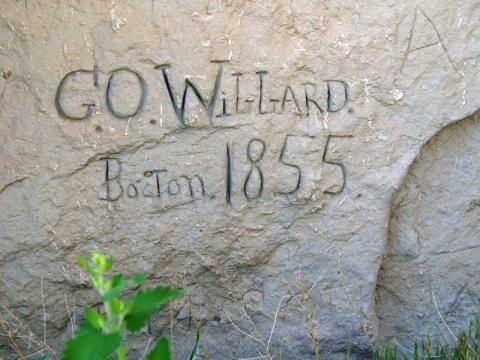
Register Cliff—the chalky bluff rising above the south bank of the North Platte that served as a traditional camping and inscription site for overland travelers—gave the location its character. Emigrants who had rested at Fort Laramie, replenished their supplies, and repaired their equipment were now, one day west of the fort, in a position to purchase additional livestock, exchange worn animals for fresher ones, and take on any provisions they had been unable to obtain at Fort Laramie itself.5
Trade and Physical Description
The Sand Point Post engaged in three overlapping forms of commerce. The first was conventional emigrant trade: hardware, cloth goods, and provisions sold to westbound wagon trains in the spring and summer travel season. The second, and apparently most lucrative, was livestock exchange. Ward and Guerrier maintained fields and ranching facilities near Sand Point where they fattened cattle and oxen acquired from emigrants whose animals were exhausted from the trail east of Fort Laramie. They then sold or exchanged these recuperated animals to westbound parties at a substantial premium and traded for mules from Kiowa and Comanche who brought animals up from the southern Plains.6
This livestock operation was the foundation of Seth Ward’s claim, recorded in popular history if not always in documents, to have pioneered the practice of wintering cattle on the open range along Chugwater Creek in 1852–53, demonstrating that animals could survive Wyoming winters without supplemental feed. Whether or not that specific episode is precisely documented, Ward’s Sand Point operation was unambiguously central to the emergence of organized livestock commerce in the Fort Laramie region.7
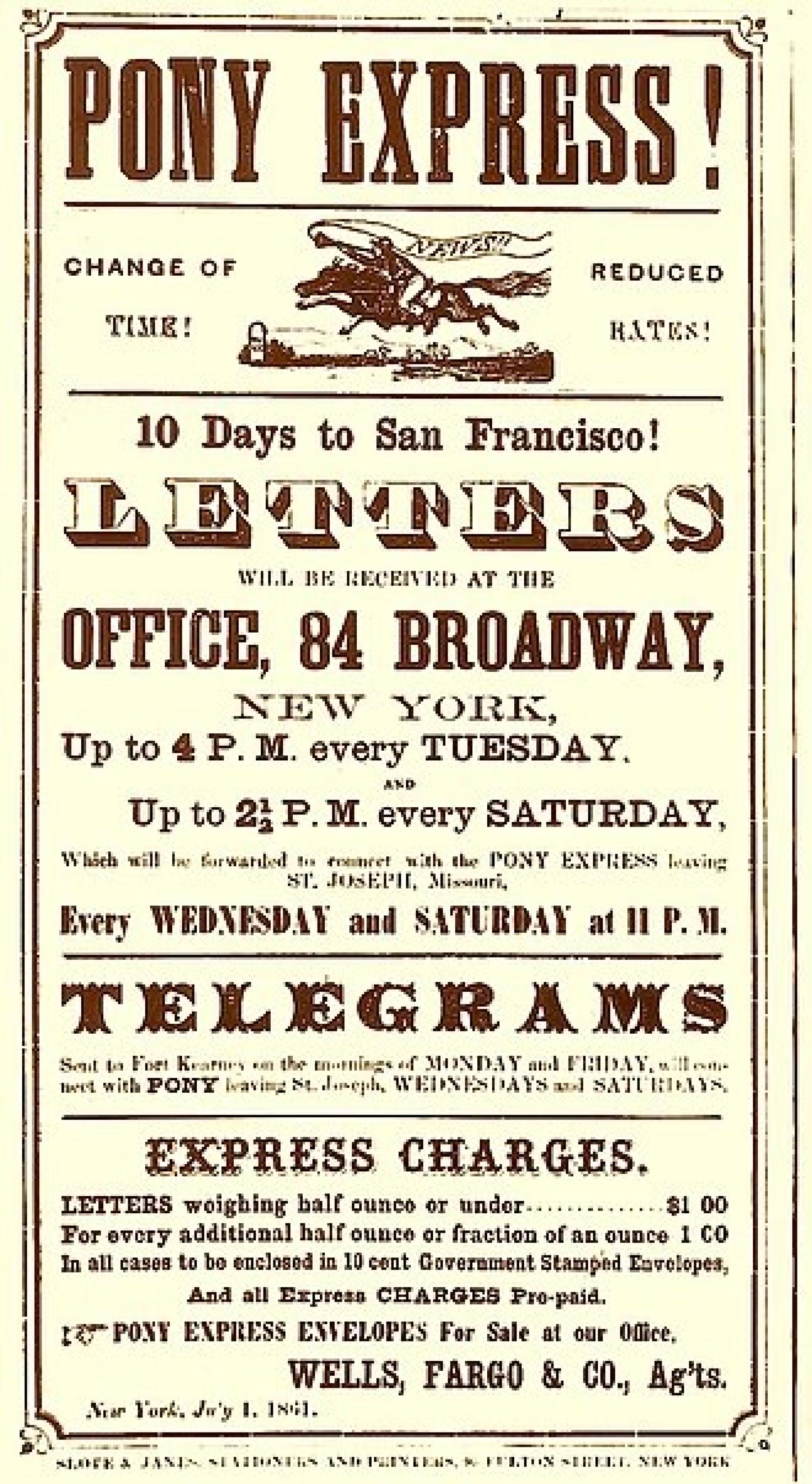
The third commercial dimension was the river crossing business. Ward and Guerrier were involved in multiple bridge construction projects on the North Platte River and built a toll bridge across the river as part of their Sand Point enterprise. A letter from John S. Tutt to John Dougherty, held in the Dougherty Papers at the Missouri Historical Society, provides further evidence of this involvement, though details of their specific bridge interests are not fully documented. The post also served as a mail station and, after 1860, as a Pony Express station, roles that brought additional revenue and kept Ward and Guerrier connected to the communications infrastructure of the overland corridor.8
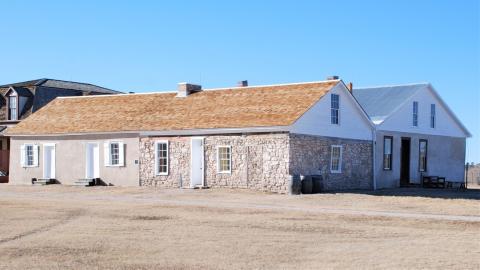
The physical form of the Sand Point Post is known only in outline. Elizabeth Woodcock Ferris, who traveled the Oregon Trail in 1856 and published her account that year, described a complex of two or three wood buildings and a larger stone building, giving Sand Point a more substantial and durable character than many contemporary trading establishments. The uses of the individual buildings are not specified in surviving accounts, though standard post design of the period typically divided functions among a trading house, storage rooms, and residential quarters. Corrals for the livestock trade and burials associated with the post are also documented in the historical record. A stone chimney, whose remains may still be visible at the site, could mark the post’s location.9
Temporary Abandonment and Resumed Operations
In 1855, General William S. Harney ordered the Platte River traders to relocate to Fort Laramie as part of his campaign to punish the Lakota for the violence following the Grattan Fight of August 1854. Ward and Guerrier complied, arriving from Sand Point and soon establishing a trading post near the fort itself, an establishment that appears on an army lieutenant’s map of 1856 as “Ward and Guerrier’s Trading Post.” During the period of abandonment, emigrants stripped portions of the Sand Point Post for fuel, destroying some of the wooden structures. Once the traders were released from the forced relocation, Ward and Guerrier resumed operations at Sand Point, though the post required rebuilding.10
Ward as Fort Sutler, Guerrier’s Death, and Later Operations
In 1857, Seth Ward was appointed post sutler at Fort Laramie by Colonel William Hoffman, the sole licensed civilian storekeeper at the military post, a monopoly position of considerable commercial value.11 Ward operated the sutlership from the adobe sutler store at Fort Laramie while Guerrier continued to manage Native American and emigrant trade at Sand Point.12 Indian Agent Thomas Twiss, who arrived at Fort Laramie in 1855, accused Ward and other traders of corruption in the conduct of Indian affairs. Traders responded by attacking Twiss’s own integrity in turn, and Twiss himself faced accusations of trading annuity goods for buffalo hides and exchanging goods for a young woman.13
This arrangement—Ward at the sutlership, Guerrier running Sand Point—ended abruptly on February 16, 1858, when William Guerrier was killed at a trading camp on the Niobrara River near present-day Lusk, Wyoming. Sparks from his pipe ignited a powder keg, and he died in the resulting explosion.14 After Guerrier’s death, Ward placed B. B. Mills and Antoine Janis in charge of Sand Point operations.15 The post remained commercially active as late as 1860–1861.16 Ward retained his trading license in the Fort Laramie territory at least through 1864, when letters from John Loree of the Upper Platte Agency confirm his continued engagement in Native American trade.17 Ward’s 1863 relocation to Nebraska City represented a shift in his base of operations rather than a complete withdrawal from the region.18
Ward’s 1868 correspondence, in which he listed his regional properties in an effort to sell his interests, makes no mention of the Sand Point Post, suggesting that by that date he no longer considered it an active or recoverable asset.19 By 1871, Ward had relinquished the Fort Laramie sutlership and departed the region entirely.20 He returned to Westport, Missouri—present-day Kansas City—where he invested his accumulated frontier wealth in real estate and lived as a prosperous civic figure for the remainder of his life, dying on December 9, 1903, at the age of eighty-three.21
Significance
Sand Point Post is significant as the commercial nexus of one of the most successful trading enterprises in the Fort Laramie corridor during the peak emigrant era. Seth Ward’s career—spanning nearly three decades of continuous trade in the North Platte region, culminating in the Fort Laramie sutlership and a return to Missouri as a wealthy man—illustrates the degree to which commercial success on the overland trails was achievable by those with capital, connections, and the flexibility to adapt as conditions changed. The Sand Point livestock exchange in particular represents an early and important form of the commercial ranching that would define Wyoming’s economy in the decades following the Civil War.
The post’s intersection with the Pony Express and the overland mail service adds another layer of significance, connecting Ward and Guerrier’s enterprise to the communications infrastructure of the West.22 That Guerrier’s death in 1858 ended the partnership’s most productive phase, and that the Sand Point Post was not rebuilt after Ward’s departure, leaves Sand Point as a case study in how personal relationships, as much as commercial conditions, shaped the life spans of Oregon Trail-era trading establishments.
Footnotes
-
Greg Pierce, Trading Posts in Wyoming, Multiple Property Documentation Form, National Register of Historic Places, Wyoming State Historic Preservation Office, State Parks and Cultural Resources, Cheyenne, Wyoming, 2012, Section E, 62–63.
-
Merrill J. Mattes, “Seth E. Ward,” in The Mountain Men and the Fur Trade of the Far West, ed. LeRoy R. Hafen, vol. 3 (Glendale, California: Arthur H. Clark, 2000), 357–384; James H. Nottage, “A Frontier Census: Fort Laramie in 1860,” WyoHistory.org, January 9, 2023, https://www.wyohistory.org/encyclopedia/frontier-census-fort-laramie-1860.
-
Dan L. Thrapp, “Guerrier, William,” in Encyclopedia of Frontier Biography, vol. 2 (Lincoln: University of Nebraska Press, 1988), 597; Mattes, “Seth E. Ward,” 357–365.
-
LeRoy R. Hafen and Francis Marion Young, Fort Laramie and the Pageant of the West (Glendale, California: Arthur H. Clark, 1938), 240; Mattes, “Seth E. Ward,” 364–365; Thrapp, “Guerrier, William,” 597; “Register Cliff,” WyoHistory.org, https://www.wyohistory.org/encyclopedia/register-cliff.
-
Mattes, “Seth E. Ward,” 364–365; Pierce, Trading Posts in Wyoming, Section E, 62–63.
-
Mattes, “Seth E. Ward,” 365–366; Thrapp, “Guerrier, William,” 597; Pierce, Trading Posts in Wyoming, Section E, 62; Samuel Western, “The Wyoming Cattle Boom, 1868–1886,” WyoHistory.org, November 8, 2014, https://www.wyohistory.org/encyclopedia/wyoming-cattle-boom-1868-1886.
-
Mattes, “Seth E. Ward,” 365–366; Pierce, Trading Posts in Wyoming, Section E, 62.
-
John S. Tutt, letter to John Dougherty, n.d., Dougherty Papers, Missouri Historical Society, Kansas City, Missouri, cited in Pierce, Trading Posts in Wyoming, Section E, 62; Mattes, “Seth E. Ward,” 368, 371; Thrapp, “Guerrier, William,” 597; Pierce, Trading Posts in Wyoming, Section E, 62–63.
-
Mrs. Benjamin G. Ferris, The Mormons at Home (New York, 1856), 62–63; Barnhart, Register Cliff, 4; Pierce, Trading Posts in Wyoming, Section E, 62–63.
-
Pierce, Trading Posts in Wyoming, Section E, pp. 62–63; Mattes, “Seth E. Ward,” 371.
-
William Hoffman to Adjutant General, March 4, 1857, Records of the United States Army Commands, Letters Sent, Fort Laramie, Record Group 98, National Archives, Washington, DC.
-
Pierce, Trading Posts in Wyoming, Section E, 62.
-
James H. Nottage, “Indian Agent Thomas Twiss, Man of Two Worlds,” WyoHistory.org, July 5, 2022, https://www.wyohistory.org/encyclopedia/indian-agent-thomas-twiss-man-two-worlds.
-
“Pioneer’s Tombstone Presented to State by Historian Hunton,” Sheridan Post-Enterprise, August 19, 1927, 2.
-
Mattes, “Seth E. Ward,” 371.
-
Mattes, “Seth E. Ward,” 371–372.
-
John Loree to Commissioner of Indian Affairs, November 5, 1863, and Loree to [Hon. Julian], February 10, 1864, Records of the Upper Platte Agency, National Archives, Washington, DC.
-
“The Life of Seth Ward,” in A Memorial and Biographical Record of Kansas City and Jackson County, Missouri (Chicago: Lewis Publishing Company, 1896), 567–570.
-
Mattes, “Seth E. Ward,” 379.
-
James Anderson to Ray Mattison, letter, June 6, 1956, National Park Service, Cultural Resources, Washington, DC; Seth Ward to Bullock, letter, May 20, 1871, Fort Laramie Letters, in Seth Ward Papers, 1838–1892, Western History Collection, Denver Public Library, Denver, CO.
-
“Seth Ward Dies Suddenly,” Kansas City Times, December 10, 1903, 6, accessed September 8, 2026, via Newspapers.com
-
Pierce, Trading Posts in Wyoming, Section E, 62.