Bissonette’s North Platte River Post
Between 1850 and 1854, the experienced fur trader and interpreter Joseph Bissonette operated an independent trading post on the North Platte River in what is now Goshen County, Wyoming, approximately three miles upstream from Bordeaux’s Sarpy’s Point Post.
Although little physical evidence of the post survives, Bissonette’s North Platte River Post occupies a meaningful place in the history of Oregon Trail-era commerce. It represents the kind of small-scale independent enterprise that flourished briefly in the open competitive landscape following the American Fur Company’s departure from the region, and its operator was among the most connected figures on the Northern Plains, a man whose relationships with both the Brulé Lakota and the emerging emigrant economy gave his post a commercial resilience that outlasted many of his contemporaries.1
Joseph Bissonette: Background and Career
Joseph Bissonette was baptized in St. Louis, Missouri, in June 1814, the son of a French-Canadian family with deep roots in the North American fur trade.2 He entered the trade in earnest by the early 1840s, when he and John Baptiste Richard (known widely as “Reshaw”) were placed in charge of operations at Fort Platte by its then-owners John Sybille and David Adams. Several contemporary travelers referred to the post as Fort Bissonette or Richard’s Fort, reflecting the prominent roles both men played there.
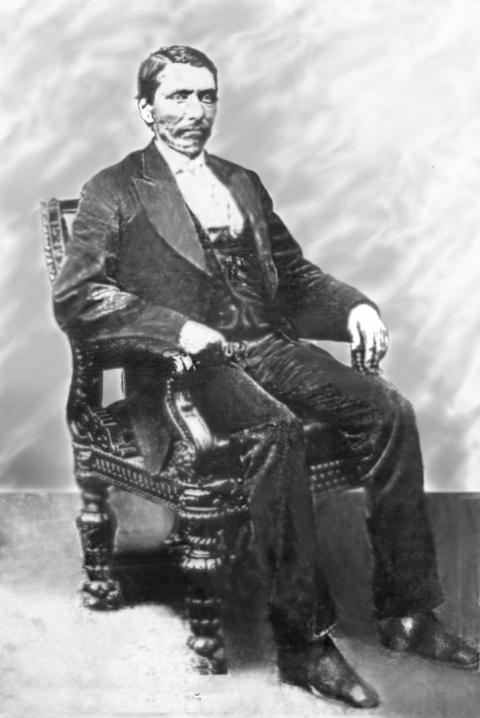
Bissonette’s particular contribution was field work: while Richard managed the post, Bissonette ranged out to trade in Lakota villages, a division of labor that reflected his fluency in Lakota and his extensive kinship ties within the Brulé bands. When Sybille and Adams dispatched their traders to winter locations in the fall of 1842, Bissonette was assigned to Horse Creek with eight men and two Native women, a complement that reflects the scale of the field operation he led.3 Bissonette also served as an interpreter for the explorer John C. Frémont in 1842, accompanying the expedition from Fort Laramie to the Red Buttes near present-day Casper.4
After Fort Platte’s owners sold it in 1843 and the operation was reorganized under Bernard Pratte Jr. and Jean Charles Cabanne, Bissonette continued in the region. He and Richard helped construct Fort Bernard in 1845 and managed its operations until the post burned in 1846. Following the fire, Bissonette’s movements are poorly documented until 1849, when he allegedly formed an association with James Bordeaux and Charles Primeau at Bordeaux’s Sarpy’s Point Post. The association dissolved in 1850, with Bissonette striking out on his own and establishing a new post three miles upriver from Bordeaux.5
The North Platte Post: Location, Trade, and Operations
The post sat on the North Platte in the vicinity of Sarpy’s Point, the same stretch of river that had drawn a succession of independent traders since the American Fur Company’s departure. Its location three miles upstream from Bordeaux’s post placed it in direct competition with its neighbor for the same streams of revenue: trade goods and robes from the Lakota bands camped in the region, and provisions, livestock, and ferriage sold to the emigrant trains filing past on the Oregon Trail. Captain Howard Stansbury, who traveled the trail in 1849–50 and published his survey report in 1852, noted Bissonette’s location in relation to Bordeaux’s post, providing the primary geographic reference for the site.6
From this post, Bissonette traded hardware, cloth goods, and other supplies to Native groups and engaged in the emigrant trade in the spring and summer months. He also ran a livestock operation—trading and exchanging animals—and operated a ferry to carry emigrant wagons across the North Platte, a service for which there was strong demand and which provided a reliable seasonal income.7 In 1852, Bissonette extended his commercial reach further upriver, joining John Baptiste Richard and several other partners in constructing the first successful toll bridge over the North Platte near the California Crossing, the structure that became known as Reshaw’s Bridge. The bridge and its associated trading post represented a significant expansion of Bissonette’s interests, though the partnership eventually dissolved: Bissonette sold his share in the bridge enterprise to Richard in 1854 and relocated his primary trading operations downriver to the mouth of LaBonte Creek, near present-day Douglas.
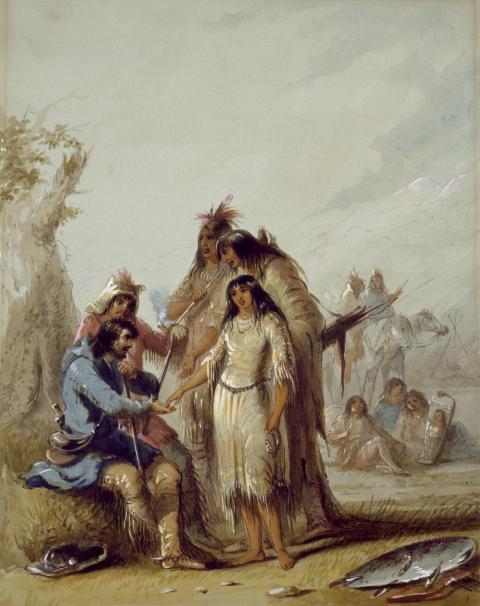
The North Platte Post was in operation at the peak of the emigrant era on the Oregon Trail. Traffic through the region reached its highest recorded level in 1852, when an estimated seventy thousand westbound travelers crossed the North Platte. The post was also active during the years immediately preceding the Grattan Fight of August 1854, a period of mounting tension between the United States and the Brulé and Oglala Lakota over treaty violations, resource depletion, and military overreach. Bissonette’s well-established relationships within the Lakota bands, reinforced through marriage and long personal acquaintance, gave him access and stability that traders without such connections found difficult to maintain.8
No contemporary account describes the size, layout, or construction of Bissonette’s North Platte Post, and its exact location has not been confirmed, though it is known to have stood three miles upriver from Bordeaux’s Sarpy’s Point Post in what is now Goshen County. What Bissonette actually did there offers the best clues to what the post contained: his documented work servicing emigrant wagons and trading livestock suggests it likely included a blacksmith shop and some form of stable or corral.9
Bissonette After 1854
The move to LaBonte Creek in 1854 proved difficult. Following the Grattan Fight in August of that year, Brulé warriors raided Bissonette’s new post and took most of his trade goods. The following year, a party of Miniconjou Lakota seized one of his supply wagon trains bound for the Powder River. By the summer of 1855, the United States military had ordered all traders in the region to suspend commerce with Native groups pending military action against the Lakota, and Bissonette spent the winter of 1855–1856 at Fort Laramie.10
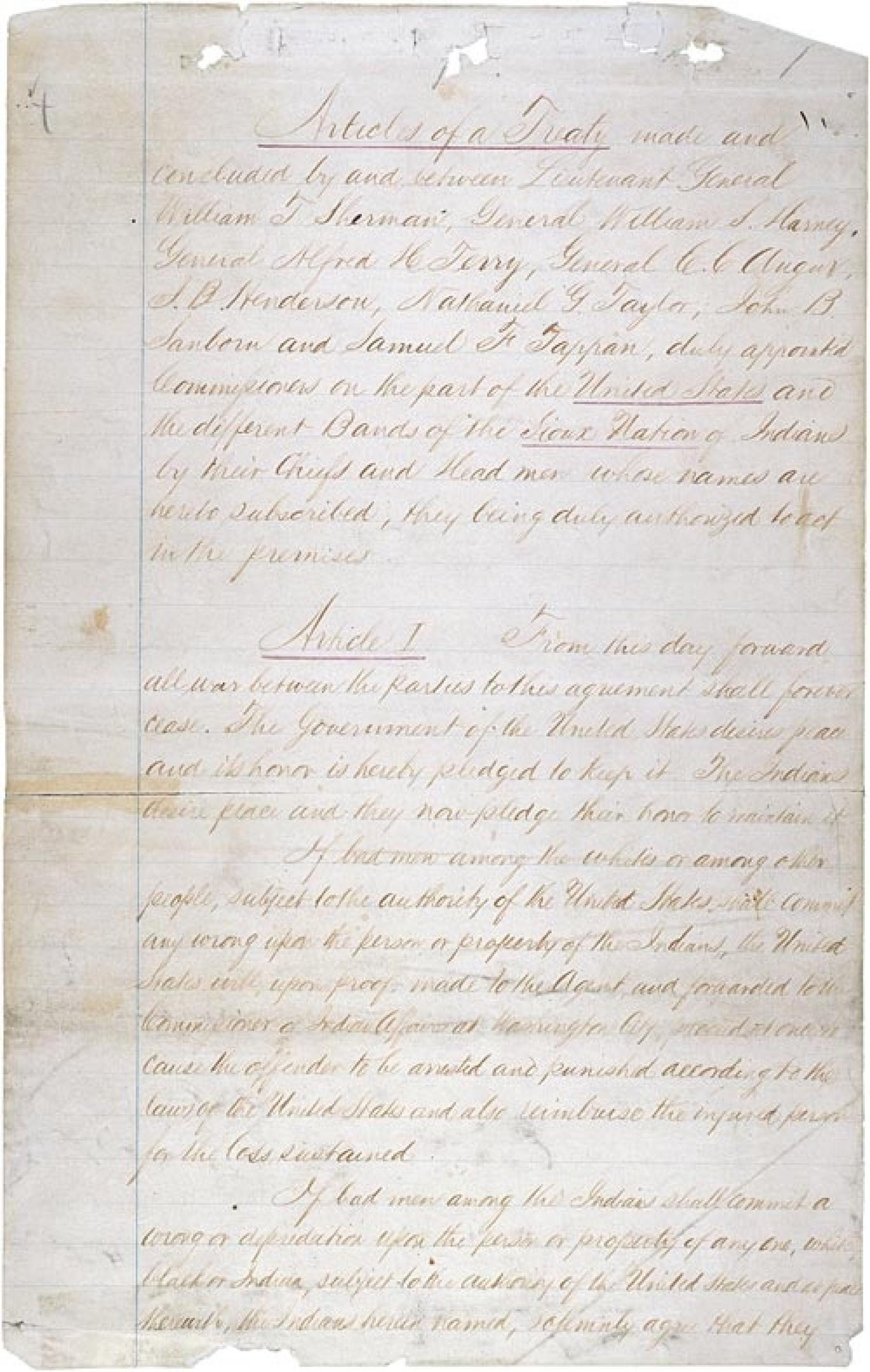
There, his friendship with Indian Agent Thomas Twiss led to his appointment as a government interpreter in September 1856, a transition that would define the later decades of his career. By 1857 Bissonette had relocated his trading and interpreting activities to Deer Creek, near present-day Glenrock, where he operated through the early 1860s. When the Raynolds Expedition came through in 1859–60, Bissonette’s post at Deer Creek was sufficiently prominent that it served as a staging point and communication node for the expedition. He later served as a special interpreter for the Brulé during negotiations that produced the Fort Laramie Treaty of 1868 and remained associated with Spotted Tail’s band at various reservation locations until his death at Pine Ridge, South Dakota, in 1894.11
Significance
Bissonette’s North Platte Post illustrates the web of commercial, personal, and diplomatic relationships that sustained independent trading on the Oregon Trail during the post-American Fur Company era. Unlike many contemporaries who operated only brief or isolated enterprises, Bissonette moved fluidly between the roles of post trader, ferry operator, bridge partner, field trader, and eventually government interpreter—each transition reflecting his ability to adapt commercial strategies to changing conditions on the northern Plains. Underpinning that adaptability were two marriages into the Lakota bands—first to an Oglala woman and later to a Brulé woman—that together produced twenty-one mixed-heritage children.12 The post’s four years of operation straddled the height of emigrant traffic and the beginning of the escalating violence that would ultimately end the independent trading era, giving it a significance that exceeds what the sparse documentary record might suggest.
The post’s most important scholarly treatment appears in John D. McDermott’s biographical essay on Bissonette in The Mountain Men and the Fur Trade of the Far West, a collection of 292 biographies by more than twenty scholars edited by LeRoy R. Hafen. McDermott draws on Bissonette’s own legal statements from the 1890s—depositions made in support of claims against the United States government for property seized or destroyed by the Lakota—as well as on the broader documentary record of the North Platte trading community.13
[Editor’s Note: Special thanks to the author and to the Wyoming State Historic Preservation Office for making this article available, and to the Wyoming Cultural Trust Fund for its ongoing support for this project. Greg Pierce’s historical monograph, Negotiating the West: A History of Wyoming Trading Posts, from which this article is adapted and excerpted, is one of many historic contexts published by the Wyoming State Historic Preservation Office. These documents are meant to offer a broad background against which historic developments can be better understood as the agency works to preserve properties and places important to an understanding of Wyoming’s past. The contexts also, however, are based on sound research and are full of well-told, vivid stories. With this in mind, WyoHistory.org is collaborating with the SHPO office to bring more of this history to a wider readership. The Cultural Trust has provided the funds to make this collaboration possible. We offer our thanks to all.]
Footnotes
-
Greg Pierce, Trading Posts in Wyoming, Multiple Property Documentation Form, National Register of Historic Places, Wyoming State Historic Preservation Office, State Parks and Cultural Resources, Cheyenne, Wyoming, 2012, Section E, 59–60.
-
John D. McDermott, “Joseph Bissonette,” in The Mountain Men and the Fur Trade of the Far West, ed. LeRoy R. Hafen, vol. 4 (Glendale, California: Arthur H. Clark, 2001), 49–51.
-
McDermott, “Joseph Bissonette,” 49; David W. Lupton, “Fort Platte, Wyoming, 1841–1845: Rival of Fort Laramie,” Annals of Wyoming 49, no. 1 (1977), 87. Charles E. Hanson Jr. and Veronica Sue Walters, “The Early Fur Trade in Northwestern Nebraska,” Nebraska History 57 (1976), 301.
-
Tom Rea, “The Pathfinder’s Lost Instruments: John C. Frémont’s Cavalier Attitude toward His Scientific Apparatus,” Commonplace 4, no. 4 (July 2004), https://commonplace.online/article/the-pathfinders-lost-instruments/.
-
Pierce, Trading Posts in Wyoming, Section E, 59; Charles E. Hanson Jr. and Sue Walters, “The Early Fur Trade in Northwestern Nebraska,” Nebraska History 53, no. 7 (1976), 305; David Walker Lupton, “Fort Bernard on the Oregon Trail,” Nebraska History 60, no. 1 (Spring 1979), 33.
-
Statement of Joseph Bissonette, October 16, 1893, Claim no. 619, Records of the United States Court of Claims, Record Group 205, National Archives, Washington, D.C.; Howard Stansbury, Exploration and Survey of the Valley of the Great Salt Lake of Utah (Philadelphia: Lippincott, Grambo, 1852), 288.
-
Pierce, Trading Posts in Wyoming, Section E, 59–60; McDermott, “Joseph Bissonette,” 54.
-
Jefferson Glass, “Reshaw’s Bridge,” WyoHistory.org, https://www.wyohistory.org/encyclopedia/reshaws-bridge; John Unruh, The Plains Across: The Overland Emigrants and the Trans-Mississippi West, 1840–60 (Chicago: University of Illinois Press, 1993), 85.
-
Pierce, Trading Posts in Wyoming, Section E, 60.
-
Pierce, Trading Posts in Wyoming, Section E, 63–64; Statement of Joseph Bissonette, October 6, 1892, claim no. 1442, Records of the United States Court of Claims, Record Group 123, National Archives, Washington, D.C.; McDermott, “Joseph Bissonette,” 55.
-
McDermott, “Joseph Bissonette,” 55–58; “Rivers, Mountains and Plains: The Raynolds Expedition of 1859–1860,” WyoHistory.org, https://www.wyohistory.org/encyclopedia/rivers-mountains-and-plains-raynolds-expedition-1859-1860; “Three Mixed-Race Families and a Wagon Train Attack: A Story of Frontier Survival,” WyoHistory.org, https://www.wyohistory.org/encyclopedia/wagon-train-attack-story-frontier-survival.
-
McDermott, “Joseph Bissonette,” 49; Harry H. Anderson, “Fur Traders as Fathers: The Origins of the Mixed-Blooded Community Among the Rosebud Sioux,” South Dakota History 3, no. 3 (1973), 241.
-
McDermott, “Joseph Bissonette,” 49–60; Statement of Joseph Bissonette, October 6, 1892; Statement of Joseph Bissonette, October 16, 1893.