Ash Point
Ash Point was a small, one-room trading post constructed in 1850 in Goshen County, Wyoming, on the emigrant trail along the North Platte River, ten miles downriver from Bordeaux’s Sarpy Point Post. It operated for only two years before burning in 1852, leaving a limited but archaeologically significant footprint at a site that has seen continuous occupation ever since.
Construction and Operator
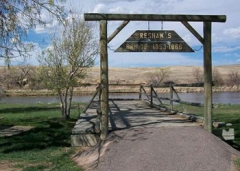
The post was constructed by John Baptiste Richard, an experienced mountain trader who had been active in the region since at least the early 1840s.1 Richard had previously worked for Sybille and Adams at Fort Platte and later partnered with Joseph Bissonette at Fort Bernard.2 After Fort Bernard’s destruction, he remained in the region and eventually built Ash Point in 1850, where the post primarily traded in horses.3 Richard is perhaps better known today for what he went on to build after selling Ash Point: in the fall of 1852, he and several partners—including Joseph Bissonette, Charles Bordeaux, Louis Guinard, and William Kenceleur—constructed the first successful bridge to span the North Platte River near present-day Casper, Wyoming.4 Because Richard spoke with a thick French accent, most travelers of the day mistook the pronunciation of his name, thinking it was “Reshaw,” and the bridge became widely known as Reshaw’s Bridge.5
Ownership and Abandonment
Richard operated Ash Point until April 1851, when it was purchased by Seth Ward and William Le Guerrier.6 Ward was a Virginian who had been active in the fur trade since the late 1830s; Guerrier was his long-time business partner.7 Ward and Guerrier abandoned the post after it burned in 1852, relocating to Sand Creek, near Register Cliff.8 From there, the pair went on to establish a notable trading post at Fort Laramie, where Ward was appointed official sutler in 1857.9 Guerrier was killed in an accident in 1858.10 There is no indication Ash Point was immediately reoccupied for trading activities after the fire. By the late nineteenth century, however, the location was occupied by the Swan Land and Cattle Company, and the site has seen continuous occupation since.
What Is Known About the Post
Few documents referencing Ash Point survive, a reflection of its limited occupation and the narrow range of activities conducted there. The post’s location was recorded in reference to Bordeaux’s Post, whose location is known, allowing Ash Point to be placed with reasonable confidence. Beyond a brief description as a one-room establishment, little else is recorded about the post’s physical character. There is no mention of stockades, storage rooms, or a blacksmith shop, three features common to trading posts of the period. The references to horse trading, however, raise the possibility that stables or corrals were present.
Archaeological investigations conducted during the 1980s are believed to have located the remains of Ash Point at a Goshen County ranch where agricultural activity had revealed historic cultural deposits from the right time period. Although more than a century of activity—including modern construction and terrace leveling—had disturbed much of the site, a portion retained enough integrity that foundations and cultural material recovered there are believed to represent the original post. Data from those undisturbed sections may still yield information on emigrant-era trade and horse exchange, though the extent of damage across the rest of the site limits what can be recovered.11
Footnotes
-
David Eckles, Report of Archaeological Investigations at Richard’s Trading Post, submitted to the Wyoming State Historic Preservation Office, State Parks and Cultural Resources, Cheyenne, Wyoming, 1983, 6.
-
John D. McDermott, Frontier Crossroads: The History of Fort Caspar and the Upper Platte Crossing (Casper, Wyoming: City of Casper, 1997), 289–303.
-
John Unruh, The Plains Across: The Overland Emigrants and the Trans-Mississippi West, 1840–60 (Chicago: University of Illinois Press, 1993), 270; George Zeimens, “Trading Posts: The Forgotten Places and Artifacts of Emigrant Trail History,” manuscript on file, Western Plains Historic Preservation Association, Lingle, Wyoming, n.d., 9.
-
Jefferson Glass, “Reshaw’s Bridge,” WyoHistory.org, https://www.wyohistory.org/encyclopedia/reshaws-bridge.
-
Ibid.
-
John S. Tutt, letter to John Dougherty, n.d., Dougherty Papers, Missouri Historical Society, Kansas City, Missouri; Unruh, The Plains Across, 279.
-
James H. Nottage, “A Frontier Census: Fort Laramie in 1860,” WyoHistory.org, January 9, 2023, https://www.wyohistory.org/encyclopedia/frontier-census-fort-laramie-1860.
-
Merrill J. Mattes and Thor Borrensen, “Historical Approaches to Fort Laramie,” manuscript on file, Fort Laramie National Historic Site, Fort Laramie, Wyoming, n.d., 9; Zeimens, “Trading Posts,” 9.
-
Nottage, “A Frontier Census.”
-
Ibid.
-
George Zeimens, Alan Korell, Don Housh, Dennis Eisenbarth, and Bob Curry, “The Korell-Bordeaux and Rock Ranch Protohistoric Sites: A Preliminary Report,” The Wyoming Archaeologist 30, no. 3–4 (1987): 78–80.