Ward and Guerrier’s Fort Laramie Post
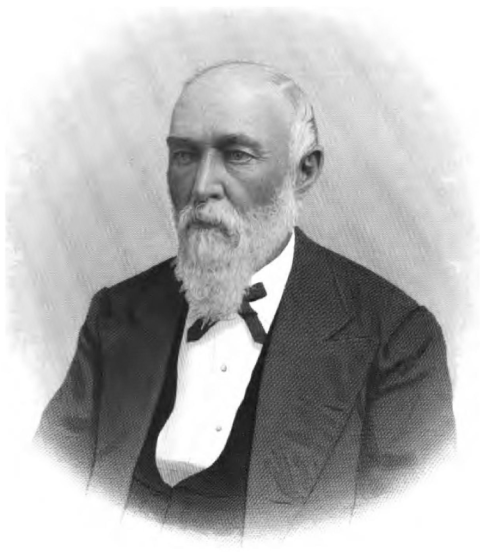
Ward and Guerrier’s Fort Laramie Post was a civilian trading establishment operated from approximately 1855 to 1863 on the south bank of the Laramie River, directly across from Fort Laramie in what is now Goshen County, Wyoming. It was the second and better-documented of the two posts Seth Ward and William Le Guerrier operated together—the other being their Sand Point Post near Register Cliff—and its location within the boundaries of what is now Fort Laramie National Historic Site has made it one of the better-understood civilian trading operations of the emigrant era.1
Background: Ward and Guerrier at Fort Laramie
The Fort Laramie Post grew directly out of the crisis that ended independent trading along the North Platte in 1855. When General William S. Harney ordered the Platte River traders to relocate to Fort Laramie following the violence of the Grattan Fight in August 1854, Seth Ward and William Guerrier arrived from their Sand Point Post near Register Cliff and soon established a trading presence in the immediate vicinity of the military fort. A post was erected possibly as early as 1855 and certainly by 1856, when a “Ward and Guerrier’s Trading Post” appears on a map of Fort Laramie drawn by an army lieutenant.2
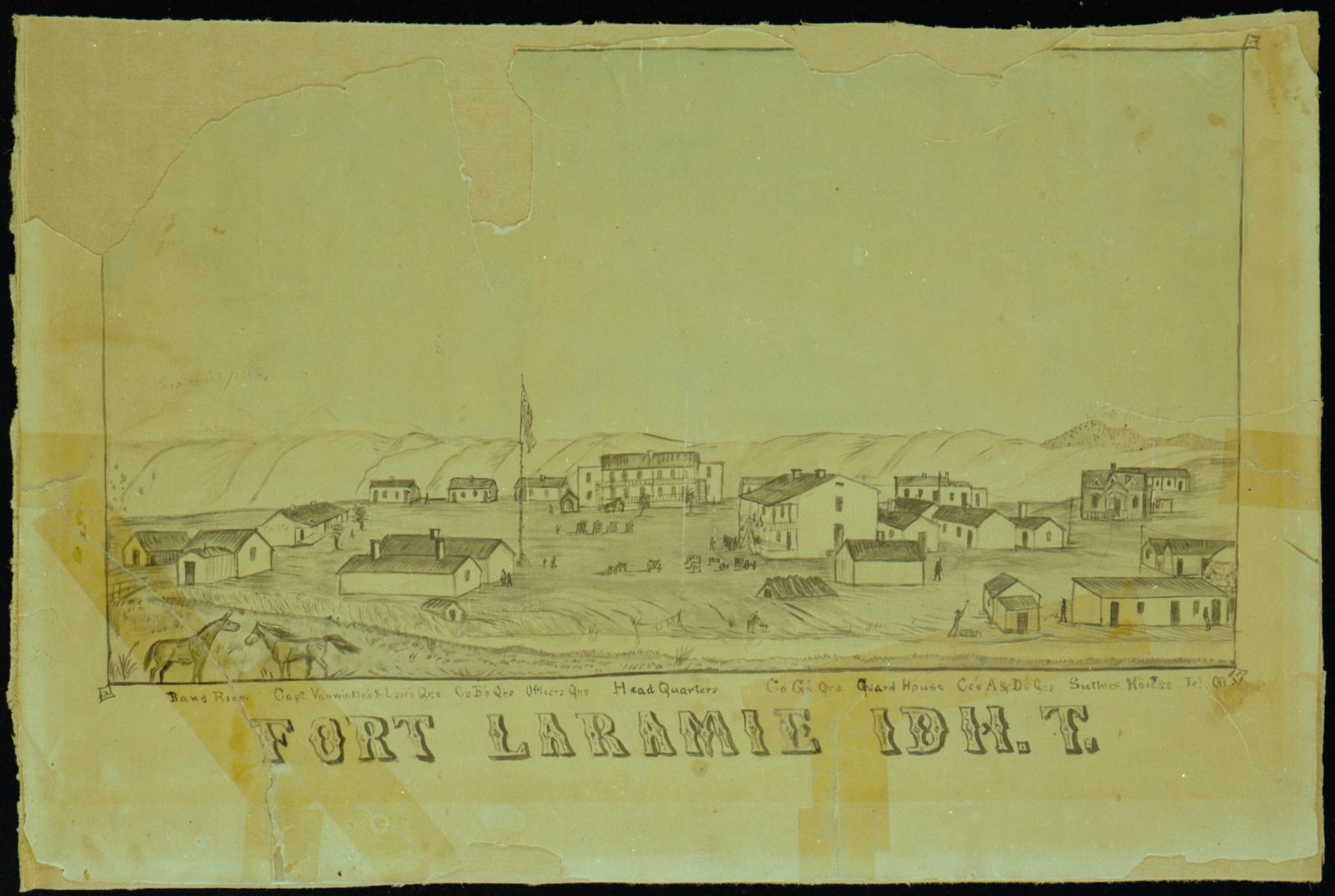
By this date Ward and Guerrier were already the most commercially powerful civilian traders in the Fort Laramie corridor. They had been partners in the fur and emigrant trade since at least 1851, operating first from the Ash Point area and then from Sand Point near Register Cliff. Their combined commercial operations encompassed livestock exchange, emigrant provisions, Native American trade, and river crossing enterprises. The move to Fort Laramie consolidated their position at the center of military and civilian commerce on the upper North Platte, placing them adjacent to the largest concentration of soldiers, agency officials, and overland emigrants in eastern Wyoming.3
Operations and the Ward Sutlership
The Fort Laramie Post operated alongside, rather than as a substitute for, Ward and Guerrier’s continuing Sand Point operations. Ward ran the Fort Laramie end of their combined enterprise while Guerrier—a skilled interpreter who had worked at Bent’s Fort and who had long-standing ties to the Cheyenne through his Cheyenne wife—managed the Native American trade, which required the mobility and personal relationships that a fixed military-post location could not fully support. In the spring of 1857, Colonel William Hoffman appointed Seth Ward as official sutler at Fort Laramie, the licensed civilian storekeeper whose monopoly on retail sales to soldiers was one of the most commercially valuable positions available on the frontier. As sutler, Ward operated from the fort’s adobe sutler store while simultaneously maintaining his trading interests in the broader region.4
Ward’s dominance of the regional trade drew the attention of Indian Agent Thomas Twiss, who arrived at Fort Laramie in 1855 and accused Ward and other traders of corruption in the conduct of Indian affairs. Historians have generally read Twiss’s charges as reflecting his own ambition to control the Indian trade rather than documented wrongdoing on Ward’s part; that Ward drew particular attention likely says more about his commercial prominence than his conduct.5
The arrangement between Ward and Guerrier meant that the Fort Laramie Post likely served primarily as a base for Ward’s sutlership and general trading, while Guerrier continued to range between Sand Point and the Native camps. Correspondence from Ward in 1857 indicates that Sand Point had been damaged by emigrants during the period of enforced abandonment and had not yet been repaired, suggesting that Guerrier may also have conducted at least some Native trade from the Fort Laramie Post during this period.6
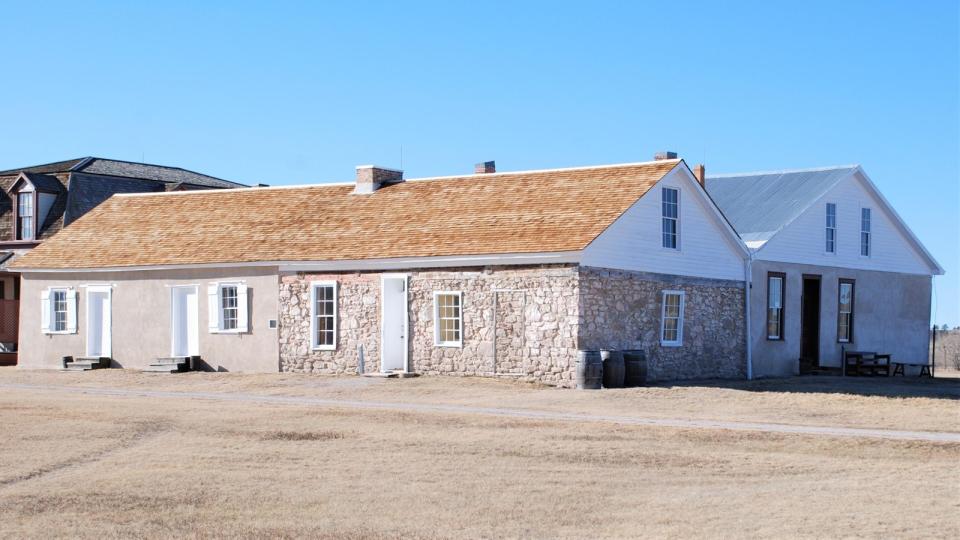
This arrangement ended on February 16, 1858, when William Guerrier was killed at a trading camp on the Niobrara River near present-day Lusk, Wyoming. Sparks from his pipe ignited a powder keg, and he died in the resulting explosion. After Guerrier’s death, Ward placed B. B. Mills and Antoine Janis in charge of the Sand Point operation, while a man named William Bullock became his operations manager at the sutler’s store. The Fort Laramie Post’s primary commercial function effectively ended at this point, as Ward’s energies consolidated around the sutlership and the revived Sand Point operation. Maps of the fort produced after 1863 no longer show the Ward and Guerrier trading post at its former location, confirming that the site had been vacated by that date.7
Location and Physical Form
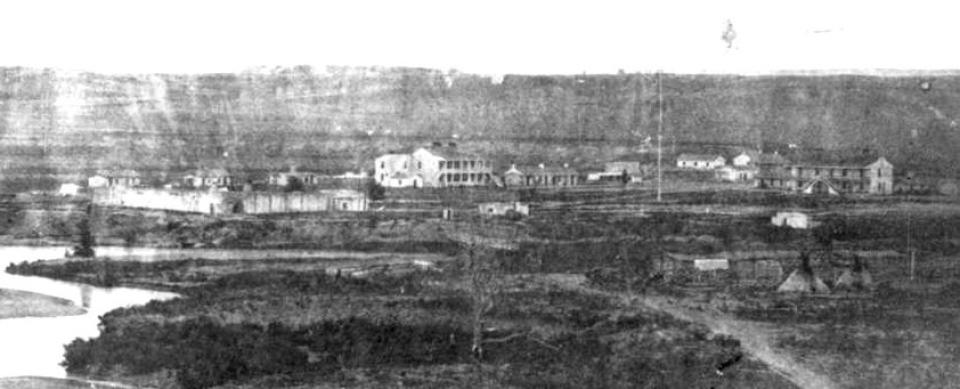
The post was situated just south of the Laramie River, immediately across from the fort itself and east of Deer Creek. Its presence in this location is confirmed by the earliest known photograph of Fort Laramie, taken in 1858, in which the Ward and Guerrier trading post is visible in the background beyond the parade grounds. This location placed the post within easy reach of the military post while remaining on the civilian side of the river, a positioning that reflected both the commercial logic of proximity to the fort’s soldiers and the regulatory distinction between military and civilian space.8
The post consisted of two wood buildings: a larger rectangular structure and a smaller square structure. Both were built with logs sunk vertically in post holes and sided with wood planking, and at least some of the interior walls of the larger building were plastered, a level of finish that went beyond bare utility. Archaeological investigation has established that the post was deliberately disassembled rather than destroyed or left to decay: no collapsed roofing or wall material was found, indicating that usable lumber, planking, and hardware were salvaged before the site was vacated. The larger building served as the combined storage house, trading house, and living quarters; the smaller functioned as the post’s blacksmith shop.9
Significance
Ward and Guerrier’s Fort Laramie Post is significant both as a material record of one of the most commercially successful trading enterprises in the Fort Laramie corridor and as a site whose archaeological investigation has contributed to the study of frontier commerce and craft industry. Its location within Fort Laramie National Historic Site ensures its long-term preservation and continued accessibility to future research, though it also places the post within a landscape of overlapping historic resources whose management requires balancing competing priorities.10
The post’s history encapsulates the commercial logic of the 1855–1863 period at Fort Laramie: the Harney-era consolidation that brought civilian traders under military supervision, the transformation of independent trading into licensed sutlership, and the gradual transition from the emigrant-era economy of the 1840s and 1850s to the military-supply economy of the 1860s. Ward and Guerrier were also, in a practical sense, among the founders of the Wyoming cattle industry: their practice of buying worn-out oxen and horses from westbound emigrants, fattening them over the winter on the open range, and reselling them at a profit established a pattern that later ranchers would follow on a much larger scale.11
Ward’s tenure as sutler extended from 1857 until the early 1870s, well beyond the formal life of the trading post itself. The 1860 census recorded his personal wealth at $10,000, exceptional for a civilian trader on the northern Plains and a measure of the cumulative profits of his decade of commercial activity in the region. He relocated to Nebraska City in 1863 but retained his trading license and commercial interests in the Fort Laramie territory until at least 1864. By 1871 he had relinquished the sutlership and returned to Westport, Missouri, where he invested his frontier wealth in real estate and lived as a prosperous civic figure until his death in 1903. The Ward and Guerrier Fort Laramie Post was where that career found its institutional anchor.12
Footnotes
-
Greg Pierce, Trading Posts in Wyoming, Multiple Property Documentation Form, National Register of Historic Places, Wyoming State Historic Preservation Office, State Parks and Cultural Resources, Cheyenne, Wyoming, 2012, Section E, 65–66.
-
Pierce, Trading Posts in Wyoming, Section E, 65–66; Lt. J. C. Kelton, plot of Fort Laramie, map in cartographic section, National Archives, Washington, D.C., cited in Pierce, Trading Posts in Wyoming, Section E, 65.
-
Merrill J. Mattes, “Seth E. Ward,” in The Mountain Men and the Fur Trade of the Far West, ed. LeRoy R. Hafen, vol. 4 (Glendale, California: Arthur H. Clark, 2000), 357–384; Pierce, Trading Posts in Wyoming, Section E, 65–66.
-
Colonel William Hoffman, letter of March 4, 1857, to Adjutant General, National Archives, Washington, D.C., cited in Pierce, Trading Posts in Wyoming, Section E, 65; Mattes, “Seth E. Ward,” 369–371; Dan L. Thrapp, “Guerrier, William,” in Encyclopedia of Frontier Biography, vol. 2 (Lincoln: University of Nebraska Press, 1988), 597; James H. Nottage, “A Frontier Census: Fort Laramie in 1860,” WyoHistory.org, January 9, 2023, https://www.wyohistory.org/encyclopedia/frontier-census-fort-laramie-1860.
-
Pierce, Trading Posts in Wyoming, Section E, 65; “Indian Agent Thomas Twiss, Man of Two Worlds,” WyoHistory.org, https://www.wyohistory.org/encyclopedia/indian-agent-thomas-twiss-man-two-worlds.
-
Seth Ward, letter of May 9, 1857, Ward to James W. Denver, Commissioner of Indian Affairs, Seth Ward Papers, 1838–1892, Western History Collection, Denver Public Library, Denver, Colorado; Mattes, “Seth E. Ward,” 371.
-
“Explosion Kills William Guerrier,” Goshen News and Fort Laramie Scout, September 1, 1927, 1; Mattes, “Seth E. Ward,” 371; Pierce, Trading Posts in Wyoming, Section E, 65–66; Nottage, “A Frontier Census,” WyoHistory.org.
-
Nottage, “A Frontier Census,” WyoHistory.org; K. Seger, Rocky Mountain Inventory of Archaeological Sites, 48GO16, submitted to the Wyoming State Historic Preservation Office, State Parks and Cultural Resources, Cheyenne, Wyoming, 1976; Pierce, Trading Posts in Wyoming, Section E, 66.
-
Wilfred M. Husted, Archaeological Test Excavations at Fort Laramie National Historic Site (on file, Fort Laramie National Historic Site, Fort Laramie, Wyoming, 1963), 27–29; Craig Cellar, Ward and Guerrier Report (on file, Fort Laramie National Historic Site, Fort Laramie, Wyoming, 1976), 2; Pierce, Trading Posts in Wyoming, Section E, 66; Section F, 79–80.
-
Pierce, Trading Posts in Wyoming, Section E, 65–66; Nottage, “A Frontier Census,” WyoHistory.org.
-
Mattes, “Seth E. Ward,” 357–384; Laura Woodworth-Ney, “The Wyoming Cattle Boom, 1868–1886,” WyoHistory.org, https://www.wyohistory.org/encyclopedia/wyoming-cattle-boom-1868-1886.
-
Nottage, “A Frontier Census,” WyoHistory.org; Mattes, “Seth E. Ward,” 371–384; John Loree, letters of November 5, 1863, and February 10, 1864, Records of the Upper Platte Agency, Record Group 75, National Archives, Washington, D.C., cited in Pierce, Trading Posts in Wyoming, Section E, 63; “Life of Seth Ward,” in A Memorial and Biographical Record of Kansas City and Jackson County, Missouri (Chicago: Lewis Publishing, 1896), 567–570.