Bordeaux’s Rawhide Buttes Post
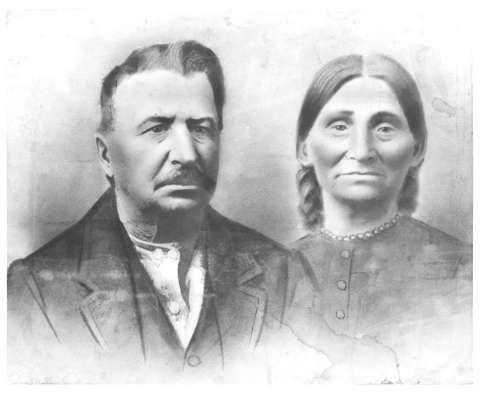
James Bordeaux entered the fur trade in 1826 at age twelve, gaining employment on an American Fur Company expedition on the Missouri River, and remained with the company in various capacities until the United States Army purchased Fort Laramie in 1849.1 After the sale, Bordeaux struck out as an independent trader, first occupying a wintering post he had built in 1846 on the White River near present-day Chadron, Nebraska, then constructing a second post on the North Platte, known as Bordeaux’s Sarpy’s Point Post, roughly eight miles below Fort Laramie.2,3 Bordeaux’s trade goods were among those seized by the Sioux following the 1854 Grattan Fight near Sarpy’s Point, but he continued trading in the North Platte region for more than a decade afterward.4
In 1862, James Bordeaux constructed a post at Rawhide Buttes, which was located 12 miles south of present-day Lusk, Wyoming.5 Bordeaux’s activities at the post were limited, as he only occupied the site for a year or two.6 The point at which he abandoned the post is unknown, although contemporary accounts mention the remains of a post at the site in 1864.7 During the period the Rawhide Buttes Post was in operation, 1862-1864, Bordeaux continued to operate at Sarpy’s Point and Bordeaux Creek, Nebraska. In 1867, while still operating out of Sarpy’s Point, Bordeaux built a store at the junction of newly constructed roads connecting Fort Laramie, Fort Fetterman and Fort D.A. Russell; he continued trading in the region until 1868.8
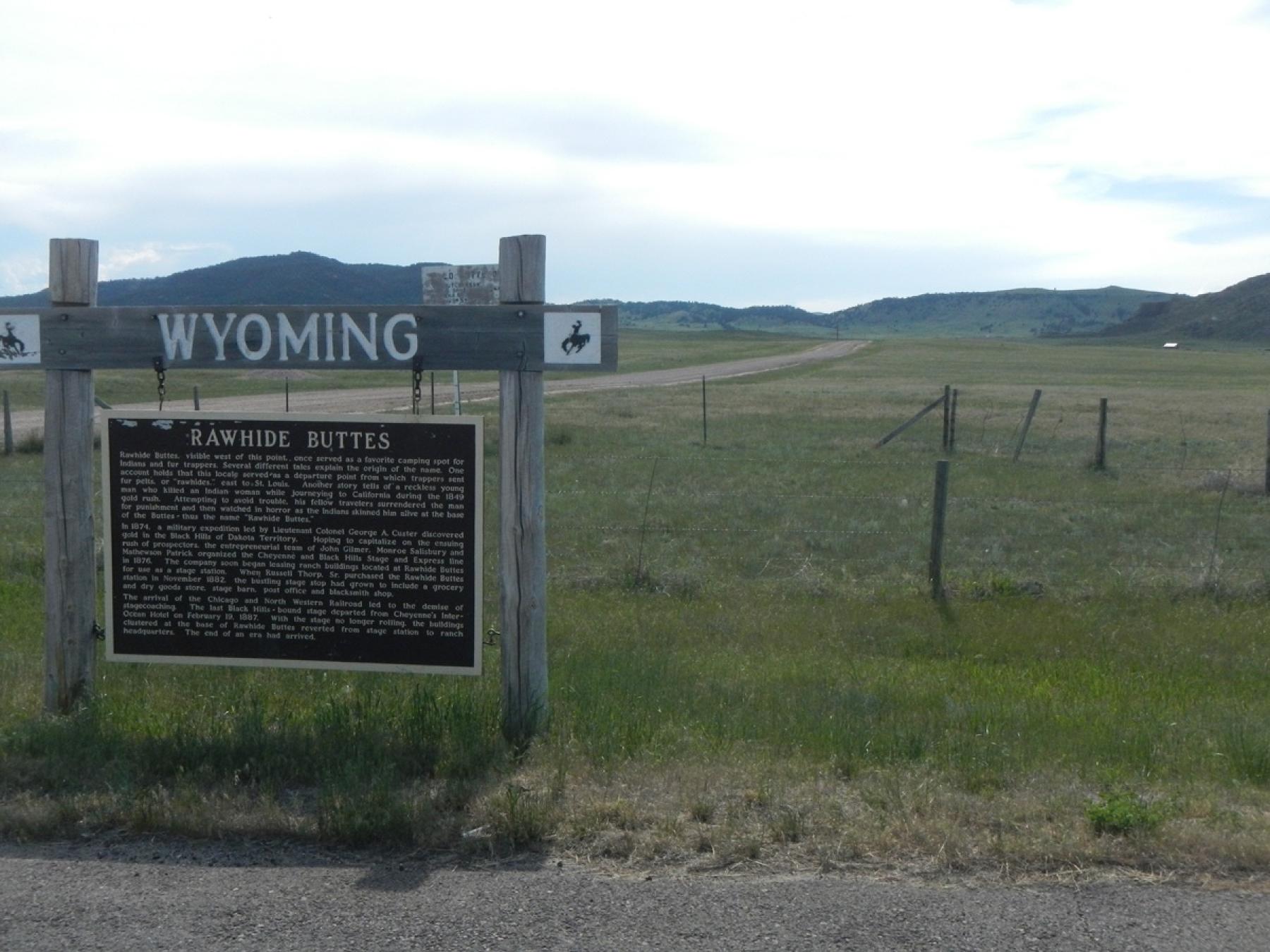
Rawhide Buttes remained a landmark and stopping point on the trail for more than a decade after Bordeaux abandoned his post there. Beginning in 1876, the Cheyenne and Black Hills Stage and Express Line, organized that year by John Gilmer, Monroe Salisbury and Mathewson Patrick to serve travelers to the Black Hills gold rush, leased ranch buildings at the buttes for use as a stage station. Russell Thorp Sr. purchased the station in November 1882, by which time it had grown to include a store, stage barn, post office and blacksmith shop. The station closed after the last Cheyenne-to-Deadwood stage departed on February 19, 1887, and the buildings reverted to ranch use.9
Today the site sits on private land in Goshen County, Wyoming. There have been no archaeological investigations of the post. There is little known about the post design, layout, or the trading activities.10 Additional historic and archaeological research is needed to provide a better understanding of the historical activities at this location.
Footnotes
-
John D. McDermott, “James Bordeaux,” The Mountain Men and the Fur Trade of the Far West, Vol. V, edited by LeRoy R. Hafen (Glendale, CA: Arthur H. Clark, 2002), 65–66.
-
Virginia Cole Trenholm, “The Bordeaux Story,” Annals of Wyoming 26, no. 2 (1954): 121.
-
Charles E. Hanson Jr. and Sue Walters, “The Early Fur Trade in Northwestern Nebraska,” Nebraska History 53 (1976): 305; Charles E. Hanson Jr., “James Bordeaux,” Museum of the Fur Trade Quarterly 2 (Spring 1966): 6.
-
Hanson, “James Bordeaux,” 7–8.
-
R.G. Robertson, Competitive Struggle: America’s Western Fur Trading Posts 1764-1865 (Boise, ID: Tamarack Books, Inc., 1999), 80.
-
McDermott, “James Bordeaux,” 75.
-
Hanson, “James Bordeaux,” 8.
-
Greg Pierce, Trading Posts in Wyoming, Multiple Property Documentation Form, National Register of Historic Places, Wyoming State Historic Preservation Office, State Parks and Cultural Resources, Cheyenne, Wyoming, 2012, Section E, 57.
-
“Rawhide Buttes,” historical marker erected by the Wyoming State Historic Preservation Office, The Historical Marker Database, accessed September 3, 2026, https://www.hmdb.org/m.asp?m=98304.
-
Pierce, Trading Posts in Wyoming, Section E, 75