The Yarn Behind Let ’Er Buck
By Leslie Waggener
As University of Wyoming football fans take up the old rallying cry “Powder River, Let 'er Buck” this season, it’s worth revisiting where the phrase supposedly came from—a story that’s been told and retold for nearly a century. By World War I, the cry had spread widely, sounded by western outfits serving on French soil, and soldiers carried it home when the war ended.
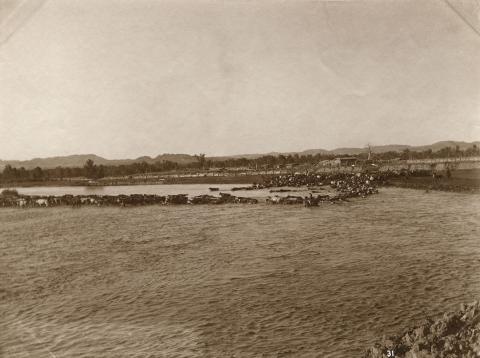
The most detailed account comes from Edward J. Farlow, a former mayor of Lander, who set down his version in the January 1939 issue of Wyoming Annals (predecessor to today’s Annals of Wyoming). Farlow wrote that he was prompted to do so after an “eastern publication” questioned the phrase’s Wyoming origins, and that he turned to old issues of the Cheyenne Leader to back up his account.
Farlow recalled a fall 1893 cattle drive, when he served as trail boss driving 1,600 head from the Lander area to the railroad at Casper. None of his crew had ever seen the Powder River, and they were all excited at the prospect. Among them was a cowhand he called “Missouri Bill,” identified as William Shultz, who worked for the L outfit in the Wind River Basin country. Once they were close to the Powder, Farlow told the men to prepare by saddling their “swimming horses,” warning they’d cross the river several times before nightfall. Bill grumbled that his horse “couldn’t even wade a river.”
But the storied Powder River turned out to be little more than a trickle when they reached it, its water “standing in holes and barely running from one hole to the other.”
That anticlimax became the seed of a saloon story. In Casper, once the herd was loaded for shipping, Bill bought round after round, boasting with escalating flourish that he’s crossed, then swum, then survived the rising floodwaters of the Powder River—firing his revolver into the ceiling and hollering what Farlow remembered as the first utterance of “Powder River, let 'er buck.”
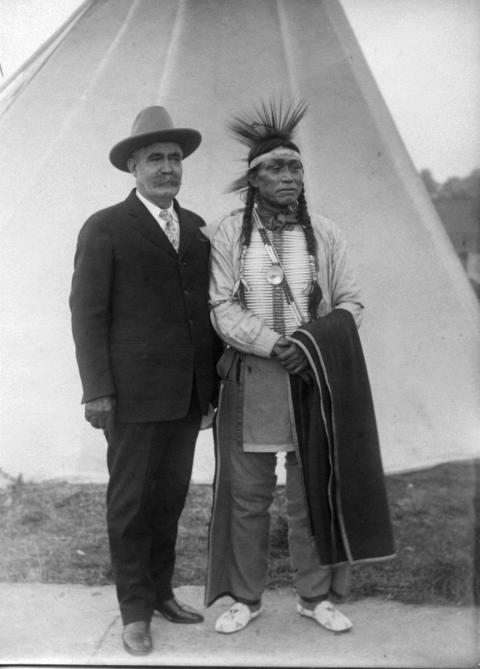
Best to give a word of caution before you retell this one at a tailgate: Farlow was no stranger to a good show, having spent decades as a producer of Wild West performances and a Hollywood talent scout, and his account was set down more than four decades after the events it describes. Wyoming lore, too, includes more than one man who went by “Missouri Bill.” Take it as a good campfire story more than settled history—though a great yarn never hurt a rallying cry.
Figure 2: Ed Farlow, left, with Jack Shavehead, an Arapaho, in London, 1923, during a six-month tour with Tim McCoy staging Arapaho performances ahead of screenings of The Covered Wagon. Lander Pioneer Museum.