Fraeb’s Post
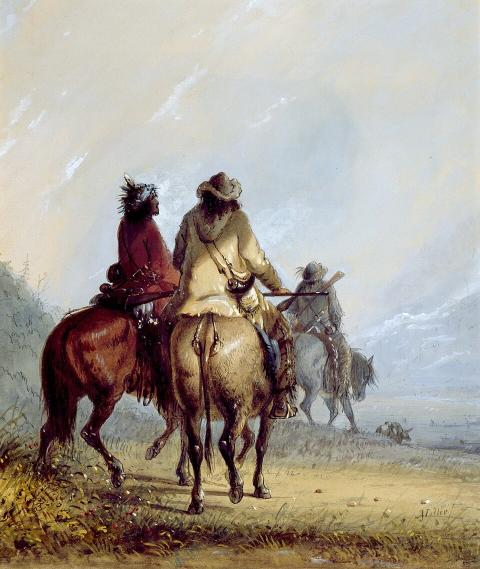
“Fraeb’s Post” is the name applied in Wyoming historical records to a reported trading post in the Little Snake River Valley of present-day Carbon County, Wyoming, associated with fur trader Henry Fraeb. Whether a permanent trading post ever existed at this location has been a matter of scholarly debate. What is not in dispute is that Fraeb, a veteran mountain man and one-time partner of Jim Bridger, died in a battle with Sioux, Cheyenne, and Arapaho warriors near the Little Snake River in August 1841, and that some form of temporary structure was associated with that event. The nature of that structure, however, and its relationship to a permanent trading post, remain unresolved questions in Wyoming fur trade history.1
Henry Fraeb and His Career in the Rocky Mountain Fur Trade
Henry Fraeb, known to some contemporaries as “Frapp,” was a German-born fur trader from St. Louis whose birth year is unknown. His documented career in the Rocky Mountains began in 1829, by which time he was already a veteran trapper. Between 1830 and 1834 he was one of five partners who managed the Rocky Mountain Fur Company after purchasing it from Jedediah Smith, David Jackson, and William Sublette; his partners in the enterprise were Thomas Fitzpatrick, Jim Bridger, Milton Sublette, and Jean Baptiste Gervais. Fraeb attended the annual rendezvous throughout this period and trapped the regions of what would become Wyoming, Colorado, Idaho, and Utah.2
After the Rocky Mountain Fur Company dissolved at the Ham’s Fork rendezvous in 1834, Fraeb continued as an independent trader. By the summer of 1837, he and Peter Sarpy had secured backing from the St. Louis firm of Pratte, Chouteau and Company to build and operate Fort Jackson, an adobe stockade trading post on the South Platte River in present-day eastern Colorado. Fort Jackson was established near the wintering grounds of the Cheyenne and Arapaho, and was one of four posts—together with Fort Lupton, Fort Vasquez, and Fort St. Vrain—operating simultaneously along a thirteen-mile stretch of the South Platte during the late 1830s.3
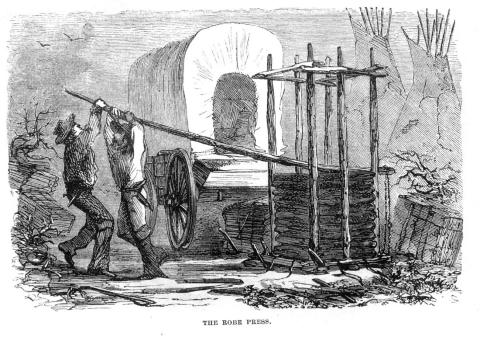
This unusual concentration was driven by the productivity of the Cheyenne and Arapaho bison robe trade in the region, and these posts dealt almost exclusively in robes rather than beaver pelts. Fraeb and Sarpy arrived with more than $10,900 worth of trade goods, and during the 1837–38 season Fort Jackson took in nearly 2,900 bison robes.4 During this period Fraeb worked the post while Sarpy ranged the field, traveling as far north as the North Platte, where he established the short-lived seasonal outpost known as Fort Sarpy during the 1837–38 season.5
Despite Fort Jackson’s productivity, its run was brief. Financial pressures including those brought on by the Panic of 1837 contributed to its closure, and Fraeb and Sarpy transferred the post to William Bent and Ceran St. Vrain in October 1838, after which the structure was demolished.6 After returning to St. Louis, Fraeb partnered once more with Bridger, and the two men headed west together in the spring of 1840 to attend what proved to be the last Rocky Mountain Rendezvous, held that year on the Green River. In midsummer 1841, they began construction of a new trading post on the Green River between the mouths of Big Sandy Creek and Black’s Fork. The post was never finished. Fraeb was killed that August before the buildings were completed, and it is unknown whether the post was ever occupied. It should not be confused with the trading post of the same name that Bridger built two years later, in 1843, with new partner Louis Vasquez, at a site roughly fifty miles to the southwest.7
The Battle of Little Snake River, August 1841
After leaving the Green River, Fraeb’s party encountered a group of Sioux, Cheyenne, and Arapaho in northern Colorado and traded whiskey for meat. When the tribesmen sobered up and realized they had surrendered most of their provisions, tensions escalated. The allied tribes moved north into Wyoming, attacking a Shoshone village associated with Fraeb’s camp and stealing more than 100 horses.9 Word reached Bridger on the Green River, and he dispatched trapper Jim Baker to warn Fraeb.8 Baker arrived at Fraeb’s camp on the Little Snake River at roughly the same time as another of Fraeb’s men came south with the same warning.
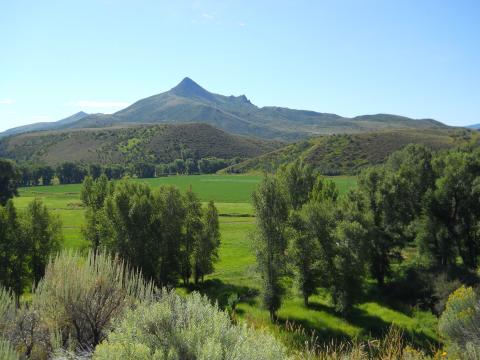
On August 20, 1841, Fraeb’s party moved up the Little Snake River to the base of what became known as Battle Mountain, near the confluence of Battle Creek, where they built a temporary fortification—described in historical accounts as a rudimentary fort or corral—to protect themselves and their horses. On the morning of August 21, the warriors charged the fortification more than forty times during the course of the day, killing Fraeb, several other trappers and Shoshone allies, and more than 100 horses. The trappers held off the attack until nightfall. Low on powder and lead, they buried their dead, cached their supplies, and departed for Bridger’s post on the Green River, arriving on August 27.10
The Question of a Permanent Trading Post
Wyoming and Colorado state records both assign site designations to a “Bridger and Fraeb trading post” said to have operated from approximately 1839 to 1841 in the extreme southern part of Carbon County, near the confluence of Battle Creek with the Little Snake River. The label derives from historic trail maps compiled in the early 1970s from local traditions and oral histories.11
Historians and researchers have questioned whether a permanent post ever existed here. A permanent establishment in this mountain country in the late 1830s or early 1840s would have been economically out of step with the times: the beaver trade had collapsed, and posts throughout the region were relocating to major waterways and emigrant trails. Moreover, tracking Fraeb’s movements reveals no period before July 1841, a month before his death, during which he was active in this area.12
In 2011, archaeologists conducted field investigations in the Little Snake River Valley to locate the battlefield and any possible post remains. Their conclusion, published in Plains Anthropologist in 2015, was that what historical sources describe as a “fort” near the battlefield was most likely the temporary defensive fortification Fraeb’s men built immediately before the August 21 battle, rather than a permanent commercial establishment. To date, that question remains open.
[Editor’s Note: Special thanks to the author and to the Wyoming State Historic Preservation Office for making this article available, and to the Wyoming Cultural Trust Fund for its ongoing support for this project. Greg Pierce’s historical monograph, Negotiating the West: A History of Wyoming Trading Posts, from which this article is adapted and excerpted, is one of many historic contexts published by the Wyoming State Historic Preservation Office. These documents are meant to offer a broad background against which historic developments can be better understood as the agency works to preserve properties and places important to an understanding of Wyoming’s past. The contexts also, however, are based on sound research and are full of well-told, vivid stories. With this in mind, WyoHistory.org is collaborating with the SHPO office to bring more of this history to a wider readership. The Cultural Trust has provided the funds to make this collaboration possible. We offer our thanks to all.]
Footnotes
-
Greg Pierce, Trading Posts in Wyoming, Multiple Property Documentation Form, National Register of Historic Places, Wyoming State Historic Preservation Office, State Parks and Cultural Resources, Cheyenne, Wyoming, 2012, Section E, 51–52; Greg Pierce and Mark E. Miller, “In Search of the Fraeb Battlefield and Trading Post, August 1841,” Plains Anthropologist 60, no. 235 (2015): 223.
-
Pierce and Miller, “In Search of the Fraeb Battlefield,” 225–226; LeRoy R. Hafen, “Henry Fraeb,” in Mountain Men and the Fur Trade of the Far West, vol. 3, ed. LeRoy R. Hafen (Glendale, California: Arthur H. Clark Company, 1966), 131–139.
-
Cody Newton, “Native Place, Environment, and the Trade Fort Concentration on the South Platte River, 1835–45,” Ethnohistory 59, no. 2 (2012): 239–260; Cody Newton, “Fort Jackson,” Colorado Encyclopedia, https://coloradoencyclopedia.org/article/fort-jackson.
-
Ibid.
-
Pierce, Trading Posts in Wyoming, Section E, 47; LeRoy R. Hafen, “Fort Jackson and the Early Fur Trade on the Southern Platte,” Colorado Magazine 5 (1928): 9–17.
-
Newton, “Fort Jackson;” Pierce and Miller, “In Search of the Fraeb Battlefield,” 227.
-
Pierce and Miller, “In Search of the Fraeb Battlefield,” 226–227; Fred R. Gowans and Eugene E. Campbell, Fort Bridger: Island in the Wilderness (Provo, Utah: Brigham Young University Press, 1975), 10; Hunt Janin, Fort Bridger, Wyoming: Trading Post for Indians, Mountain Men, and Westward Migrants (Jefferson, NC: McFarland Press, 2001), 58.
-
Pierce and Miller, “In Search of the Fraeb Battlefield,” 227–228.
-
Ibid., 228.
-
Ibid., 228–229.
-
Pierce, Trading Posts in Wyoming, Section E, 51; Pierce and Miller, “In Search of the Fraeb Battlefield,” 224.
-
Pierce, Trading Posts in Wyoming, Section E, 51–52; Pierce and Miller, “In Search of the Fraeb Battlefield,” 224; Dorothy O. Johansen, Robert Newell’s Memorandia (Portland: 1959), 39.
-
Pierce and Miller, “In Search of the Fraeb Battlefield,” 229–230, 244.