Fort Bridger
Noted frontiersman Jim Bridger and his partner, Louis Vasquez, established Fort Bridger in 1843 to service emigrant traffic. For the next century, the area—known as the Bridger Valley—served as a crossroads for the Oregon/California Trail, the Mormon Trail, the Pony Express Route, the Transcontinental Railroad and the Lincoln Highway. Today, the valley in southwestern Wyoming is a historic byway, incorporating the small towns of Fort Bridger, Urie, Mountain View and Lyman, which were bypassed when Interstate 80 was built.
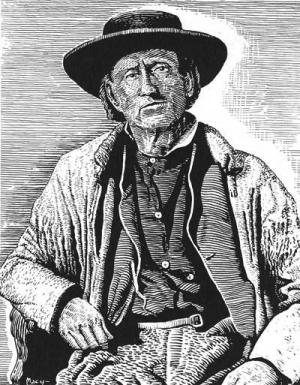
Bridger was already one of the most experienced travelers and traders in the Rocky Mountain West by the time he turned his attention to the Green River Valley. Born in 1804, he entered the fur trade in 1822 and spent the next two decades trapping across the Rockies, eventually becoming a partner in the Rocky Mountain Fur Company, which held a partial interest in Fort William on the Laramie River from 1835 to 1836. His long familiarity with the Eastern Shoshone—Bridger married into the tribe and counted Chief Washakie among his lifelong friends and family—gave him both knowledge of and access to the Green River Valley’s resources and relationships.
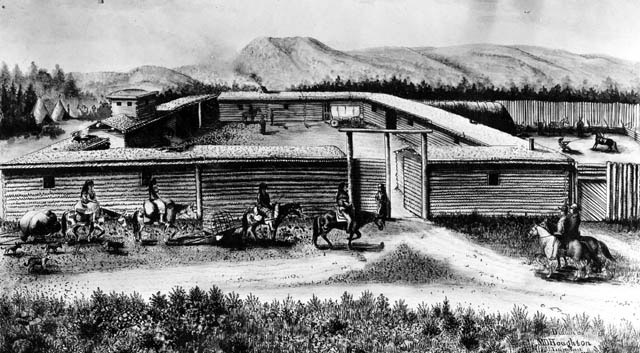
The most notable historic resource in the Bridger Valley remains old Fort Bridger, now operated as a state historic site. Bridger and Vasquez established the fort on the Blacks Fork of the Green River and planned to trade both with the American Indians they had befriended during their years in the fur trade and the westward-bound emigrants. Bridger himself described the new post’s purpose in a December 1843 letter to Pierre Chouteau Jr., writing that he had established “a small fort, with a blacksmith shop and a supply of iron in the road of emigrants on Black Fork of Green River, which promises fairly.” Their first "fort" consisted of two rude double-log houses about 40 feet in length, joined with a pen for horses. They also boasted a blacksmith's shop, something that many emigrants welcomed after months on the trails.
But, for those emigrants who had long looked forward to their arrival at Fort Bridger, the post often turned out to be a disappointment. It was not nearly as well outfitted as the seemingly luxurious Fort Laramie on the eastern Wyoming plains. Fort Bridger turned out to be little more than a crude collection of rough-hewn log buildings. Emigrant Edwin Bryant said of the fort: "The buildings are two or three miserable cabins, rudely constructed and bearing but a faint resemblance to habitable houses.”
By 1847, travelers described two adjoining log cabins, each roughly forty feet long, arranged in an L shape and joined by a log picket eight to ten feet high. In the fall of 1847 or spring of 1848, Bridger and Vasquez added six new buildings, along with a corral for horse trading and additional storage space. Mormon reports from the period placed the overall post at approximately eighty feet square, and this configuration appears to have remained largely unchanged until Bridger relinquished control of the post in 1853.
In addition to outfitting emigrants, the post maintained a buffalo robe and hide trade with the Eastern Shoshone, Ute and other tribes whose homelands included the Green River Valley, and served as a seasonal gathering place for trappers, traders and Native families connected to Bridger and Vasquez through marriage. Archaeological investigations have recovered lithic materials at the site consistent with Eastern Shoshone manufacture, corroborating the presence of Native lodges around the post recorded in nearly every emigrant account. Chief Washakie and Bridger remained lifelong friends, and Washakie later signed both the Fort Bridger Treaty of 1863 and the Fort Bridger Treaty of 1868 at the post.
The Mormon Pioneer Company arrived at the fort on July 7, 1847. They spent a day there, but found all the prices very inflated. When a small group of Mormons settled nearby, tensions began to mount between Bridger and the new settlers. The settlers reported that Bridger was selling liquor and ammunition to the Indians, in violation of federal law.
Tensions escalated further in 1853 when Bridger and other free traders, having already lost much of their emigrant business to Salt Lake City merchants and facing new territorial taxation on their operations, forcibly retook control of the Green River ferries from Mormon operators. Brigham Young, president of the Church of Jesus Christ of Latter-day Saints, and a federal Indian agent, responded by sending the Mormon militia to the fort in 1853. Bridger learned they were coming and fled before the Mormons arrived. Later that year, the Mormons established Fort Supply about twelve miles south of Fort Bridger, specifically to service the Mormon emigrants. Whether the Mormon party burned the post during this 1853 episode, as Bridger later alleged, remains disputed; the posse’s own inventories suggest they did not, though Bridger maintained otherwise for the rest of his life.
Bridger complained to Gen. Benjamin F. Butler, a U.S. senator, claiming the Mormons had robbed him of over $100,000 in goods and supplies and threatened him with death. The next spring, Young sent a detachment of well-armed Mormons to take control of both Fort Bridger and the Green River ferries, both of which became integral parts of the Mormon settlement plans for the region. The Mormons built a large stone wall around the fort. Once purchased, the post was rebuilt as a stone structure fourteen feet high and one hundred feet square, with picketed walls, bastions at the diagonal corners and a fifty-two-foot-square corral outside the walls.
The Mormons controlled the fort for a year, until July 1855, when Bridger returned. They asked him to sell but, seeing the new improvements, Bridger balked. After several months, he finally agreed. But the tensions for the Mormons were far from over. The fort again became embroiled in controversy in the fall of 1857 when President Buchanan sent U.S. Troops to Utah Territory to enforce federal authority and to install federally appointed territorial officers. The move became known as the Utah War, and followed years of tension between the Mormons and the federal government over questions of sovereignty, polygamy, land rights, water rights and the authority of courts.
The U.S. Army, under the command of Col. Albert Sidney Johnston, planned to use Fort Bridger as a base of operations for the march into Utah. But, before they could seize the fort, Mormon militia under “Wild Bill” Hickman and his brother burned it. The fort’s cobblestone wall, built during the Mormon reconstruction, survived the fire even as the wooden structures within it burned; Johnston’s troops found only smoldering ruins inside its walls when they arrived. As a result, Johnston’s army spent a miserable winter with little shelter and food.
That winter the Army established the temporary Camp Scott a mile or two to the south of the burnt fort, and in the spring of 1858, tension between the Mormons and the U.S. military subsided. The Army took over and rebuilt Fort Bridger to as a base for troops whose later jobs included protecting laborers on the transcontinental railroad, gold miners at South Pass and Shoshone Indians near the fort and later after their reservation was established on Wind River.
When the Utah War ended, the U.S. government refused to honor either Bridger's or the Mormons' claim to the property and instead turned the commercial parts of its operation over to William Alexander Carter, who had come west with Johnston's army as a sutler. Along with his family, Carter lived at the fort, rebuilding and stocking it and eventually becoming Wyoming's first millionaire.
Various volunteer units of the U.S. Army were stationed at the post during the Civil War. Beginning in 1866, the post was manned by regular units of the U.S. Army until 1878, when it was temporarily abandoned. The Army again occupied it from 1880 to 1890, when, with the end of the Indian Wars the Army closed it for a final time. Many of its buildings were sold and dismantled.
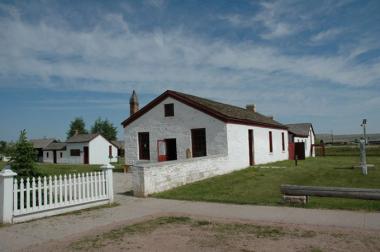
The 38-acre site was named a Wyoming Historical Landmark and Museum in 1933. Parts of the stone wall constructed by the Mormons in the 1850s have recently been the subject of archaeological explorations at Fort Bridger. Several historic buildings, which have been restored, remain at the fort, as well as a reconstructed trading post, an interpretive archaeological site and a museum housing artifacts from the different periods of Fort Bridger’s use.
Fort Bridger holds a distinct place in Wyoming’s trading-post history as the first post in the state built expressly to serve emigrant traffic rather than the beaver-pelt fur trade, and its position at the point where the Oregon, California and Mormon trails converged gave it a commercial importance in the region second only to Fort Laramie. The post’s passage from independent trading post to Mormon-controlled way station to U.S. military garrison also traces, in miniature, the broader struggle between federal authority and Mormon territorial governance that produced the Utah War.
[Editorial Note: This article has been updated in August 2026 with new research and with resources from Greg Pierce’s Negotiating the West: A History of Wyoming’s Trading Posts.]
Resources
Primary Sources
- Bryant, Edwin. What I Saw in California: Being the Journal of a Tour by the Emigrant Route and South Pass of the Rocky Mountains, across the Continent of North America, the Great Basin, and through California, in the Years 1846, 1847. New York, N.Y: D. Appleton & Co., 1848. Reprinted Palo Alto, Calif: Lewis Osborne, 1967. Kristin Johnson transcription.
- Carter, Edgar N. “Fort Bridger Days.” The Westerners Brand Book 1947. Los Angeles: Los Angeles Corral of Westerners International, 1947, 83–88.
- Carter, William A. Letterbook of W. A. Carter, Fort Bridger, Wyoming, 1860–1861. 17B-4-5, Columbia, Mo.: Missouri Historical Society.
- Fillmore, L. [Lemuel]. Diary, 1858. Special correspondent for the New York Herald for Kansas and the Utah War, 1858. Typescript, American Heritage Center. Copy in OCTA Manuscripts, Mattes Library. See also, [Lemuel Fillmore], Fort Laramie, 18 May 1858 and 19 to 29 May. In Gove, The Utah Expedition . . . and Special Correspondence of the New York Herald, 226–38; 249–60.
- Finlay, William Porter. “The Army for Utah.” Dispatches, July to September 1857, in Saint Louis Leader, 5 October, page 4, columns 3-4; 7 October, 4/3-4; 8 October, 4/2-3; and 27 October 1857, 2/2-3. Reprinted in MacKinnon, ed., At Sword’s Point: A Documentary History of the Utah War to 1858.
- Ferguson, Samuel Wragg. “With Albert Sidney Johnston’s Expedition to Utah, 1857.” Collections of the Kansas State Historical Society, 1911-12, 12, 303–12.
- Gove, Capt. Jesse A. The Utah Expedition, 1857–1858: Letters of Capt. Jesse A. Gove, 10th Inf., U.S.A., of Concord, N.H., to Mrs. Gove, and Special Correspondence of the New York Herald. Ed. by Otis G. Hammond. Concord, NH: New Hampshire Historical Society, 1928.
- Gove, Jesse Augustus. “March of the Utah Expedition from Fort Bridger to Fort Leavenworth, 1861.” WA MSS 226, Beinecke Rare Book and Manuscript Library, Yale University, Green Haven, Conn.
Secondary Sources
- Fifer, Barbara and Fred Pflughoft and David Morris, photographers. Wyoming’s Historic Forts. Helena, Mont.: Farcountry Press, 2002.
- Fort Bridger Historical Association. “Fort Bridger,” accessed 9/14/11 at http://www.forttours.com/pages/fortbridger.asp.
- Janin, Hunt. Fort Bridger, Wyoming: Trading Post for Indians, Mountain Men and Westward Migrants, Jefferson, N.C.: McFarland and Company, 2007.
- Moulton, Candy. Roadside History of Wyoming. Missoula, Mont.: Mountain Press Publishing, 1995, 286-288.
- Wyomingheritage.org “Fort Bridger,” accessed 5/8/12 at http://www.wyomingheritage.org/fortBridger.html.
- Wyoming Tales and Trails. “Fort Bridger Photos.” Accessed Sept. 14, 2011, at http://www.wyomingtalesandtrails.com/bridger.html.
- Wyoming State Parks and Cultural Resources. "Fort Bridger." Accessed August 21, 2013, at http://wyoparks.state.wy.us/Site/SiteInfo.aspx?siteID=17.
- Wyoming State Parks and Cultural Resources. "Fort Bridger Historic Site" brochure, with site map plus information on fort history, public events etc.accessed August 21, 2013 at http://wyoparks.state.wy.us/pdf/ft_bridger.pdf.
-
Gardner, A. Dudley. “Fort Bridger and the Native Americans.” Paper presented at the International Society for Historical Archaeology, Kansas City, Missouri, January 1993.
-
Gardner, A. Dudley. “Fort Bridger and Environmental Change From 1843 to 1890.” Paper presented at the International Society for Historical Archaeology, Vancouver, British Columbia, January 1994.
-
Gardner, A. Dudley, David E. Johnson, and Martin Lammers. “Test Excavations along the Mormon Corral Wall: Fort Bridger Wyoming.” The Wyoming Archaeologist 55, no. 2 (2011): 11–40.
-
Gardner, A. Dudley, and Martin Lammers. “Lithic Materials and Fort Bridger.” The Wyoming Archaeologist 45, no. 1 (2001): 43–51.
-
Gowans, Fred R., and Eugene E. Campbell. Fort Bridger, Island in the Wilderness. Provo, Utah: Brigham Young University Press, 1975.
-
Gowans, Fred R., and Eugene E. Campbell. Fort Supply: Brigham Young’s Green River Experiment. Provo, Utah: Brigham Young University Press, 1976.
-
Ismert, Cornelius M. “James Bridger.” In The Mountain Men and the Fur Trade of the Far West, edited by LeRoy R. Hafen, vol. 6, 85–92. Glendale, Calif.: Arthur H. Clark, 2002.
-
Pierce, Greg. Trading Posts in Wyoming. Multiple Property Documentation Form, National Register of Historic Places, Wyoming State Historic Preservation Office, State Parks and Cultural Resources, Cheyenne, Wyoming, 2012.
-
Stamm, Henry E., IV. “Chief Washakie of the Shoshone: A Photographic Essay.” History Jackson Hole. https://jacksonholehistory.org/learn/archives-research/chief-washakie-of-the-shoshone-a-photographic-essay-by-henry-e-stamm-iv-ph-d/.
Illustrations
- The early drawing of Fort Bridger is from the Wyoming State Museum. Used with thanks.
- The drawing of Jim Bridger, after a photo, is from the National Park Service.
- The photo of Fort Bridger is from Wikipedia.
- In the photo gallery, the picture of the entrance sign at Fort Bridger is by Wyoming State Parks and Historic Sites. Used with thanks. The four photos of buildings at Fort Bridger are by Tom Rea.