Fort Sarpy
Fort Sarpy was a short-lived trading outpost established in 1837 near the confluence of the Laramie and North Platte rivers in present-day Goshen County, Wyoming. Constructed by Pierre Sylvestre Grégoire Sarpy as a seasonal extension of a broader American Fur Company trading operation, it functioned for only a single trading season before being abandoned. To date, its exact location has not been determined, no archaeological investigations have been conducted at the site, and only two primary historical documents make reference to the post. Fort Sarpy has been, by nearly every measure, all but lost to history.1
Background: The American Fur Company’s Platte River Push
Fort Sarpy’s origins lie in the intensely competitive fur trade arena of the mid-1830s. After John Jacob Astor sold his interest in the American Fur Company in 1834, the St. Louis firm of Pratte, Chouteau, and Company purchased the western division and became the dominant force in the Rocky Mountain fur trade, establishing a strong network of posts throughout the West. In 1836, now operating under the American Fur Company name, the firm decided to expand aggressively into the Platte River region.2
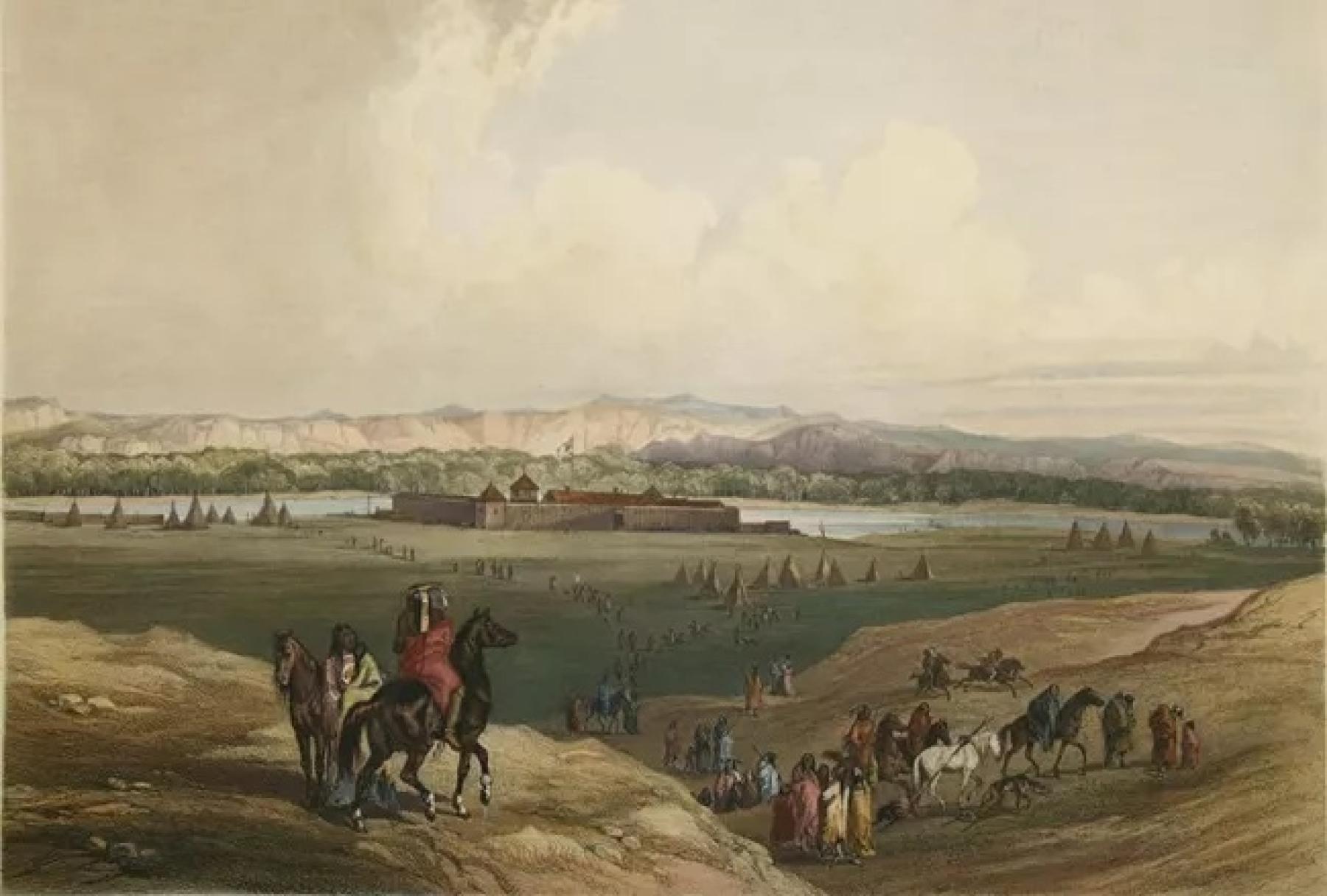
They employed Pierre Sarpy and Henry Fraeb as their agents to advance this cause. Sarpy and Fraeb established Fort Jackson on the South Platte in late 1836 or early 1837, in an area that already held Fort Lupton, Fort Vasquez, and Fort St. Vrain. All were within twenty miles of one another, making for fierce competition.3 These posts dealt almost exclusively in bison robes produced by Cheyenne and Arapaho hunters who wintered in the region, and their close proximity reflected the exceptional productivity of the local robe trade rather than poor planning. Fraeb and Sarpy arrived at Fort Jackson with more than $10,900 worth of trade goods, and during the 1837–38 season alone the post took in nearly 2,900 bison robes.4
Construction and Operation
During the 1837–1838 trading season, Fraeb remained at Fort Jackson to oversee operations while Sarpy traveled north to the North Fork of the Platte River—the Fort William area—where he established a small outpost from which to conduct trading for the season.5 This outpost, Fort Sarpy, is known from a contemporary letter by John A. Hamilton placing Sarpy eight miles from B. Woods, who was the Fort William post trader in 1837.6 Hamilton’s letter to Chouteau was largely pessimistic about the season, warning that robes would be very scarce for years to come and describing prospects for the Upper Missouri trade as miserable. It does note that Woods, at Fort William, had run out of goods and that Native Americans in his area were instead going to Sarpy, though Hamilton drew no explicit conclusion about what this meant for Sarpy’s own trade.7 Hamilton’s own role at the firm is not stated in the letter, but its content suggests he was a St. Louis–based correspondent handling accounts and relaying field reports for Chouteau, rather than a trader stationed at a post himself: he writes of using “your surplus funds” at his discretion, and passes along trade news gathered from correspondents across the region.
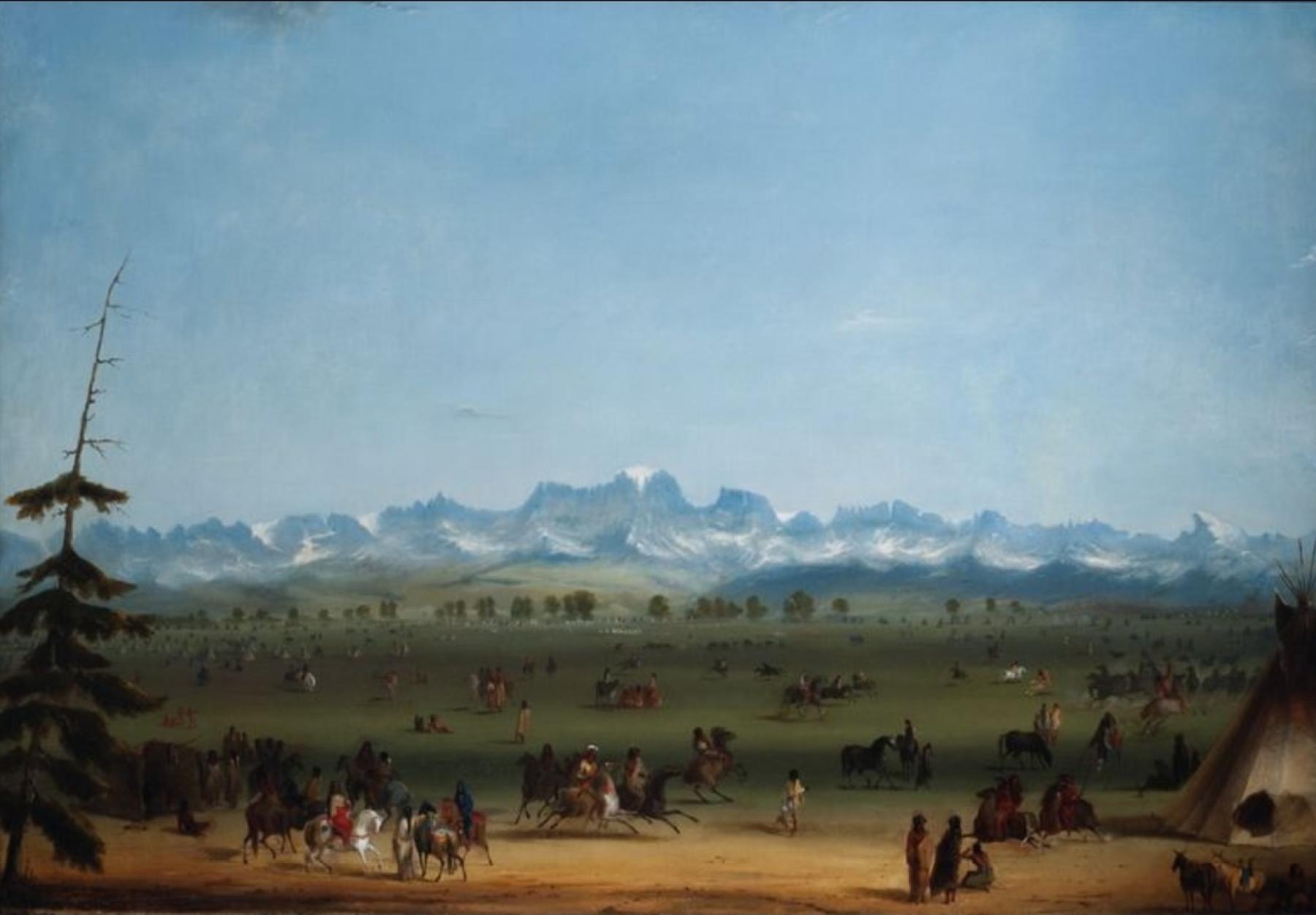
Beyond its general location and brief operational record, almost nothing is known about Fort Sarpy. There are no references in the historical record to its size, construction materials, layout, or physical character. All indications are that it was not a permanent post in its own right, but rather a seasonal trading outpost operating as a temporary extension of Fort Jackson.8
One document does offer a glimpse inside the post, though only near the very end of its life. Writing from Fort Sarpy to Pierre Chouteau’s Upper Missouri agent Joseph Picotte on September 27, 1838, trader Louis Howard reported the store almost empty of merchandise: no blankets and no tobacco, only broadcloth, scarlet cloth, and a few other small articles, along with six hundred sixty robes on hand, which he described as very poor quality. Oglala and Shawnee bands wintering nearby told Howard the post was poorly situated and urged that operations move to the nearby post built by Lucien Fontenelle, where there was more grass for horses. Howard also reported fearing that the rival firm of Vasquez & Sublette intended to seize Fontenelle’s post for its own use and had already stationed five hired men there to forestall that.9
Abandonment
Fort Sarpy’s abandonment was tied directly to events further south. Chouteau had grown uneasy about future fur trading prospects in the Missouri and Platte region and was moving his interests elsewhere. Fort Jackson was sold to George Bent and Ceran St. Vrain in October 1838, an event that ended Sarpy’s partnership with Fraeb. Financial pressures, including those brought on by the Panic of 1837, had contributed to Fort Jackson’s closure and, following the transfer, the structure was demolished.10 The sale also effectively rendered the North Platte outpost unnecessary: the American Fur Company had recently purchased Fort William, giving it a permanent presence at the Laramie–Platte confluence and making the small, seasonal Fort Sarpy redundant. There is no indication Chouteau or any of his agents ever reoccupied the post.11 Howard’s September 1838 letter suggests this shift was already under discussion on the ground, independent of the Fort Jackson sale: he had asked Picotte whether Fort Sarpy should be given up altogether in favor of Fontenelle’s post before Picotte’s own arrival.12
After the sale of Fort Jackson, Sarpy returned his attention to his trading business at Fort Bellevue on the Missouri River, where he operated for the next twenty years.13 Fraeb, meanwhile, returned to St. Louis before heading west again with Jim Bridger in the spring of 1840, the two men forming a partnership that led to the construction of a new trading post on the Green River in the summer of 1841, a venture cut short when Fraeb was killed in a battle with Sioux, Cheyenne, and Arapaho warriors in August of that year near the Little Snake River.14
The circumstances surrounding Fort Sarpy’s abandonment reflect a broader economic transformation underway across Wyoming’s fur trade by the late 1830s. Trading posts in the region were rapidly relocating to major waterways and emigrant trail systems to capture the burgeoning bison robe trade and the growing traffic of overland emigrants. The construction of an outpost well away from those developing routes, as Fort Sarpy was, no longer made economic sense.15
What We Know and Don’t Know About Fort Sarpy
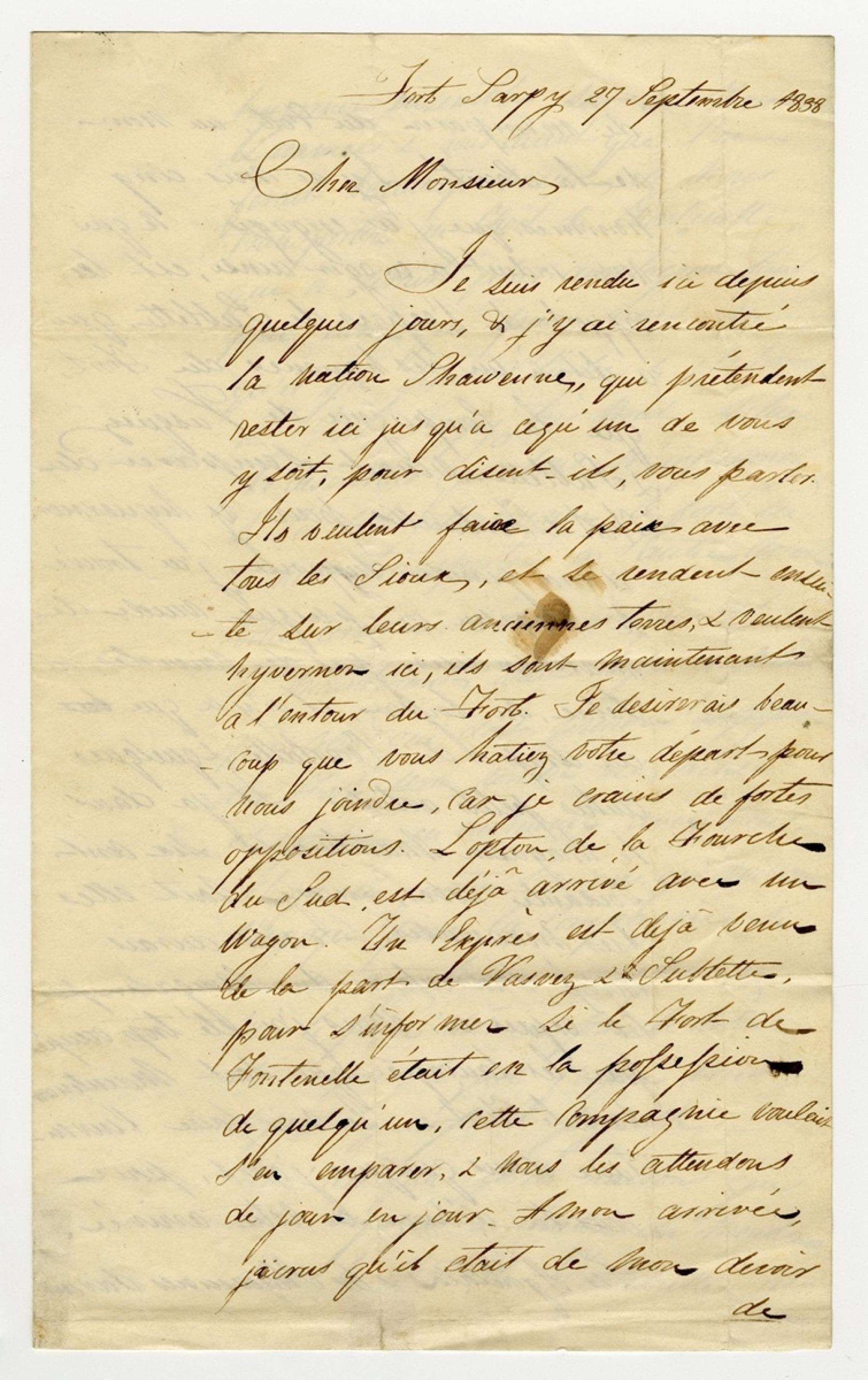
Fort Sarpy is documented by only two primary sources: a letter from John A. Hamilton to Pierre Chouteau, Jr. dated December 22, 1837, and a letter from Louis Howard written from Fort Sarpy to Picotte at Fort Pierre on September 27, 1838. Both letters are held in the Chouteau-Papin Collection at the Missouri Historical Society in St. Louis. Beyond these documents, the post appears only briefly in a handful of modern fur trade histories. Its precise location remains unknown, and it is possible the site has been lost entirely.16
If the post’s location is ever identified and physical remains survive, the site could shed light on fur trading activity at a pivotal moment: the late 1830s, when the Rocky Mountain beaver trade was collapsing and commerce was shifting toward the buffalo robe trade and the growing emigrant traffic along the Platte.17 Researchers should note that two separate and better-documented Montana forts also bore the name Fort Sarpy. Both were Chouteau Company posts for trade with the Crow Nation on the Yellowstone River, named for John B. Sarpy, a company partner and nephew of Pierre Sylvestre Grégoire Sarpy, who built the Wyoming post described here. The two forts are geographically and operationally unrelated to this one.18
[Editor’s Note: Special thanks to the author and to the Wyoming State Historic Preservation Office for making this article available, and to the Wyoming Cultural Trust Fund for its ongoing support for this project. Greg Pierce’s historical monograph, Negotiating the West: A History of Wyoming Trading Posts, from which this article is adapted and excerpted, is one of many historic contexts published by the Wyoming State Historic Preservation Office. These documents are meant to offer a broad background against which historic developments can be better understood as the agency works to preserve properties and places important to an understanding of Wyoming’s past. The contexts also, however, are based on sound research and are full of well-told, vivid stories. With this in mind, WyoHistory.org is collaborating with the SHPO office to bring more of this history to a wider readership. The Cultural Trust has provided the funds to make this collaboration possible. We offer our thanks to all.]
Footnotes
-
Greg Pierce, Trading Posts in Wyoming, Multiple Property Documentation Form, National Register of Historic Places, Wyoming State Historic Preservation Office, State Parks and Cultural Resources, Cheyenne, Wyoming, 2012, Section E, 47–48.
-
Jim Hardee, “The Fur Trade in Wyoming,” WyoHistory.org, November 8, 2014, https://www.wyohistory.org/encyclopedia/fur-trade-wyoming.
-
LeRoy R. Hafen, French Fur Traders and Voyagers in the American West (Spokane, Washington: Arthur H. Clark Company, 1995), 292; Pierce, Trading Posts in Wyoming, Section E, 47.
-
Cody Newton, “Native Place, Environment, and the Trade Fort Concentration on the South Platte River, 1835–45,” Ethnohistory 59, no. 2 (2012): 239–260; Cody Newton, “Fort Jackson,” Colorado Encyclopedia, 2026, https://coloradoencyclopedia.org/article/fort-jackson.
-
J. A. Hamilton, letter to Pierre Chouteau, Jr., December 22, 1837, Chouteau-Papin Collection, Missouri Historical Society, St. Louis; Louis Howard, letter to Picotte at Fort Pierre, September 27, 1838, Chouteau-Papin Collection, Missouri Historical Society, St. Louis.
-
R. G. Roberson, Competitive Struggle: America’s Western Fur Trading Posts 1764–1865 (Boise: Tamarack Books, 1999), 71.
-
Hamilton, letter to Chouteau, December 22, 1837; Howard, letter to Picotte, September 27, 1838.
-
Pierce, Trading Posts in Wyoming, Section E, 48.
-
Howard, letter to Picotte, September 27, 1838.
-
Newton, “Fort Jackson;” Greg Pierce and Mark E. Miller, “In Search of the Fraeb Battlefield and Trading Post, August 1841,” Plains Anthropologist 60, no. 235 (2015): 227.
-
Pierce, Trading Posts in Wyoming, Section E, 48.
-
Howard, letter to Picotte, September 27, 1838.
-
Hafen, French Fur Traders, 97.
-
Pierce and Miller, “In Search of the Fraeb Battlefield,” 226–229.
-
Pierce and Miller, “In Search of the Fraeb Battlefield,” 224.
-
Hamilton, letter to Chouteau, December 22, 1837; Howard, letter to Picotte, September 27, 1838; Charles Jr. Hanson and Sue Walters, “The Early Fur Trade in Northwestern Nebraska,” Nebraska History 53, no. 7 (1976): 291–314.
-
Pierce, Trading Posts in Wyoming, Section E, 48.
-
The Montana Forts Sarpy were named after John B. Sarpy, a Chouteau Company partner and nephew of Pierre Sylvestre Grégoire Sarpy, who established the Wyoming post described in this article. Both were built by Alexander Culbertson as Chouteau Company posts for trade with the Crow Nation on the Yellowstone River: the first (1850–1855) was situated on the north bank about five miles below the mouth of Rosebud Creek; the second (1857–1860) was located about 25 miles below the mouth of the Bighorn River. Activity at the Forts Sarpy is documented by the journal of James Chambers (January 1855–August 1856), held in the Pierre Chouteau, Jr. and Company records (MC 4) at the Montana Historical Society, Helena, and published in Contributions to the Historical Society of Montana, vol. 10 (1940). The two Montana posts share only the Sarpy name and have no operational, geographic, or documentary connection to the post described in this article.