Legacy 101: How Wyoming Remembers Nellie Tayloe Ross
By American Heritage Center Historian Kail Moede
Editor's note: The following post originally appeared on "Discover History," the blog of the University of Wyoming’s American Heritage Center. We’re pleased to share it with our readers as we mark the 101st anniversary of Nellie Tayloe Ross taking the oath of office as Wyoming's and the nation's first woman governor on January 5, 1925.
On December 20, 1977, The Wyoming Eagle marked Nellie Tayloe Ross' death with a simple but powerful headline: "Nellie Tayloe Ross Dies at 101." Beneath it, the paper summarized her lifetime of public service and listed her achievements as first woman governor in the United States, first woman director of the U.S. Mint, former vice chairman of the Democratic National Committee, lecturer, and campaigner.
In a single opening sentence, the paper captured the scope of Ross' career and underscored the national significance of a woman who began her public life in Wyoming and carried it onto a national stage.
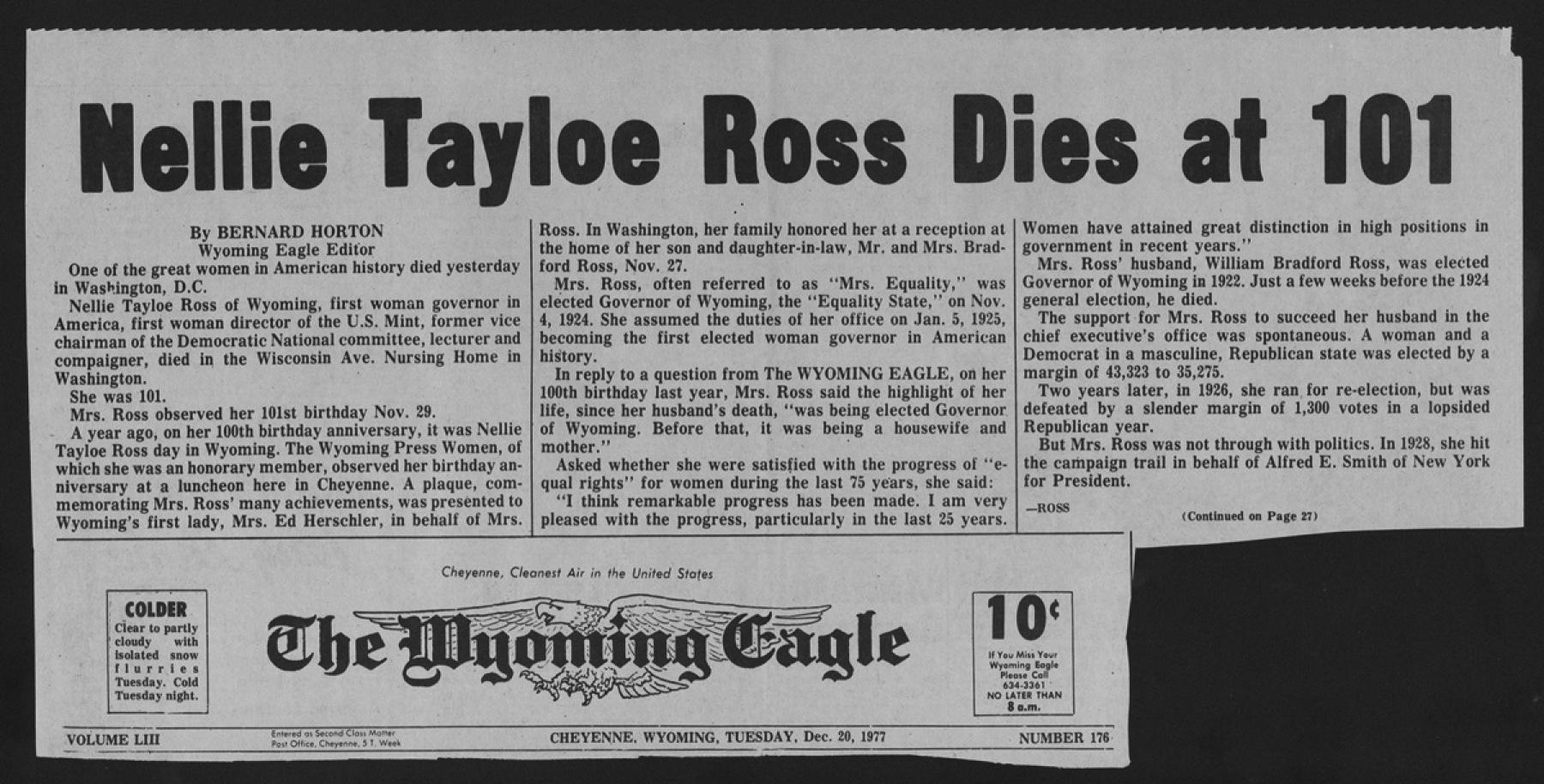
January 5, 2025, marks 101 years since Nellie Tayloe Ross took the oath of office as Wyoming’s and the nation’s first woman governor. This post explores how Wyoming remembers and honors Ross and her lasting legacy.
First some background:
After the sudden death of Wyoming Governor William Bradford Ross, voters elected his wife, Nellie Tayloe Ross, governor in a special election. When she took the oath of office on January 5, 1925, Ross became the first woman to serve as governor of a United States state.
While she didn’t win re-election in 1926, she remained active in the Democratic Party, later serving as the Democratic National Committee vice-chair and director of the DNC Women’s Division, two positions that brought her national attention once again.
In 1933, President Franklin Delano Roosevelt appointed Nellie Tayloe Ross as the first female director of the U.S. Mint, a position she held until 1953. To this day, she is still the longest serving director of the U.S. Mint.
Now, the legacy:
In Wyoming, Nellie Tayloe Ross is remembered in ways that extend beyond a single story or historical marker. Her legacy appears in both ordinary settings and formal commemorations, reflecting her continued presence in the state’s sense of itself and its long-standing identification as the Equality State. When Wyoming recalls its history of political firsts for women, Ross is frequently included, remembered as a figure whose public career began locally and reached national significance.
Ross’ presence is embedded in Wyoming’s physical landscape through buildings, monuments, and public art. At the University of Wyoming, Ross Hall was constructed in 1959 and opened the following year as a women’s dormitory, a naming choice intended to honor a woman whose public service had broken national barriers.
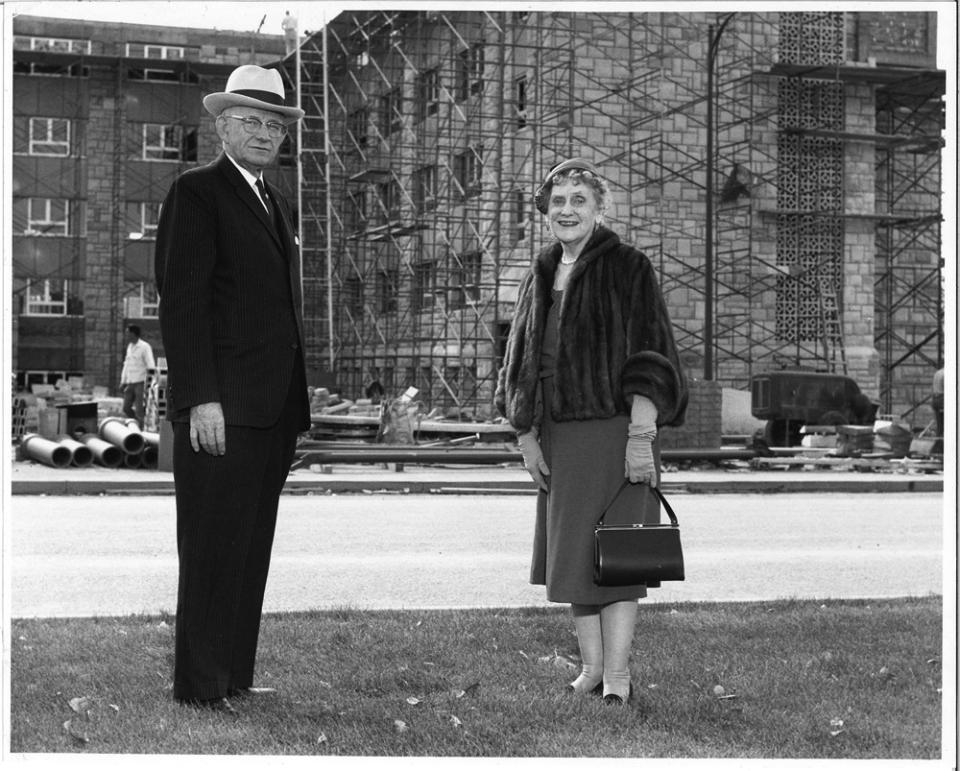
Although Ross did not attend the university, her connection to the campus is grounded in historical circumstance. In 1924, her husband, Governor William Bradford Ross, became ill while speaking in Old Main, an event that directly preceded his death and the special election that brought his wife into office.
She later acknowledged the significance of the honor in a 1960 letter to University of Wyoming President Clifford P. Hansen, writing that the news that one of the new buildings would bear her name stirred in her “sentiments beyond [her] power of expression.” A brass plaque inside the building further marks Ross Hall as a site of remembrance.
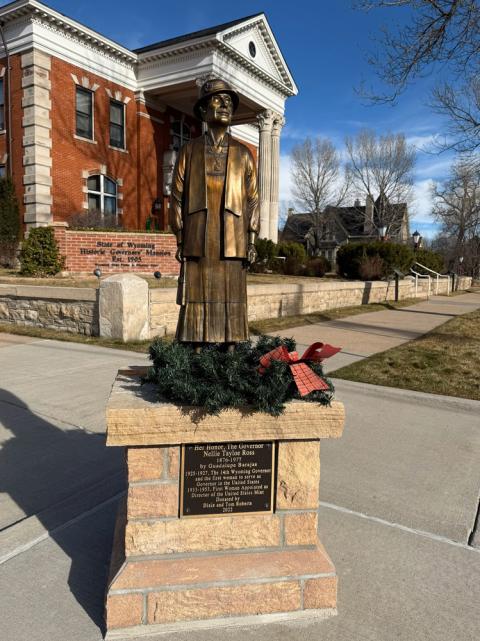
Public art also plays a role in sustaining Ross’ visibility. Bronze sculptures in downtown Cheyenne place her likeness in the civic landscape of the state capital. The sculpture titled Her Honor the Governor stands directly in front of the Historic Wyoming Governor’s Mansion, and Nellie Tayloe Ross stands down the block from the Wyoming Capitol, both placements appear intentional and visually associate Ross with executive authority. Rather than functioning only as ceremonial markers, these works are encountered in everyday settings, allowing her legacy to remain present through routine use of public space.
Ross’ memory is also sustained through tradition. The Wyoming Democratic Party’s Nellie Tayloe Ross Award and Banquet, which date back to at least 1984, were established only a few years after her death in 1977. The timing reflects an early effort to formalize her contributions into an ongoing act of remembrance. Presented at selected moments rather than continuously, the award preserves Ross’ memory by recognizing women whose service reflects commitment to public life. Anniversaries, particularly milestone years, similarly return Ross to public attention and provide occasions for reflection.
An important part of Ross’ legacy in Wyoming is also shaped by how her papers came to the American Heritage Center. During the late 1950s, Ross received multiple requests from institutions interested in acquiring her personal and professional records, including the Library of Congress, Radcliffe College, and the Wyoming State Historical and Archives Building, now the Wyoming State Archives. These inquiries reflected growing recognition of the historical value of her career and the significance of her role in national and state politics.
Ross ultimately chose to place her papers with the University of Wyoming, transferring them to what would become the American Heritage Center in either 1959 or 1960. Rather than dispersing her materials among national repositories, Ross anchored her legacy in Wyoming, where they could support research, interpretation, and public engagement over time.
The Nellie Tayloe Ross papers include correspondence, speeches, and other materials created and collected by Ross during her long career in public service. These preserved records provide insight not only into her political achievements but also into her working life and decision-making over several decades. Ross’ choice to place her papers at the University of Wyoming reflects an understanding of legacy as something actively shaped, ensuring that future generations would have access to the documentary record of her life and work.
Interpretation and preservation further shape how Ross is remembered. Through a series of blog posts published over time, the American Heritage Center has revisited different aspects of Ross’ life and career, drawing from her papers to highlight different facets of her work. By returning to her story more than once, the AHC avoids presenting a single, fixed narrative.
More than a century after she took the oath of office, Nellie Tayloe Ross remains a figure Wyoming returns to at meaningful moments. Her memory is sustained through continued reference and reinterpretation, shaped by where her name appears and how her story is told. Taken together, these acts of remembrance offer a kind of legacy lesson, showing how Wyoming teaches its history not all at once, but through repetition, place, and practice.
Be on the lookout for a Nellie Tayloe Ross exhibit, coming to the American Heritage Center April 2026!
AHC resources for more information on Nellie Tayloe Ross:
- Finding aid for Nellie Tayloe Ross papers
- Digitized materials in Nellie Tayloe Ross papers
- 1926 Revisited: Nellie Tayloe Ross, First Woman Governor, Wins Again?
- Mrs. Money – Nellie Tayloe Ross
- Nellie Tayloe Ross: The (First) Governor Lady
- Shattering Stereotypes: The Remarkable Story of Nellie Tayloe Ross
WyoHistory.org article on Ross: