Fort Adams
Fort Adams was a short-lived trading post established in September 1841 near the confluence of the Laramie and North Platte rivers in present-day Goshen County, Wyoming. Built by the trading firm of Sybille, Adams, and Company and occupied for only a single season, it was one of several posts competing simultaneously for the North Platte trade in the early 1840s. Fort Adams left almost no mark on the historical record: its location has never been determined, no physical description of the post survives beyond the fact of its cottonwood log construction, and it was abandoned before it could attract any sustained attention from contemporary travelers or diarists.1
Background: The North Platte’s Crowded Trading Ground
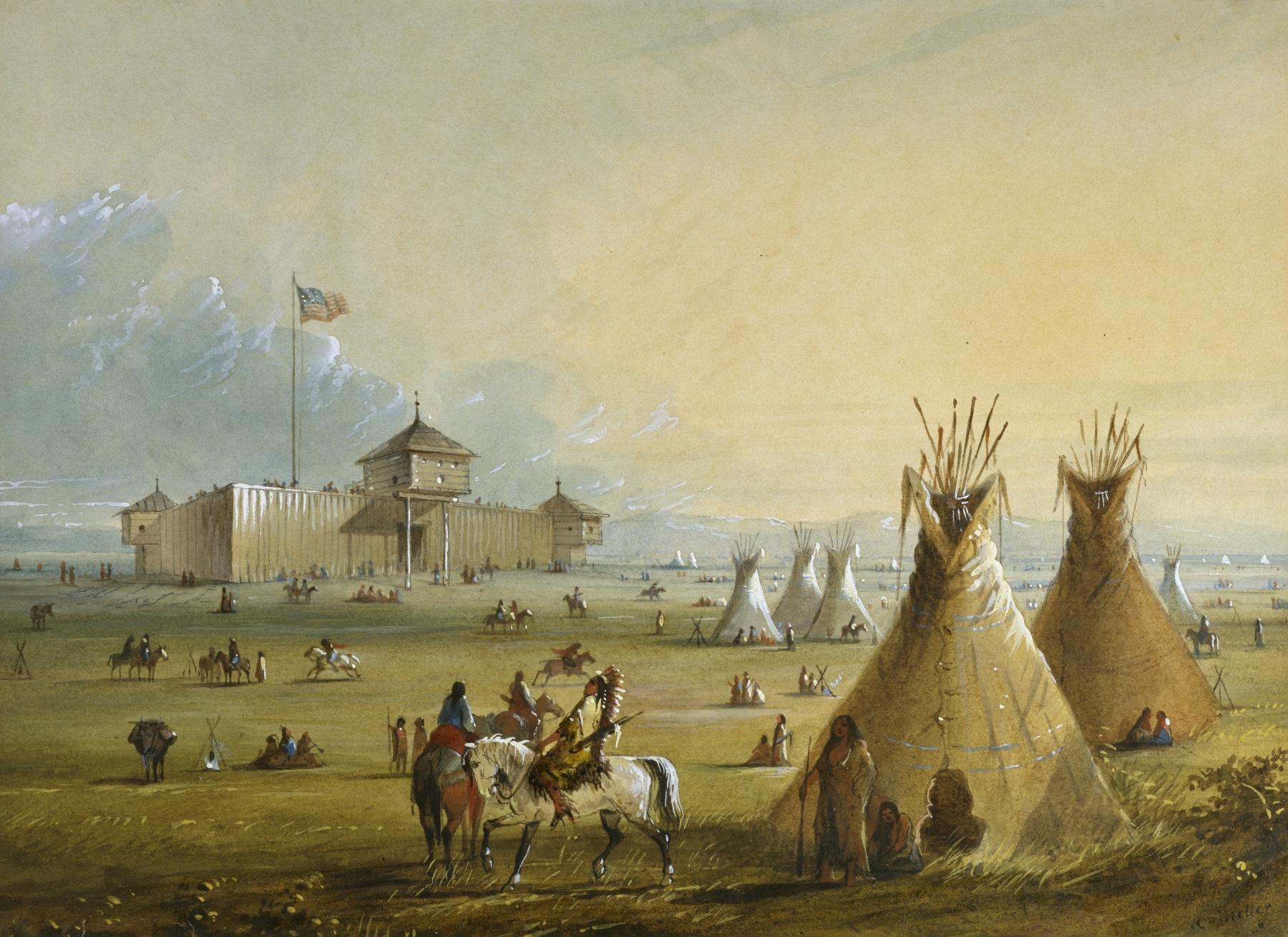
Fort Adams entered a commercial landscape already crowded with competition. By the fall of 1841, the Laramie–Platte confluence had become one of the most actively contested trading locations in Wyoming, with the American Fur Company’s newly built Fort John, Lancaster Lupton’s Fort Platte, and at least one other post—the Lock and Randolph Company—all operating within a few miles of one another.2 The surge of competition reflected the commercial opportunity the location offered: the Laramie–Platte confluence sat directly on the overland trails to Oregon and California, which were beginning to carry significant numbers of westbound emigrants, while the surrounding Lakota Sioux hunting grounds provided a steady supply of bison robes. Posts in this location could serve both the Native American robe trade and the growing emigrant traffic simultaneously, and the years 1841–1842 marked the height of that competitive scramble.3
Founders and Financing
Fort Adams was established by John Sybille and David Adams, who had recently received their first trading license to operate as freelance traders in the Laramie’s Fork, Cheyenne, and Wind River areas.4 The venture was financed by David’s brother John Adams and by Bernard Pratte Jr., a former partner of Pierre Chouteau Jr. in the St. Louis fur trade.5 Sybille and Adams were relative newcomers to independent trading but were well connected to the established commercial networks of the Missouri and Platte fur trade. Their subsequent career in the region proved far more durable than Fort Adams itself: after abandoning the post in the spring of 1842, they purchased Fort Platte from Lancaster Lupton and operated it for about a year and a half, eventually taking on Joseph Bissonette and John Richard—the latter rumored to have brought liquor from Taos—as key figures in their operations before selling the post to Bernard Pratte Jr and John Charles Cabanne in early August 1843.6
Construction, Operation, and Abandonment
Sybille and Adams constructed Fort Adams in September 1841 on the overland trail route near Fort John and Fort Platte, positioning the post to intercept emigrant and robe trade.7 The only reference to its physical character in the historical record identifies the post as having been constructed of cottonwood logs.8 Nothing is known of its dimensions, layout, interior features, or exact location. David Adams’s journal of November 1841, held in the Missouri Historical Society, provides the sole primary documentary evidence for the post’s existence and activities.9
Fort Adams was abandoned in the spring of 1842 when Sybille and Adams purchased the larger and better-established Fort Platte from Lupton.10 The acquisition of Fort Platte made Fort Adams redundant: the two posts were in close proximity, and Fort Platte’s greater size and more established operations offered a far stronger commercial platform. After the purchase of Fort Platte, the historical record makes no further mention of Fort Adams, and the fate of the post’s structures is unknown. Given the cottonwood log construction—a material that deteriorated quickly in Wyoming’s climate, as the experience of Fort William made clear—the post likely did not survive long after abandonment.11
Historical Significance
Fort Adams occupied the North Platte for only a single trading season, and John Sybille and David Adams’s subsequent operations at Fort Platte proved far more consequential to the history of the region than Fort Adams itself. Bissonette and Richard, who had managed Fort Platte under Sybille and Adams, went on to help build Fort Bernard in 1845 under the ownership of Bernard Pratte Jr. and John Charles Cabanne, the same partners who had purchased Fort Platte from Sybille and Adams in 1843. Fort Adams itself made little impression on contemporaries and has received scant attention from historians.12
Despite its obscurity, Fort Adams was constructed at a pivotal moment in Wyoming’s fur trade history. The autumn of 1841 marked the transition from a trade focused primarily on Native American exchange to one increasingly oriented toward supplying the emigrants pouring westward along the Oregon and California trails. A post operating at the Laramie–Platte confluence during that single season would have participated in both economies simultaneously. Should the archaeological remains of Fort Adams ever be located and found to be undisturbed, the site would offer a rare opportunity to examine the material record of the North Platte trade at precisely this transitional moment, a snapshot of commerce on the eve of the emigrant era.13
[Editor’s Note: Special thanks to the author and to the Wyoming State Historic Preservation Office for making this article available, and to the Wyoming Cultural Trust Fund for its ongoing support for this project. Greg Pierce’s historical monograph, Negotiating the West: A History of Wyoming Trading Posts, from which this article is adapted and excerpted, is one of many historic contexts published by the Wyoming State Historic Preservation Office. These documents are meant to offer a broad background against which historic developments can be better understood as the agency works to preserve properties and places important to an understanding of Wyoming’s past. The contexts also, however, are based on sound research and are full of well-told, vivid stories. With this in mind, WyoHistory.org is collaborating with the SHPO office to bring more of this history to a wider readership. The Cultural Trust has provided the funds to make this collaboration possible. We offer our thanks to all.]
Footnotes
-
Greg Pierce, Trading Posts in Wyoming, Multiple Property Documentation Form, National Register of Historic Places, Wyoming State Historic Preservation Office, State Parks and Cultural Resources, Cheyenne, Wyoming, 2012, Section E, 53; R. G. Roberson, Competitive Struggle: America’s Western Fur Trading Posts 1764–1865 (Boise: Tamarack Books, 1999), 39.
-
Charles Jr. Hanson and Sue Walters, “The Early Fur Trade in Northwestern Nebraska,” Nebraska History 53, no. 7 (1976): 298; David W. Lupton, “Fort Platte, Wyoming, 1841–1845: Rival of Fort Laramie,” Annals of Wyoming 49, no. 1 (1977): 86.
-
Pierce, Trading Posts in Wyoming, Section E, 28–30; Greg Pierce and Mark E. Miller, “In Search of the Fraeb Battlefield and Trading Post, August 1841,” Plains Anthropologist 60, no. 235 (2015): 224.
-
Louis Barry, The Beginning of the West (Topeka: Kansas State Historical Society, 1972), 437.
-
Ibid.
-
Lupton, “Fort Platte,” 86; John D. McDermott, “John Baptist Richard,” in Mountain Men and the Fur Trade of the Far West, vol. 2, ed. LeRoy R. Hafen (Glendale, California: Arthur H. Clark Company, 2000), 289–303.
-
David Adams, Journal, November 1841, David Adams Papers, Missouri Historical Society, St. Louis, Missouri; Hanson and Walters, “Early Fur Trade,” 298.
-
Roberson, Competitive Struggle, 39.
-
Adams, Journal, November 1841.
-
Lupton, “Fort Platte,” 86.
-
Pierce, Trading Posts in Wyoming, Section E, 53; Hanson and Walters, “Early Fur Trade,” 298.
-
Pierce, Trading Posts in Wyoming, Section E, 53, 65–66.
-
Ibid.