The Black 14: Race, Politics, Religion and Wyoming Football
During the second period of the season-opening football game against Arizona on Sept. 20, 1969, a packed house at the University of Wyoming's War Memorial Stadium watched as Cowboys' split end Ron Hill, a sophomore from Denver, caught a pass and took it 24 yards into the end zone. It was Wyoming's first touchdown in the 100th anniversary year of college football.
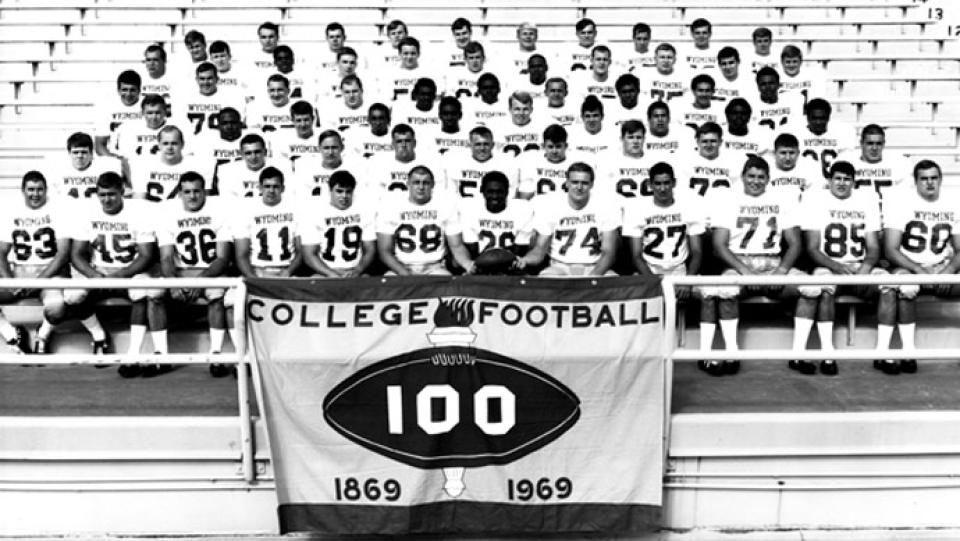
In the third quarter, Jay Berry—dubbed “Jerry Berry" by UW—a sophomore safety from Tulsa, Okla., intercepted an Arizona pass on his own 12-yard line and returned it 88 yards for another touchdown.
But these football triumphs faded quickly from public memory when a controversy that fall linking sports, race, religion, the free speech provision in the U.S. Constitution’s First Amendment and protest politics swung the nation’s news spotlights to Laramie, Wyoming at a time when Americans were already deeply divided over civil rights and the Vietnam War. Controversy erupted over the expulsion of 14 Black football players from the Cowboys’ varsity. They came to be known as the Black 14.
A Winning Team
The Cowboys opened the 1969 season by defeating Arizona, the Air Force Academy, Colorado State University and the University of Texas at El Paso, and were ranked 12th in the nation in the United Press International coaches poll as the players prepared for their next game against Brigham Young University. The UW team led the nation in rushing defense.
Under Head Coach Lloyd Eaton, Wyoming had won three consecutive Western Athletic Conference championships in the three previous years; had won 31 of the previous 36 games; defeated Florida State in the 1966 Sun Bowl and very nearly upset Louisiana State University in the Sugar Bowl on Jan. 1, 1968, after going undefeated during the 1967 regular season.
After losing a game at Arizona on Oct. 24, 1964, an exasperated Coach Eaton summed up the chief problem with the Pokes in a Tucson Citizen newspaper report: “…eventually Arizona’s speed caught up with us. … we couldn’t contain Arizona’s speed or receivers.” By the start of the 1966 season Eaton and his staff had brought in the “speed” he wanted. Outstanding Black players like Gene Huey and Tom Williams from Pennsylvania, Vic Washington from New Jersey and Dave Hampton and Dick Speights from Michigan all played a significant role in achieving that remarkable three-year record.
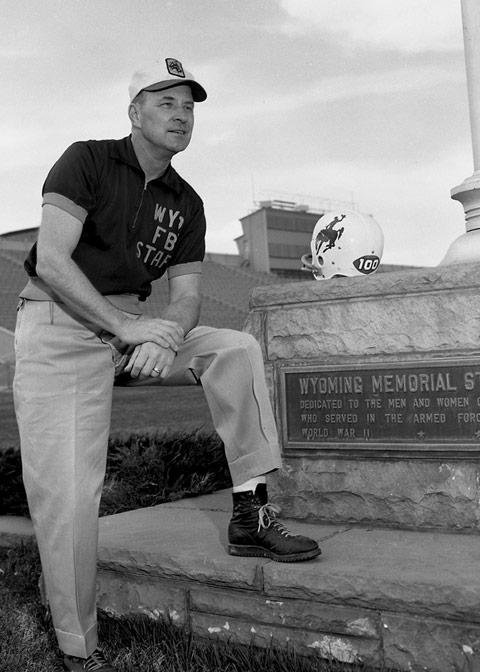
The 51-year-old Eaton, a native of Belle Fourche, S.D. near the border with Wyoming, was at the peak of his career. On Oct. 11, 1969, the Madison, Capital Times reported that Wisconsin Athletic Director Elroy Hirsch was considering Eaton as a candidate for the Big Ten team's next coach.
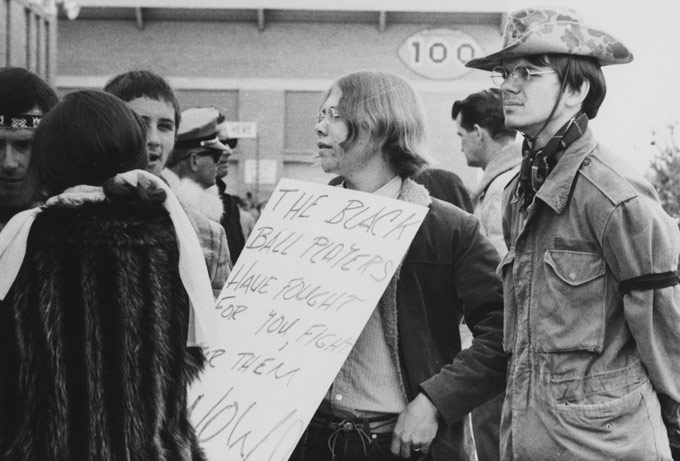
But on Friday morning, Oct. 17, 1969, the day before the BYU game, Eaton summarily dismissed Hill, Berry and the 12 other Black players on the UW team when they appeared at his office as a group wearing black armbands on their civilian clothes. BYU is owned and operated by the Church of Jesus Christ of Latter-day Saints, better known as the Mormons. By wearing the armbands, the players were protesting the LDS tenet (it took a revelation from God to change it) then in force, which barred Black men from the priesthood.
The coach's action deeply affected the players’ lives, and soon caused the demise of his own coaching career. The university, too, was profoundly affected.
A turbulent time
The controversy came at the end of the turbulent 1960s. The decade changed the nation but had apparently had less of an effect, so far, on conservative Wyoming. In 1968, the Tet Offensive had shown Americans no quick end was likely for the Vietnam War, a politically damaged president, Lyndon Johnson, had declined to run for re-election, Martin Luther King and Robert Kennedy were assassinated and protest spread wider and wider across campuses and capitals.
In October of that year, U.S. sprinters Tommie Smith and John Carlos indelibly linked sports to racial politics when, standing on the medalists’ platform at the Summer Olympics in Mexico City, they raised black-gloved fists as The Star-Spangled Banner played over the loudspeakers. They were both immediately dismissed from the Olympic team.
In the western United States, some college athletes learned of the Mormon Church’s policy of barring black men from the church’s lay priesthood and thus from leadership in the church. The students felt they could bring attention to what they saw as an injustice by protesting when their teams played Brigham Young University. BYU, located in Provo, Utah, is wholly owned and operated by the Mormon Church.
In November 1968, at San Jose State in California, black football players boycotted a home game against BYU, and only 2,800 fans “braved threats of disruption and demonstration” to come to the game, BYU’s football media guide noted the following year. In April, 1969, black track athletes at the University of Texas at El Paso were ejected from the team when they refused to participate in a meet at Provo. On Oct. 6, an Associated Press story in Wyoming newspapers reported that an Arizona State black student group had asked black students to boycott the Sun Devils' Western Athletic Conference game against BYU that week because of alleged discrimination against blacks at BYU.
Protest comes to Laramie
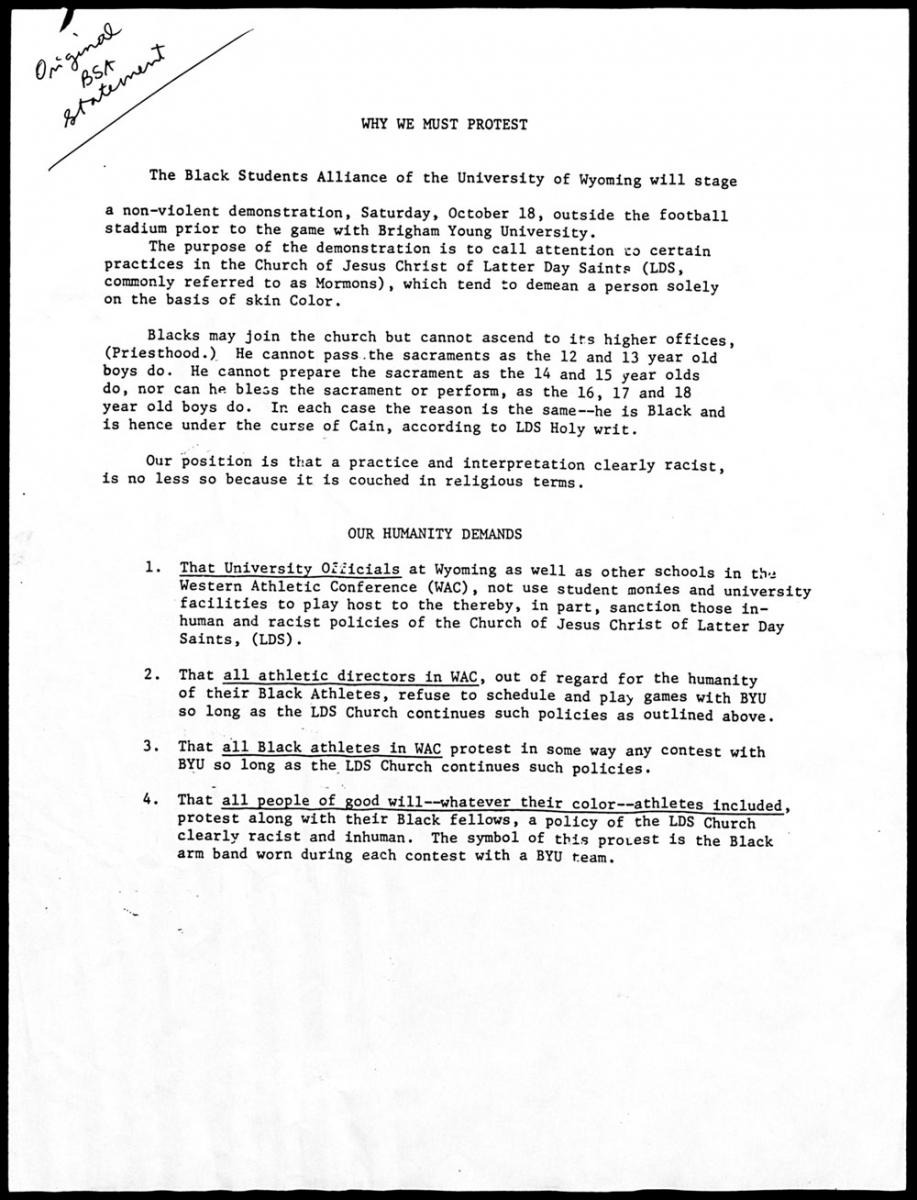
About a week before the UW-BYU game, slated to be played on UW home turf in Laramie, Willie Black, a 32-year-old math doctoral student with a wife and four children living in student housing, had learned of the Mormon policy. Black was chancellor of UW’s Black Students Alliance. On the Monday before the game, he informed alliance members, including the black football players, of what he had discovered. On Wednesday, he delivered a statement entitled "Why We Must Protest" to the UW president and athletic director. The document announced plans for a demonstration at the stadium before the BYU game.
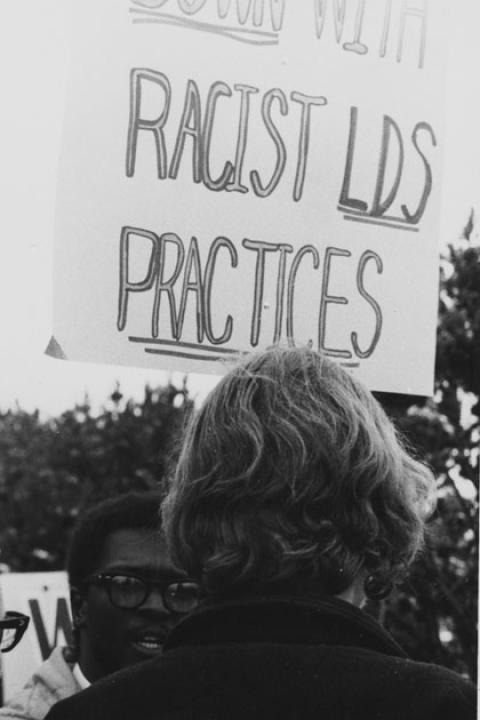
"Our Humanity Demands: . . . That all people of good will--whatever their color--athletes included" protest this policy, the document noted. Further, it called on UW and all WAC schools to stop using "student monies and university facilities to play host to [BYU and] thereby, in part, sanction those inhuman and racist policies. . . ."
Also on Wednesday, Laramie townspeople and students took part in the Vietnam Moratorium, a nationally coordinated series of demonstrations and teach-ins. It was the largest set of antiwar protests the nation—and Laramie—had seen so far.
After practice on Thursday afternoon, Oct. 16, Coach Eaton called aside one of the team’s tri-captains, Joe Williams (a Black player from Texas), and gave him some sort of warning about joining in the BSA’s call for protest. Williams testified at the trial a couple years later he thought Eaton was talking about wearing armbands on the field. On Friday morning, the players gathered at Washakie Center and apparently were not informed about the coach’s warning. They decided to don black armbands on their civilian clothes and go to his office to discuss with the coach how they might show solidarity with the BSA’s request.
Seeing them together, wearing armbands, [and without checking with the Athletic Director] Eaton led them into the upper seating area of the fieldhouse and, according to the players, immediately told them that they were all off the team. His first words were “You’re no longer Wyoming Cowboys.” After that, according to the wife of a faculty member who was walking on the fieldhouse floor below, the coach insulted the players in an angry and racially-charged manner, which further polarized the situation.
"It was pretty belligerent talk," Ann Marie Walthall recalled more than 20 years later in a documentary on the Black 14 produced by University of Wyoming Television. "I felt embarrassed for the young men hearing this tirade."
Eaton would later testify in federal court that he "told them that if the program at Wyoming was not satisfactory then perhaps they had better think about going to Morgan State or Grambling”—both traditional black colleges.
The players emptied their lockers and walked to the student union and contacted the BSA’s faculty sponsor Roger Daniels, a history professor, who contacted the President’s Office. The players were invited to come to the President’s office where they asked UW President William Carlson to arrange a meeting with Eaton. They wanted the coach to hear their side of the story. Carlson reported to them that the coach was too busy rearranging his depth chart to come over. Athletic Director Red Jacoby came instead, but only further polarized the situation.
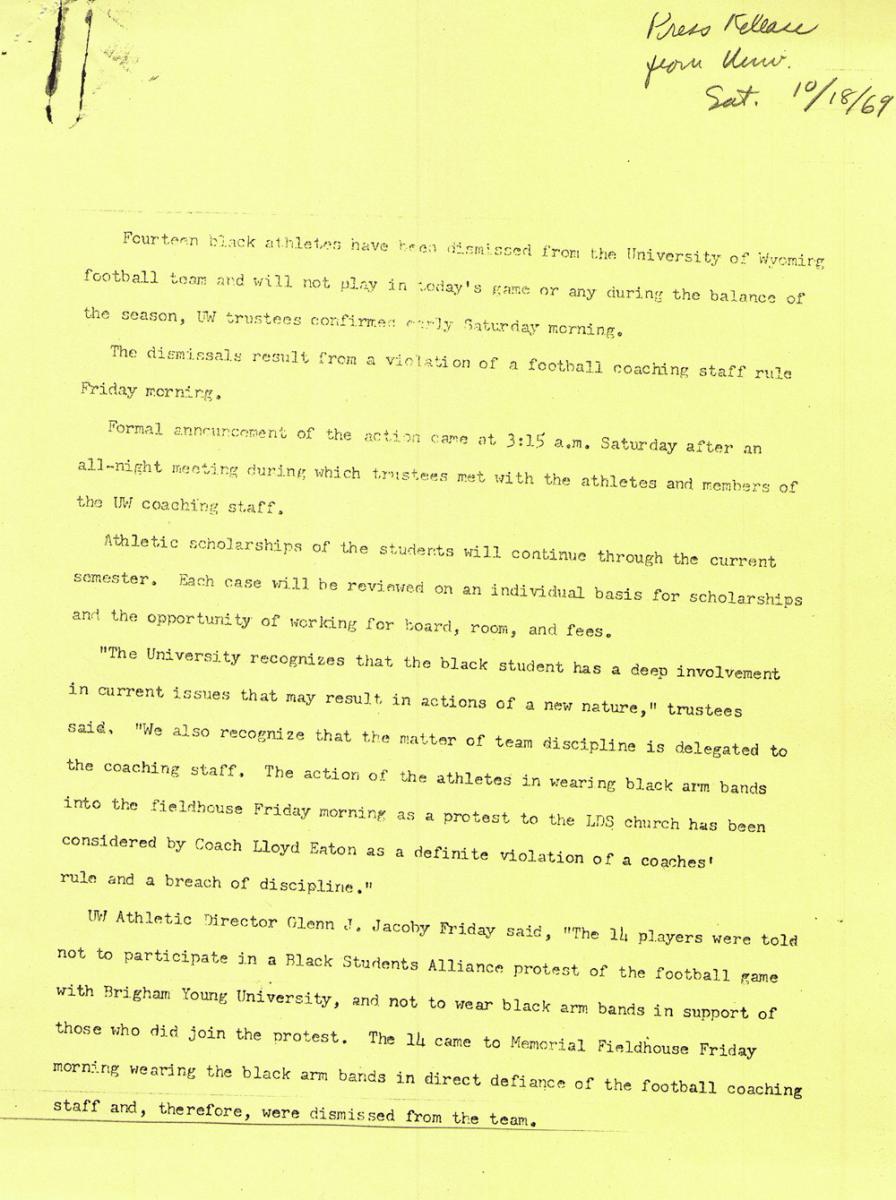
That evening, the coaches and players met separately with the UW Board of Trustees and Wyoming Governor Stanley K. Hathaway during a special meeting lasting from 8 p.m. to 3:15 a.m. Saturday. At that late hour, the university issued a press release, approved by the Trustees, saying the trustees confirmed the dismissal of the 14 players. The players "will not play in today's game or any during the balance of the season,” the press release noted, and added: "The dismissals result from a violation of a football coaching rule [prohibiting scholarship football players from participating in demonstrations any time and anywhere] Friday morning."
Athletic Director Jacoby further noted in the release that "(a)mple notice was given to all members of the football team regarding rules and regulations of the squad, some of which cover a ban on participation in student demonstrations of any kind. Our football coaching staff has made it perfectly clear to all members of the team that groups, or factions, will not be tolerated and that team members will be treated as individuals.”
According to Jacoby, the staff had “no recourse” when the 14 players appeared as a group at the coach's office. “We had no choice but to drop them from the squad. It is unfortunate this happened, but an open defiance of a coaching staff regulation cannot be tolerated." The press release did not mention anything about freedom of religion or the LDS Church tenet. In his second order dismissing the players’ lawsuit, U.S. District Judge Ewing T. Kerr ruled: “The action and order of dismissal by the Board of Trustees of the University of Wyoming was not predicated upon the existence or non-existence of any football coaching rule ...."
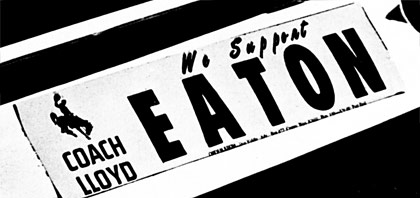
On Saturday, the Cowboys, suddenly an all-white team, defeated all-white BYU 40-7 while the 14 dismissed black players watched for part of the first half from the student section of the stands. Fans on both sides of the stadium chanted, "We love Eaton." After the game, Eaton said, "The victory was the most satisfying one I've ever had in coaching."
The players
Statistics published in the program for the game showed that the 14 Black players had contributed substantially that year to the team's unbeaten status through the first four games. John Griffin, a junior college transfer from San Fernando, Calif., was the leading receiver; Ron Hill of Denver led in kickoff returns.
Mel Hamilton, a junior and a former mayor of Boys Town, Neb., had moved into a starting position in the offensive line, and Gibson, a junior from Pittsfield, Mass., started at fullback in the UTEP game. Ivie Moore, a Pine Bluff, Ark., defensive back who transferred from a Kansas junior college, was listed as a starter for the BYU game. Three of the four regular running backs were among those dismissed, putting a heavy burden upon sophomore running back Frosty Franklin from Powell. After the win over San Jose State a week later, Franklin said he was so tired at the end of the game he had trouble holding onto the ball.
Defensive end Tony McGee, a junior from Battle Creek, Mich., had keyed the Cowboys' thrilling come-from-behind win at the Air Force Academy by tackling the AFA quarterback for losses seven times.
Only one of the 14 was a senior at the time of their dismissal. Mel Hamilton, who had been a starting offensive lineman in his sophomore season in 1966 when UW defeated Florida State in the Sun Bowl, had. He then served in the U.S. Army for almost two years and returned for his junior year in fall 1969. Half of the14 were under 21 years old (and thus minors under the law at the time).
The national spotlight
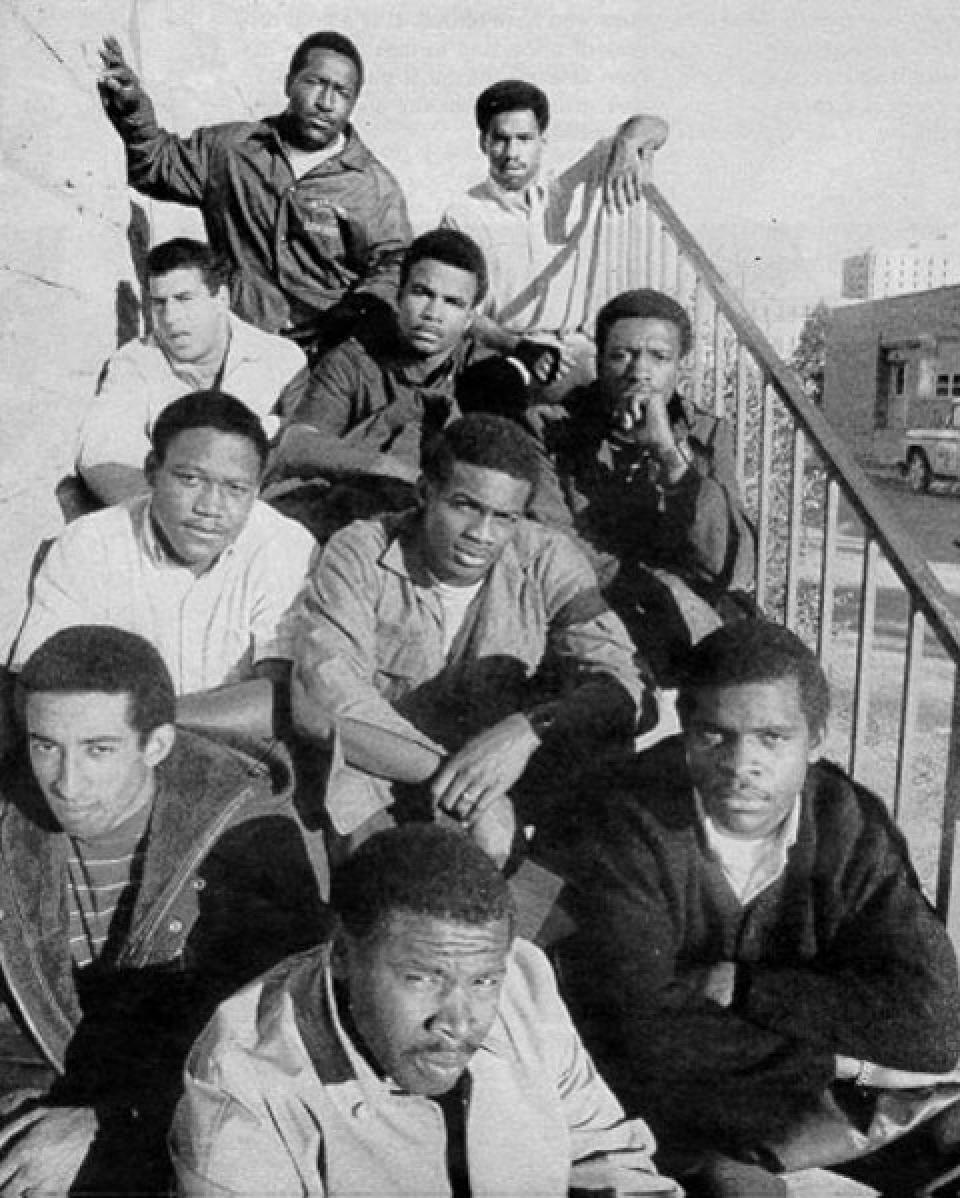
The dismissal of the 14 brought camera crews from the three big TV networks to Laramie, and articles appeared in newspapers and magazines throughout the nation. The Nov. 3, 1969, issue of Sports Illustrated carried an article with photographs including one showing 10 of the dismissed players sitting on the south steps of the Wyoming Union. The Casper, Wyo. Quarterback Club, the Rock Springs Wyo. City Council and the University of Wyoming Alumni Association supported the coach. One former legislator in Rock Springs suggested a monument to Eaton should be installed.
Aftermath
Early in 1969, the Wyoming Legislature had adopted a law allowing the UW student body president to sit as an ex-officio member of the Board of Trustees. This allowed Associated Students of the University of Wyoming President Hoke MacMillan to sit in on all of the board’s sessions that Friday night and early Saturday morning.
In the early hours that Saturday morning, the UW Student Senate adopted a resolution by a 15-3 vote alleging that “coach Eaton refused to grant a rational forum for discussion, choosing instead to degrade and arbitrarily dismiss each player....” The resolution said the ASUW Senate "expresses its shock at the callous, insensitive treatment afforded 14 Black athletes. . . .[T]he actions of coach Eaton and the Board of Trustees were not only uncompromising, but unjust and totally wrong."
Within a day or two after the dismissals, one of the many lawyers involved in the dismissals (four Trustees were lawyers, Gov. Hathaway was a lawyer, the University attorney was a law professor) apparently became aware of the Tinker vs. Des Moines School District case from the U.S. Supreme Court several months earlier in which the court ruled that school authorities could not punish by expulsion even a junior high student who had come to class wearing an arm band in protest of the Vietnam War. It was obvious under that case that dismissing the players for violating a coach’s rule was a clear violation of the players’ right of free speech. Therefore a press conference was called for mid-week at which Eaton and Carlson appeared to announce that the coach's rule prohibiting student athletes from participating in demonstrations was being amended to apply only while on the playing field. When Eaton was asked if the dismissal of the 14 would have happened if the now-modified rule had been in effect the previous week, he left the press conference, the Associated Press reported the next day. Coach Eaton announced that the modified rule would not take effect until after the football season.
The UW student newspaper, the Branding Iron, published an editorial advocating reinstatement of the players because the no-demonstrating rule had now been withdrawn.
English professor Ken Craven stated at the October 19 faculty meeting that he would resign if the players were not reinstated. Some of the other UW faculty members supported the coach, however.
During the week after the BYU game, four black trackmen quit the team and left UW in protest of the football players’ dismissals. Two of them had been conference champions in their main events the previous year. A couple of Black basketball players expected to start that season left the team.
The Cowboys finished their home slate with a victory over San Jose State a week after the BYU game. A plane pulling a banner proclaiming, "Yea Eaton," flew over the stadium, and the crowd responded with a roar and a standing ovation. Many wore "Eaton" armbands. All of the SJS players wore either black or multi-colored armbands.
A Casper Star-Tribune article on October 21 reported that Casper businessman Dode Gerdom "has started a fund drive to provide moving expenses for Ken Craven or any other faculty member" who opposed Eaton's action. "We don't care if Wyoming wins another game--we stand behind the coach," Gerdom said. When Craven did announce his resignation in the spring, Gerdom sent no money for moving expenses.
Eaton and numerous others at UW claimed that the athletes were pawns of outside agitators. But on October 24, the Associated Press reported that UW President William Carlson said those charges were unfounded. "I'm convinced their decision was on an individual basis,” Carlson said. “The BSA has acted in a most responsible manner."
On Oct. 30, 1969, the faculty of the UW College of, Arts and Sciences—the university’s largest—voted 114-38 to pass a resolution charging that "fourteen black athletes have been given deep human injury and have been dismissed without a trace of due process by Coach Lloyd Eaton. . . .[T]his faculty believes that the action. . .was unjust, unconstitutional, and unwise, bringing the entire University into disrepute."
On Nov. 12, 1969, Stanford University President Kenneth Pitzer, acting on recommendations from the campus Human Relations Committee, declared he "today barred any new commitments to intercollegiate competition with institutions sponsored by the Mormon Church."
On Nov. 25, the Cheyenne Quarterback Club held "Cowboy Night" at the Little America hotel, and a large crowd was on hand to honor Lloyd Eaton, his staff and his seniors. One of the “special guests” – according to an article in a Cheyenne newspaper -- was U.S. District Judge Ewing T. Kerr who was at that point presiding over a civil rights lawsuit brought by the 14 players against the state and the university.
Sorting it out in federal court
The week after the athletes’ dismissal, the NAACP sent a Detroit attorney, William Waterman, to Wyoming to file the federal lawsuit seeking an injunction ordering the reinstatement of the players and asking for damages for violation of their civil rights.
Judge Kerr in Cheyenne denied the injunction, and five months later threw the case out of court after a hearing, but without a trial. The 10th Circuit Court of Appeals reversed that decision on May 14, 1971, but, after a trial this time, Kerr again ruled for the state on Oct. 18, 1971. The appeals court eventually affirmed him.
Kerr had been admitted to the Wyoming bar in 1927, and served as a federal prosecutor and state attorney general before being appointed to the federal bench in 1955. During the hearing before his first dismissal, Kerr rejected the assertion by Weston Reeves, a Cheyenne attorney representing the Black 14, that the issue of race ran through the case.
"From my observation of almost half a century in Wyoming,” Kerr said at the hearing, “I have never known of any prejudice against any race in the state of Wyoming and I think the fact that the coach went out and solicited and gave scholarships to a large number of colored people is strong evidence that he was not prejudiced against any race." This prompted the NAACP in Cheyenne to point out that Cheyenne newspapers very recently had printed an article saying that the Wyoming Labor Commission had ruled that a black teacher had been discriminated against by the Rock River, Wyo. School Board.
The athletes’ accounts
Tony Gibson, another of the 14, told Ryan Thorburn, author of Black 14: The Rise, Fall, and Rebirth of Wyoming Football, in a 2009 interview, "Students on the campus were planning a demonstration against the Mormon policies and we voted that we would take part in that demonstration. And our part was wearing black armbands, if coach Eaton would let us. If Eaton didn't let us, we would just play the game. That's the part that was never brought out enough after the fact."
In interviews the week after the BYU game, Eaton claimed he had given the players ten minutes to speak. But in interviews in national magazines the following November, Joe Williams denied it. "Like hell he gave us ten minutes” Williams told Sports Illustrated. “He came in, sneered at us and yelled that we were off the squad." In Jet, Williams was similarly quoted saying Eaton booted the players "before we had a chance to talk."
In an interview reported in the Laramie Boomerang on Sunday October 19, Joe Williams stated: “We just wanted to discuss this in an intelligent manner. We wanted to play this game no matter what. We hadn't even decided to ask permission to wear the armbands during the game. … If only he had listened.”
Player Jay Berry said he joined the group not because of Mormon beliefs and policies, but because he had heard that Wyoming's black players had been mistreated during their game at Provo the previous season. "We wanted to play BYU in the worst kind of way," he said, and he saw the visit to Eaton as "a starting point for negotiations." But Eaton, Berry said, "opened his statements to us by saying ‘were it not for him we would all be on Negro relief.’"
Eaton acknowledged at the Cheyenne hearing in 1971 that there was no discussion. He said, "They had already violated our coaching rule. There was no purpose in talking."
Reversal of fortunes
The events had a devastating effect on Wyoming football. After six games, UW was still unbeaten and still rated among the top 15 in the national polls. Many fans were convinced the Cowboys could continue their winning ways without any Black players.
But protests against Eaton’s actions followed the Cowboys on the road, and they lost the last four games of the 1969 season by lopsided scores.
The 1970 team lost all of its home games and all but the CSU game on the road, finishing with one win and nine losses--the worst record since the no-wins one-tie season in 1939, and the first time UW lost all its home games since 1931. It was the Cowboys' first losing season since 1948. And future prospects looked dim because the 1970 freshman team had a winless season. Support for Eaton evaporated.
During the first week after the 1970 season ended, Wyoming sports pages included columns quoting Eaton on his plans to step up recruiting across the country, particularly from the junior college ranks. But on Dec. 6, 1970, Lloyd Eaton's coaching career came to an abrupt end.
In a press conference after their meeting, the UW Board of Trustees announced that Eaton was "retiring" from active coaching and would become an assistant athletic director whose duties were still undetermined. Eaton said the decision to retire had been made two years earlier, after the Sugar Bowl game. Defensive line coach Leonard F. (Fritz) Shurmur, 38, was appointed to replace Eaton. In 1971 Eaton left UW and held administrative and scouting positions in pro football, including a stint as Director of Player Personnel for the Green Bay Packers.
But the negative publicity affected Wyoming’s football program for years. Following the dismissal of the 14, the Cowboys lost 26 of their next 38 games through 1972. They had only one winning season during the 1970s. Paul Roach, one of Eaton's assistant coaches in 1969, returned to Wyoming as athletic director in the mid-1980s, and in 1987 also took on the head football coaching duties. His 1987 and 1988 teams went 21-5 and played in the Holiday Bowl both years.
Eaton died in Idaho in 2007.
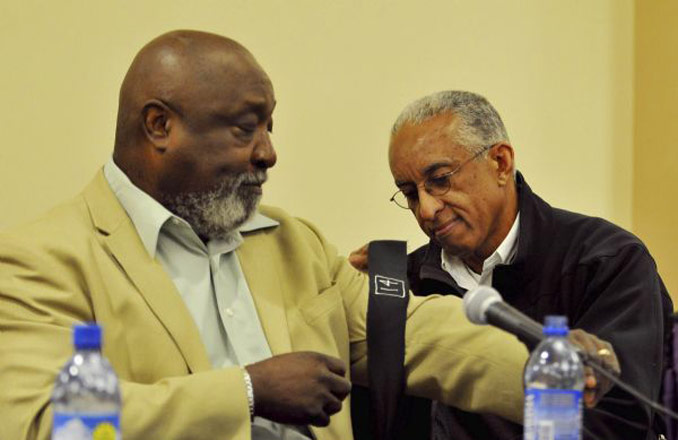
The players in later life
Tony McGee became a dominant player in the NFL, winning a Super Bowl while palying for for the Redskins. For many years McGee has hosted a sports television talk show in Washington D.C. Joe Williams also earned a Super Bowl ring with the Dallas Cowboys and then developed his own investment consulting business.
Several of the Black 14 managed to obtain college degrees. Mel Hamilton graduated from UW and has had a long career as a public school teacher and administrator in Casper. He was the first Black public school principal in Wyoming history. As of 2026 Hamilton was retired and living in South Carolina. Guillermo Hysaw, from Bakersfield, Calif., became one of the highest-ranking Black executives in the automobile industry while working for General Motors and was recruited by Toyota to roll-out the Lexus Division world-wide, and Lionel Grimes from Alliance, Ohio, became employment diversity executives with Ford and Toyota. Jay Berry became a sports anchor for television stations in Tulsa, Chicago and Detroit and was named by Associated Press as the top sports broadcaster in Texas in 1977.
Tony Gibson retired in 2011 after working nearly 38 years as a lineman for a Massachusetts power company during which time he responded to mass outages in Puerto Rico, Canada, Florida and several other states. Ted Williams has worked that long as a foreman at a specialized paint manufacturing company in Illinois. Ron Hill became a physical education teacher in Colorado. Hill died in 2025 in Alabama where he was born and lived until he spent his high school years in Denver with his brother. John Griffin has worked for the YMCA in Denver, for a hazardous waste abatement firm and as a manager for Sports Authority in Denver. Ivie Moore has worked as a floor subcontractor in his native Arkansas.
James Isaac was shot and killed by his wife in San Bernardino, Calif. in 1976. His wife pled guilty to manslaughter. Don Meadows died in 2009 and Earl Lee in 2013. Lee had a distinguished career as a teacher, coach and principal in the Baltimore area. Isaac, an all-sports star for Hanna-Elk Mountain High School in Wyoming, played football and ran track for, and graduated from, Dakota Wesleyan University in South Dakota. Don Meadows had a restaurant business in Denver.
The records section of the 2026 University of Wyoming Cowboys' Football Media Guideshows that Jay Berry’s two interceptions returned for touchdowns in the four games he played in 1969 has never been exceeded in the career and season categories, even though many players in the past 56 years played in 40 or more games during their careers
Berry had an 88-yard interception return against Arizona he carried another interception 24 yards for a touchdown in the CSU game two weeks later.
Epilogue
A Salt Lake Tribune article published Nov. 6, 2009, during the 40th anniversary, relates that the Black 14 incident quickly provoked changes at BYU, according to Tom Hudspeth, BYU head coach in 1969. Hudspeth was quoted as saying that he “cannot remember the exact date or how he was 'made aware' that LDS Church leadership wanted him to add Blacks to his team, and fast. The following year, BYU's team included Ronnie Knight, a black defensive back from Sand Springs, Okla."
On June 9, 1978, the First Presidency of the Mormon Church, composed of President and Prophet Spencer Kimball and Counselors N. Eldon Tanner and Marion G. Romney, announced that a divine revelation had been received to open the Mormon priesthood to Blacks, ending the longstanding tenet.
An AP article datelined Salt Lake City said the change came after many hours of "supplicating the Lord for divine guidance." According to the article, this was the most significant change in church doctrine since polygamy was discontinued in 1890. Church spokesman Jerry Cahill was quoted in the article as saying, "It's a momentous day, a great day we've lived through today."
Earlier that year, the LDS church had announced plans to build a new temple in Sao Paolo, Brazil—a very mixed-race place.
On May 9, 1982, the Denver Post published an extensive retrospective about the Black 14 incident, including the only interview Eaton gave after he left UW. "Divorced, Lloyd Eaton now lives a bachelor's life in a small home in Kuna, Idaho, where he refuses to have a phone," the article said. Eaton declared that he had never regretted what happened and that he would do the same thing again if given a second chance. Eaton repeated this assertion when he spoke to the Cheyenne Quarterback Club in 1991.
In an interview in 2009, Tony McGee said, "When it was over, I had more hurt feelings from how the Wyoming people reacted and the way I was treated than the whole thing with BYU."
Since the turn of the 21st century the University of Wyoming football team has had upwards of 25 Blacks on its roster nearly every season. The 2016 roster includes about 40 Blacks.
From condemnation to acclamation
Coach Eaton frequently claimed in the aftermath of his action that the Black 14 were simply pawns in the hands of Black radicals. That position was wholly adopted by the NCAA, the college football governing organization. In the late 60s and beyond, the NCAA published a monthly newsletter. In its December 1969 issue, two months after the Black 14 dismissals, the NCAA ran a long article claiming that all of the unrest caused by Black athletes at American universities was created by the Black Panthers and even Communists. The article was criticized by at least two prominent sports reporters, one in Philadelphia and one in Arizona, for not including any references or citations. The Black 14 incident in Wyoming drew particular attention in the newsletter:
“In the recent University of Wyoming situation, reliable information indicates plans were laid last summer to create an incident in the Rocky Mountain area. A Western Athletic Conference member with a stern-type football coach was to be selected as the target. The candidate colleges were narrowed to two, and [UW] finally was picked; [BYU] would be the trigger. The outside leader in this case was the head of the Denver [Black Panther Party], Willie Dawkins … On campus, the spokesman for the 14 athletes involved, in the final analysis, was Willie Black – neither athlete nor student – in his first year at Wyoming as a graduate teaching assistant in mathematics.”
Willie Black, who was obviously a student and was in his second year at UW, denied the charges. In a Billings Gazette article on December 19, he said: “They never seem to think that if a Black man stands up to protest something it’s because he’s smart enough to do it himself. It’s always a plot.”
Fifty four years later, the NCAA brought many of the surviving Black 14 players and their families (and two children of deceased players) to its national convention in Texas to award them the NCAA “Inspiration Award … recognizing them as college athletes who, when confronted with a life-altering situation used perseverance, dedication and determination to overcome the event and who now serve as role models to give hope and inspiration to others in similar situations.”
Resources
Primary Sources
- Ashworth, William. "Inside Story of Fired Black Athletes", Jet (magazine), 37 no. 6, (Nov. 11, 1969), 62-69.
- Associated Press. "BYU's Racial Policy Is Under Fire Again," Riverton Ranger. Oct. 6, 1969.
- Associated Press. "Demonstration Rule is Relaxed," Riverton Ranger, Oct. 23, 1969, 1.
- Associated Press. "Mormons Will Welcome Blacks," Paris (Texas) News, June 11, 1978, 26.
- Berry, Jay. Personal interview with author, Sept. 27, 2010.
- "Brigham Young versus Wyoming," Oct. 18, 1969 game program, University of Wyoming Athletic Department Files.
- Black Fourteen Collection, 1969-70, University of Wyoming American Heritage Center.
- Branding Iron, (UW student newspaper) Oct. 17 1969; Oct. 23, 1969; Oct. 31, 1969.
- Casper Star-Tribune, Oct. 21, 1969, 7.
- Denver Post Empire Magazine, Nov. 2, 1969, 31.
- Drew, Jay. "BYU Football: Remembering the Black 14 Protest," Salt Lake Tribune, Nov. 6, 2009.
- Fetsco, Pete. "Negro Athletes Out for Failure to Abide by Athletic Department Rules," Laramie Daily Boomerang, Oct. 19, 1969, 1.
- Madison (Wis.) Capital Times, Oct. 11, 1969.
- Putnam, Pat. "No Defeats, Loads of Trouble." Sports Illustrated, Nov. 3, 1969, 26.
- Racine (Wis.) Journal Times, Oct. 12, 1969.
- Reilly, Rick, “Eaton Has No Regrets, Says He'd Do It Again”, Denver Post, May 9, 1982, 6E.
- Riverton Ranger, Oct. 24, 1969.
- United Press International. "'Revelation' Lets Blacks into Mormon Priesthood," Salina (Kan.) Journal, June 9, 1978, 22.
- University of Wyoming Press Release, Oct. 18, 1969, University of Wyoming, American Heritage Center, Irene L. Kuttunen Schubert Black 14 Collection, Accession Number 10405, Box 2, Folder 8.
- "Eaton Here to Testify At 'Black 14' Hearing," Wyoming State Tribune, Sept. 28, 1971, 1,11.
- “Which Comes First in Wyoming,” editorial, Denver Post, October 21, 1969, p. 4.
- Williams v. Eaton, 310 F.Supp. 1342 (D. Wyo. 1970), rev'd, 443 F.2d 422 (10th Cir. 1971), on remand, 333 F.Supp. 107 (D. Wyo. 1971), aff'd 468 F.2d 1079 (10th Cir. 1972).
- 2013 Wyoming Football Media Guide, accessed Sept. 11, 2013 at http://www.gowyo.com/sports/m-footbl/spec-rel/2013-14-media-guide.html.
Secondary Sources
- Bullock, Clifford A., "Fired by Conscience." In Readings in Wyoming History. Laramie, Wyo.: Skyline West Press, 2000.
- Demas, Lane. Integrating the Gridiron: Black Civil Rights and American College Football. New Brunswick, N.J.: Rutgers University Press, 2010, 102-174.
- McElreath, Michael. The Black 14. Laramie, Wyo.: University of Wyoming Television, 1997. DVD.
- Olsen, Jack. The Black Athlete: A Shameful Story. New York: Time-Life Books, 1968, 109.
- Thorburn, Ryan. Black 14: The Rise, Fall, and Rebirth of Wyoming Football. Boulder, Colo.: Burning Daylight, Pearn and Associates, 2009.
- White, Phil, Jr. Wyoming in Mid-Century: Prejudice, Protest and the "Black 14Self-published 2019. Available on Amazon.com.
For Further Reading, Viewing and Research
  |
- “Black 14.” Topic.com, accessed Jan. 16, 2019 at https://www.topic.com/black-14. A recent, 15-minute documentary on the topic, with extensive television news footage from October 1969. Directed by Darius Clark Monroe with Spike Lee as executive producer.
- “The Black 14.” SC Featured: The Power of Sports. ESPN network. Accessed http://www.espn.com/video/clip?id=22566174. A seven-minute video about the events of October 1969 and their aftermath, including television news footage from the time and recent comments from surviving members of the Black 14, together with shots of Colin Kaepernick. Scott Hares, producer; Katelin Stevens, editor.
- Browne, Rembert. “Asking for More: The Lessons of the Black 14.” Topic.com, accessed Jan. 16, 2019 at https://www.topic.com/asking-for-more-the-lessons-of-the-black-14. Browne’s opinion piece connects the Black 14 with the Colin Kaepernick controversy and other events in the history of American civil rights. “Black people with an opinion were frowned on in 1969,” he writes. “They still are today.”
- “City to Honor Civil Rights Pioneer.” WETC-TV, Wilmington, N.C., March 6, 2020, accessed July 7, 2020 at https://www.wect.com/2020/03/06/wilmington-honor-local-member-black-with-proclamation-saturday/. Five-minute television interview with Mel Hamilton of the Black 14, the day before Wilmington, N.C., his hometown, celebrated a new Mel Hamilton Day.
- Keeler, Susan. “’We were villains:’ how Wyoming’s Black 14 blazed the way for Missouri protests.” The Guardian, Nov. 11, 2015. Accessed July 13, 2016 at https://www.theguardian.com/sport/2015/nov/11/we-were-villains-how-wyomings-black-14-blazed-the-trail-for-missouri-protests.
- Lowery, Wesley and Jacob Bogage. “Fifty years after the ‘Black 14’ were banished, Wyoming football reckons with the past.” Washington Post, Nov. 30, 2019, accessed Dec. 1, 2019 athttps://www.washingtonpost.com/national/fifty-years-after-the-black-14-were-banished-wyoming-football-reckons-with-the-past/2019/11/30/fb7e9286-e93d-11e9-9c6d-436a0df4f31d_story.html.
- Thuermer, Angus M., Jr. “Two of Wyoming’s Black 14 share untold stories, post-George Floyd view.” WyoFile.com, July 3, 2020, accessed July 6, 2020 at https://trib.com/two-of-https://www.wyofile.com/two-of-black-14-share-untold-stories-post-george...
Illustrations
- The 1969 team photo of the Wyoming Cowboys football team is from the American Heritage Center at the University of Wyoming. Used with thanks.
- The photo of 10 of the Black 14 players on the steps of the Wyoming Union was originally published in Sports Illustrated. Used with thanks.
- The photo of Coach Lloyd Eaton is from the University of Wyoming photo service. Used with permission and thanks.
- The two photos of protesters are from the Branding Iron Collection at the American Heritage Center, University of Wyoming. Used with permission and thanks.
- The images of the Eaton bumper sticker and the Black Student Alliance’s call for protest are from the Irene Schubert Collection, American Heritage Center, University of Wyoming. Used with permission and thanks.
- The 2009 image of John Griffin tying an armband on Mel Hamilton is from the Laramie Boomerang, photo by Andy Carpanean. Used with permission and thanks.
- The image of the trustees’ late-night press release in the Irene Schubert collection at the American Heritage Center is from a scan by the author. Used with permission and thanks.
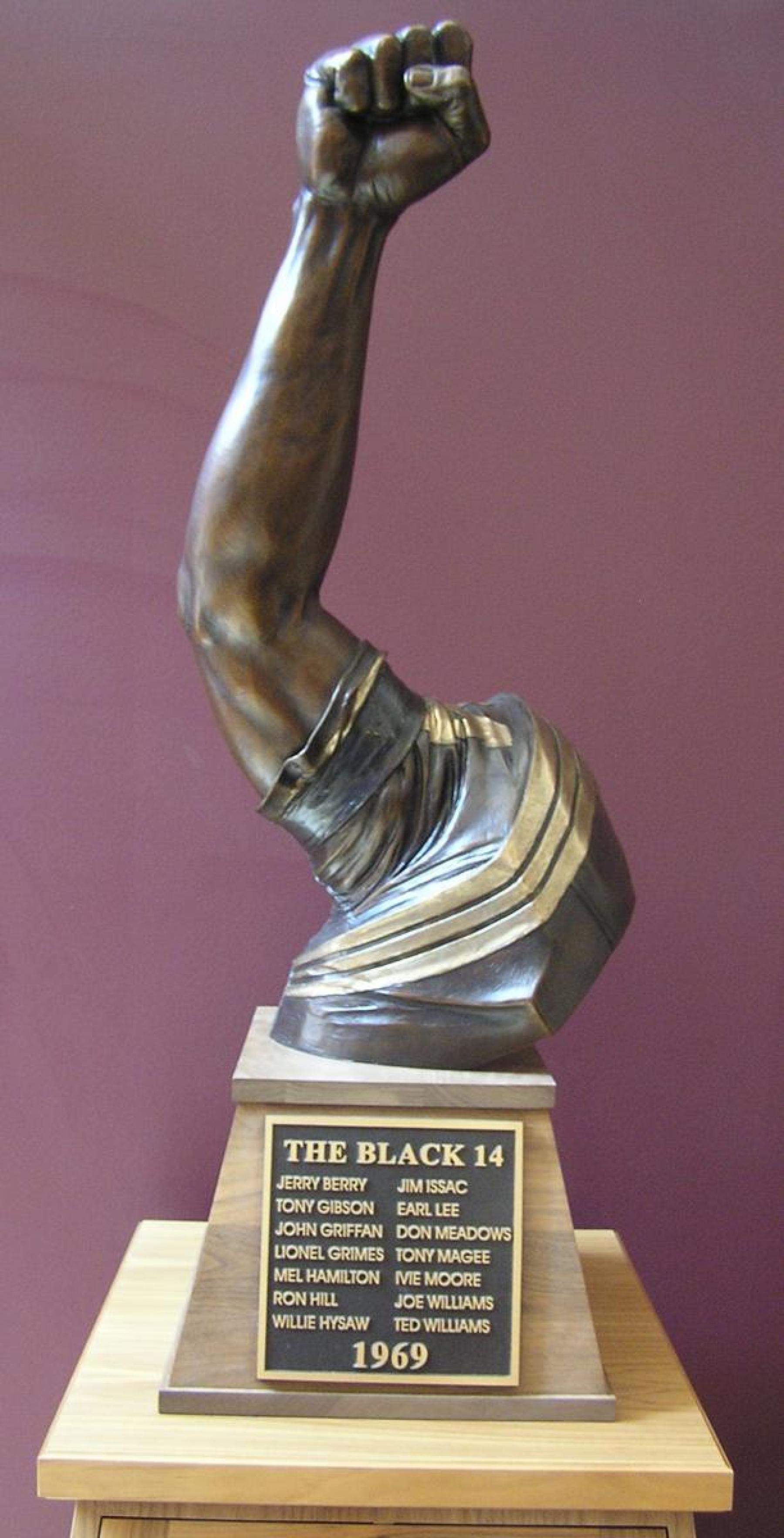
- The photo of the bronze Black 14 memorial statue is by Tom Rea.