Bissonette’s Deer Creek Post
In 1857, Joseph Bissonette, a fur trader who had worked North Platte-area posts since the early 1840s, relocated his trading activities from Fort Laramie to Deer Creek. He got his start working for Pratte and Cabanne at Fort Platte and Fort Bernard. By mid-decade, he was in partnership with John Baptiste Richard at Fort Bernard and with James Bordeaux at Sarpy’s Point, located near a prominent bend in the North Platte. In 1850, he struck out on his own on the North Platte. For unknown reasons, he made the ill-fated decision to relocate to LaBonte Creek in 1854. This venture proved disastrous. Having sold his interest in a lucrative Platte River toll bridge near Casper, he lost out on the hefty profits garnered from the emigrant trade. His business ventures further soured at LaBonte Creek, where he suffered significant financial losses from Native America raids in 1854 and 1855. The raids, along with various military edicts, saw him at Fort Laramie by the winter of 1855. Here his fortunes began to turn around. Friendship with Indian Agent Thomas Twiss resulted in his appointment as interpreter.

In 1857, Twiss relocated the Indian agency to the mouth of Deer Creek, and Bissonette followed. He constructed a post near Deer Creek in 1857 from which he conducted trade with natives on the Upper Platte Indian Agency and engaged in emigrant trade.1 He eventually also served as Deer Creek’s postmaster and stage station operator.2
Beginning in the fall of 1859, Bissonette extended store credit to a group of German Lutheran missionaries who arrived at Deer Creek with meager supplies to establish an Indian mission, joining Agent Twiss in providing them clothing and other goods until further funding reached them from Iowa and Germany.3 The missionaries’ presence at Deer Creek is remembered today for two well-documented Christmas celebrations, in 1859 and 1863, held at the mission compound upstream from Bissonette’s post—the first attended by Agent Twiss and a U.S. Army survey party under Captain William F. Raynolds, and the second by three boys from the Cheyenne tribe who were in the missionaries’ care.4
Bissonette’s tenure at Deer Creek was fraught with scandal. British travel writer Sir Richard Burton, who passed through the area in 1860, later wrote that annuity goods intended for the tribes often ended up on the shelves of Bissonette’s store, an accusation Twiss disputed.5 The store owner was also accused of trading excessive amounts of liquor to the natives. In 1861, a military sub-post was placed at Deer Creek, preventing the open sale of liquor and curtailing some of Bissonette’s profits.6
Twiss resigned office in 1861 when an incoming presidential administration appointed a new agent, John Loree, who moved the agency back nearer to Fort Laramie.7 Bissonette remained, however. His tradership was revoked in 1863 by Agent Loree and was not returned until 1864. By then, it was largely a moot point as increasing native hostilities in the region had already begun to adversely affect trading. By the summer of 1864, most of the tribes in the area were engaged in open conflict with the United States military. Through the fall and spring of 1864 and 1865, Bissonette lost up to seventy horses to the tribes. The increases in hostilities and governmental oversight reduced the profitability of the post to such an extent Bissonette abandoned the post in 1865. The next year, Native Americans burned Deer Creek.8
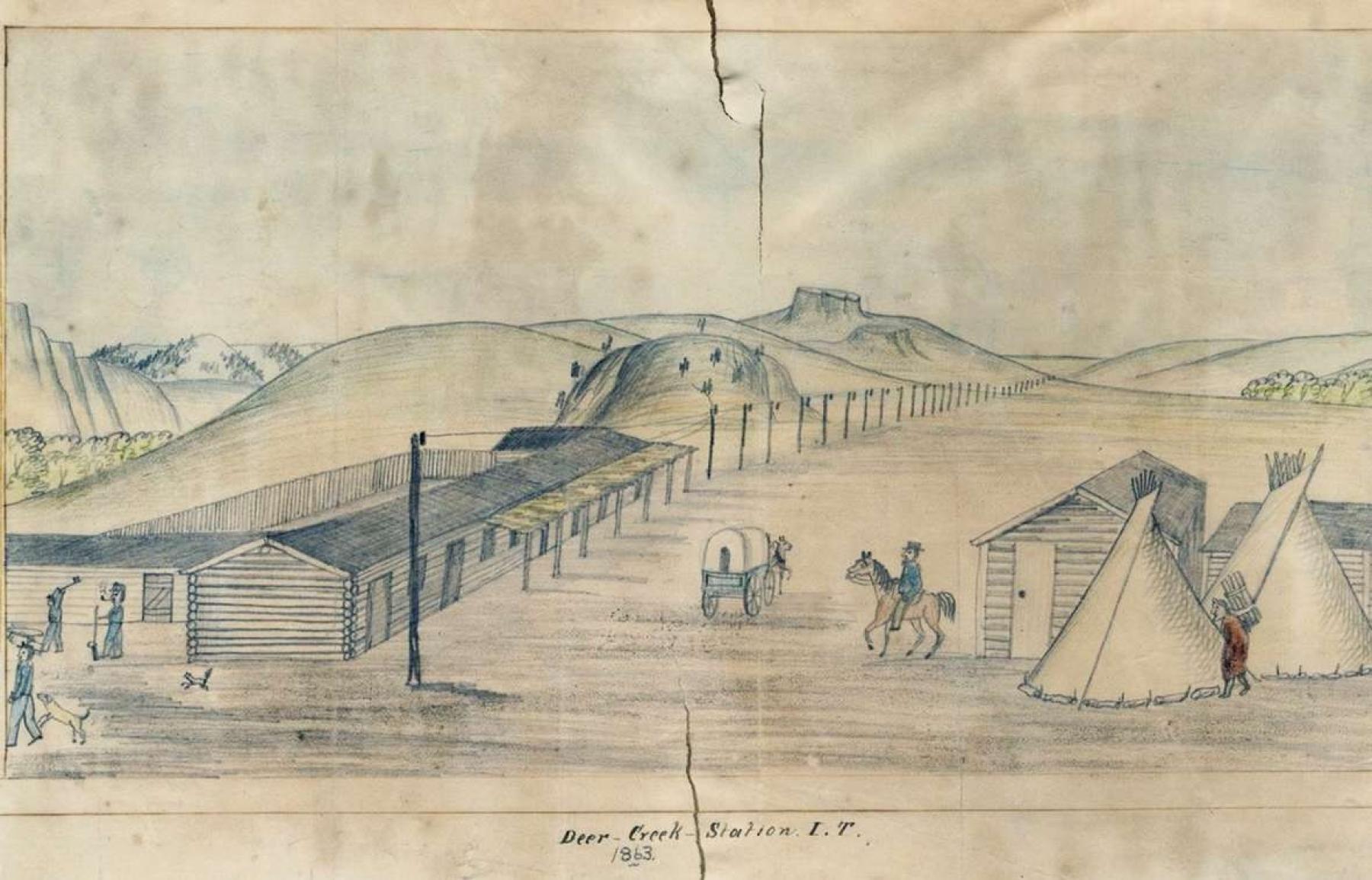
The location, size, layout, and types of trading activities at Deer Creek are relatively well known when compared to the other Bissonette posts. The Deer Creek Post was constructed a few miles from the Upper Platte Agency near the mouth of Deer Creek. Today the location of the post has been identified; it sits on 40 acres on the west bank of Deer Creek one-half mile south of its confluence with the Platte River. The site is just west of the north 200 block of 1st Street in Glenrock, Wyoming.9 This 40-acre site designation includes the Bissonette Post, a telegraph station, a post office, Pony Express station, and the military sub-post, with a portion of the Oregon Trail running through the site.10
The site was identified through historic documents and local collecting activities yielding nineteenth century material on the ground surface. There are no existing buildings at the site.11 Even so, the layout of the post is well documented in historical papers and maps. The Bissonette Post contained six buildings with fifteen rooms and three corrals. A map of the site was generated by Caspar Collins in the winter of 1863-1864.12 A trading house, blacksmith shop, hotel-saloon, and post office were part of the Bissonette Post.13
To date, the only artifacts recovered from the site have come from a private collection assembled by a local collector in the 1960s; no formal archaeological survey has been conducted there.14 A proper survey could help sort out exactly where each part of Deer Creek’s busy crossroads once stood: the stage station, Pony Express station, trading post, and military post all stood close together. Excavating the trading post itself could shed light on trade with the Upper Platte Agency, the emigrant traffic of the late 1850s and early 1860s, and how trade with Native peoples shifted as conflict in the region escalated toward all-out war by 1865.15
Until further excavation takes place, the story of Bissonette’s post at Deer Creek rests on documents, maps, and a handful of artifacts collected more than sixty years ago. Today, a historical marker in downtown Glenrock commemorates the trade, diplomacy, and conflict that once converged there.16
[Editor’s Note: Special thanks to the author and to the Wyoming State Historic Preservation Office for making this article available, and to the Wyoming Cultural Trust Fund for its ongoing support for this project. Greg Pierce’s historical monograph, Negotiating the West: A History of Wyoming Trading Posts, from which this article is adapted and excerpted, is one of many historic contexts published by the Wyoming State Historic Preservation Office. These documents are meant to offer a broad background against which historic developments can be better understood as the agency works to preserve properties and places important to an understanding of Wyoming’s past. The contexts also, however, are based on sound research and are full of well-told, vivid stories. With this in mind, WyoHistory.org is collaborating with the SHPO office to bring more of this history to a wider readership. The Cultural Trust has provided the funds to make this collaboration possible. We offer our thanks to all.]
Footnotes
-
Bill Bryans, Deer Creek: Frontiers Crossroad in Pre-territorial Wyoming (Glenrock, Wyo.: Glenrock Historical Commission, 1990), 43.
-
James H. Nottage, “Indian Agent Thomas Twiss, Man of Two Worlds,” WyoHistory.org, July 5, 2022, https://www.wyohistory.org/encyclopedia/indian-agent-thomas-twiss-man-two-worlds.
-
James H. Nottage, “Spreading the Gospel: Lutheran Missionaries at Deer Creek, 1859-1864,” WyoHistory.org, April 17, 2022, https://www.wyohistory.org/encyclopedia/spreading-gospel-lutheran-missionaries-deer-creek-1859-1864.
-
“Two Deer Creek Christmases,” WyoHistory.org (blog), December 21, 2022, https://www.wyohistory.org/blog/two-deer-creek-christmases.
-
Nottage, “Indian Agent Thomas Twiss, Man of Two Worlds.”
-
John D. McDermott, “Joseph Bissonette,” in The Mountain Men and the Fur Trade of the Far West, ed. LeRoy R. Hafen, vol. 4 (Glendale, CA: Arthur H. Clark, 2001), 56–58; W. F. Raynolds, The Yellow Stone Expedition: Preliminary Report of Capt. W. F. Raynolds, Topographical Engineers (Washington, DC: George W. Bowman, Printer, 1860); Thomas Twiss, Upper Platte Indian Agency, to A. M. Robinson, Superintendent of Indian Affairs, October 10 and 11, 1860, Upper Platte Agency Letters, National Archives, Washington, DC.
-
Nottage, “Indian Agent Thomas Twiss, a Man of Two Worlds.”
-
McDermott, “Joseph Bissonette,” 57–58.
-
Bill Bryans, “Deer Creek Station, Site Report” (report submitted to the Wyoming State Historic Preservation Office, State Parks and Cultural Resources, Cheyenne, Wyoming, 1986), 8.
-
Bryans, “Deer Creek Station,” 8; McDermott, “Joseph Bissonette,” 58; Dorothy M. Johnson, The Bloody Bozeman: The Perilous Trail to Montana’s Gold (New York: McGraw-Hill, 1971), 55–56.
-
Bryans, “Deer Creek Station,” 8.
-
Bryans, “Deer Creek Station,” 8–9; Caspar Collins, “Plans of Deer Creek Station, Camp Marshal, Sweetwater Station, South Pass Station, Three Crossings Station, and St. Mary’s Station,” n.d., Special Collections, Colorado State University Library, Fort Collins, Colorado, 1; Danny N. Walker, “Archeological Investigations at Seminoe’s Trading Post, 48NA288, Natrona County, Wyoming” (report prepared for the Wyoming State Historic Preservation Office, Laramie, WY, 2009), 33.
-
McDermott, “Joseph Bissonette,” 56; Walker, “Archeological Investigations at Seminoe’s Trading Post,” 33.
-
Greg Pierce, Trading Posts in Wyoming, Multiple Property Documentation Form, National Register of Historic Places, Wyoming State Historic Preservation Office, State Parks and Cultural Resources, Cheyenne, Wyoming, 2012, Section E, 70.
-
Ibid.
-
“Deer Creek Station,” Field Trips, WyoHistory.org, accessed September 2, 2026, https://wyohistory.org/field-trips/deer-creek-station.