When Wyoming Became an Alien Planet: Two Extras Remember Starship Troopers
By Leslie Waggener
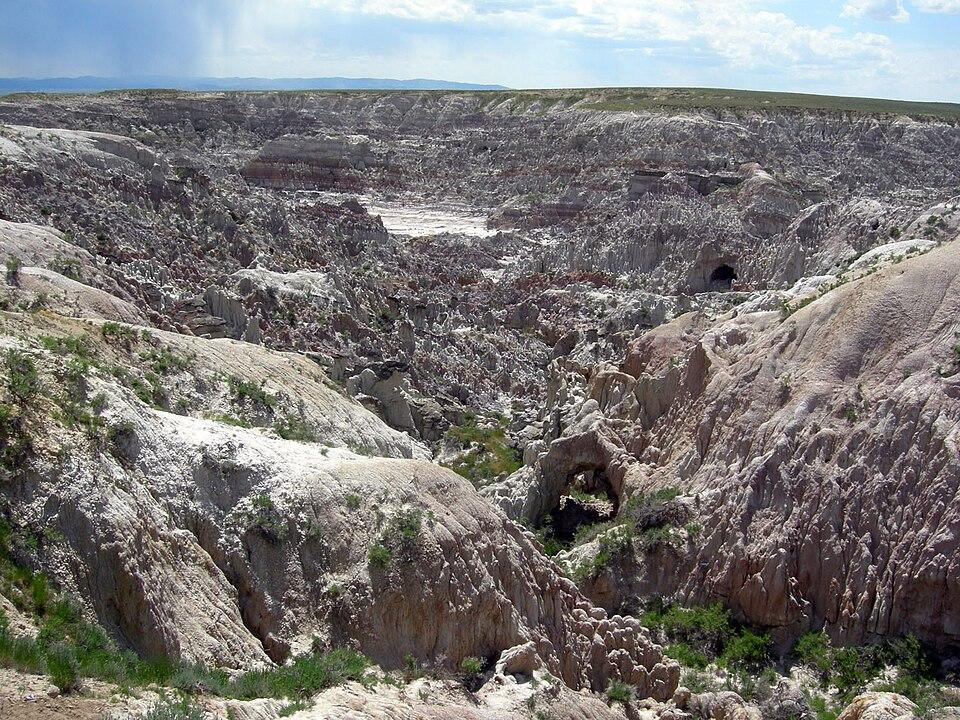
In the spring of 1996, the barren landscape of Hell’s Half Acre transformed into the alien planet Klendathu. For six weeks, Hollywood descended on the geological oddity 40 miles west of Casper, bringing with them director Paul Verhoeven, stars like Casper Van Dien and Denise Richards, and about 300 local extras ready to become Mobile Infantry troopers.
Among those extras were Melissa Parkinson and Tana Libolt, two University of Wyoming students who answered a newspaper ad seeking locals to battle computer-generated bugs in an ambitious sci-fi production. Nearly 30 years later, their memories paint a vivid picture of heat, exhaustion, camaraderie, and the strange magic of moviemaking in the Wyoming outback.
Breaking Into Hollywood’s Boot Camp
Parkinson, then working on her second bachelor’s degree in archaeology, spotted the recruitment ad and showed up to what she describes as a “cattle-call-style” casting. The process was simple: fill out a form, take a picture, and wait for callbacks. When they came, she found herself in an unexpected mini boot camp alongside about a dozen other “first string” extras.
“They paired us off with Casper Van Dien,” Parkinson recalls. “We spent the day with him, learning to look like a platoon and the proper things to call our weapons.” The training was run by a retired gunnery sergeant to acclimate them to look like soldiers, although he reminded them not to take it too seriously, but have fun.
The day ended with an impromptu autograph session that captured the production’s casual spirit. When the extras asked Van Dien if he was going to be famous, they requested his autograph—then pushed the signed papers back. “We said, ‘No, we want them personalized,’” Parkinson laughs. “He was really nice. He did it. Real sport.”
Playing Dead in a Slaughter
Parkinson’s first scene set the tone for the production’s intensity. Cast as a corpse in Port Joe Smith, where Mormon colonists had been massacred by the Arachnids, she spent hours lying motionless while a crew member with a portable bug sprayer filled with fake blood hosed her down. “They put the sprayer in my helmet and just filled it, basically,” she remembers. “I just laid there on my back for a couple hours. Kind of took a nap, until they got the shot.” When she accidentally moved, a stagehand who hadn’t realized she was a live extra jumped: “Oh! This one’s alive!”
Above the scene, director Paul Verhoeven’s voice boomed across the set. “More blood! I want more blood! This is a slaughter!” Parkinson’s internal response: “No, please, no. No more blood.” The sticky, soap-scented fake blood clung to costumes and hair, forcing extras to drive back to Casper looking like gunshot victims. “It was Casper,” notes West Magoon, who knew several people on the production. “Nobody looked. It’s like New York.”
The Challenges of Costume and Climate
The production struggled with logistics from the start. They’d ordered armor sized for larger actors, leaving many extras swimming in oversized chest plates that hung awkwardly from their shoulders. But the real torture, both women agree, was the neoprene neck piece.
“It was awful,” Parkinson says. “Like taking a rubber mouse pad and velcroing it to your neck and wearing it all day in the heat with this heavy thing over your head.” The difficulty of removing the costume for bathroom breaks—requiring complete disrobing—discouraged water consumption, leading to dehydration issues. Parkinson herself got sick and had to take two days off, learning “what your kidneys can handle in extreme heat and not drinking enough.”
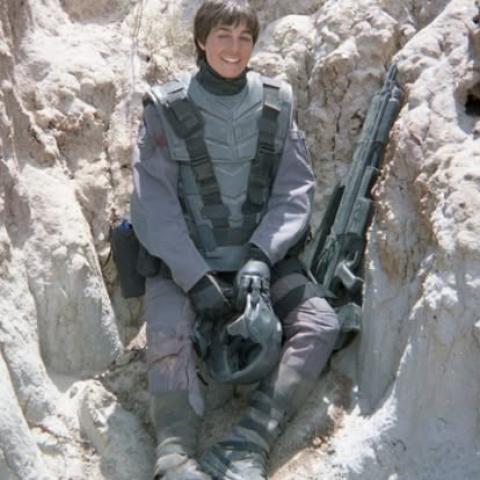
The heat took adjustment. “It took three days to adjust to the misery, and then you’re okay,” Parkinson notes. “But it took some… there was some pain involved.”
Libolt, who joined the production after Parkinson, remembers the strange morning ritual of getting helmet-ready. “For some reason, they had hired quite a lot of women with long hair to be extras,” she says. “In order to get the helmets to fit, they had quite a few different people that would spend every morning literally just making tiny braids, pinning them to the heads of every woman.”
Chaos by Design
The most memorable night came during the Klendathu invasion sequence. Libolt spent weeks working on the Brain Bug capture scene, stationed on hills with other extras, repeatedly running down to celebrate victory. “One particular other extra, I would throw my arms around and hug him,” she recalls, “and he was complaining as the day went on, ‘You’re getting slower and slower getting down here to me.’”
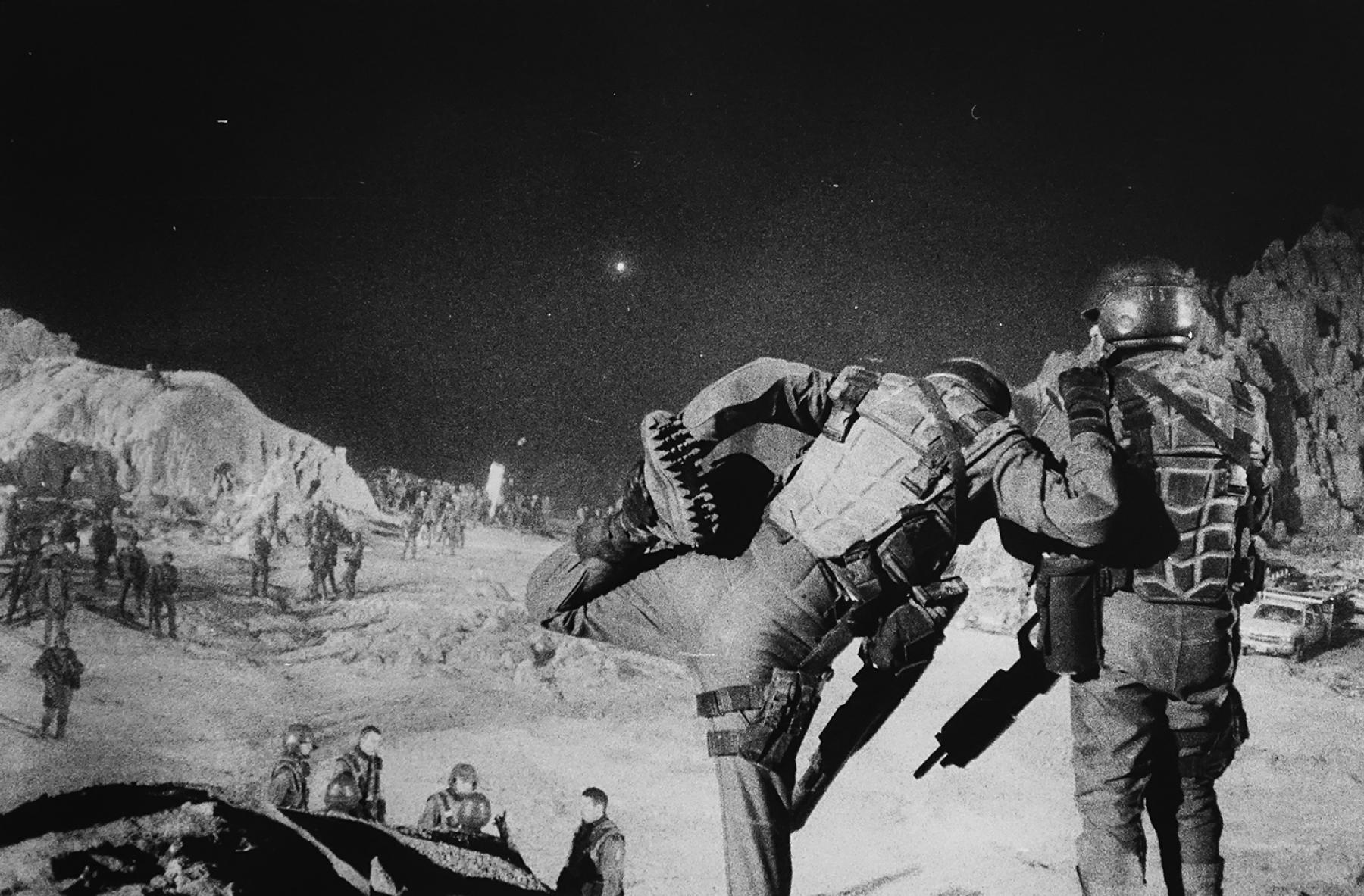
For the chaotic landing scene, Verhoeven initially had the action carefully choreographed. Then he changed his mind. “He decided, ‘No, no! They’re brand new soldiers. They wouldn’t know how to do this. They don’t have these skills. I want chaos, chaos!’” Libolt remembers. “The choreography went away. Somebody went down with a sprained ankle or bad knee almost every take, it seemed like.”
The night shoots presented their own challenges. After spending half a night carefully choreographing soldier movements, extras found themselves simply trying to protect their safety as they ran through jagged rock formations.
The Magic of Movie-Making
Both women discovered that fighting aliens requires considerable imagination. Parkinson remembers being given points to direct toward and models showing what they were reacting to. “It was really strange when the movie finally happened, and I was like, ‘Oh, wow! That’s what we were running from,’” she says. “It was just kind of a disconnect.”
For the Brain Bug scenes, at least, they had something tangible to work with: a full-size puppet of the bug’s head on a metal armature, complete with electronically controlled spider-like eyes. Though Verhoeven’s direction to get “more mucus on the vagina” (the bug’s mouth) raised eyebrows when an assistant diplomatically translated it to “more mucus on the sphincter.”
The production’s attention to detail extended to the weapons. “The boots were Adidas, and the weapons were Rubbermaid,” Parkinson notes wryly. Some of the Rubbermaid rifles actually fired blanks, requiring extensive safety training for the extras who carried them.
Unexpected Perks and Camaraderie
Despite the grueling conditions, the production treated its extras remarkably well. Early in the shoot, catering served steak, chicken, or fish daily—though extras quickly learned not to eat full meals before running in the heat in their costumes. “Incredible food, incredible catering,” Parkinson says. The cast integrated seamlessly with extras at meals. “We all ate lunch together,” Parkinson notes. “They didn’t need a bunch of starstruck people. So they just integrated us really well.”
Van Dien particularly stood out for his friendliness. “During the night shoots, he would walk around quite a lot, just chatting with extras,” Libolt remembers. “He was really friendly, outgoing.”
The production wrapped with a “Bug Bowl” at El Marco Lanes bowling alley, where cast, crew, and extras bowled together. Michael Ironside, who played Lt. Rasczak, spent most of his time at the pool table.
Captain Dye’s Speech
Perhaps the most memorable moment for Libolt came during a rain delay when the extras gathered in the cafeteria tent. Captain Dale Dye, the military consultant who ran Warriors Inc. and managed the extras, stood up to address the group.
“He said, ‘In LA, we could never get extras to do this, you know, $5 an hour,’” Libolt recalls. “And he said, ‘You’re making this film.’ He felt like it would not have looked the same way being made elsewhere, and he was really sincere and complimentary. You could see his investment. He really cared that the film looked good and told the story well, and I was really touched by that.”
The extras earned $5.50 an hour as non-union production workers, but long 12-14 hour days meant substantial overtime.
Hell’s Half Acre Transformed
The six-week shoot in Hell’s Half Acre presented unique challenges beyond heat and costume. The location, which had been closed to public access, sits on 320 acres of an unusual eroded landscape within a 960-acre county-owned tract. The bentonite soil became treacherous when it rained. “When it rained, it was a mud bog, and there were sinkholes, too,” Parkinson remembers. “I remember somebody walking through one and just sinking up to their hip and having to pull everything back out.”
During rain delays, the production team would decamp to Eastridge Mall’s food court, where writers and directors worked out scenes. “Nobody knew who they were. They could pretty much do anything in Casper because nobody really knew who they were.” Parkinson says. “I mean, we knew, so we would go watch, kind of walk around, take a stroll through the food court.”
The landscape’s archaeological significance didn’t escape Parkinson’s notice as a student archaeologist. Sitting on set one day, she noticed crocodile teeth washing out of the ancient lake bed. “There’s a lot of fossils down there,” she notes. At the shoot’s end, the fire department hosed out the roads to help restore the site.
Reflections
Neither woman immediately appreciated the film. “I’m not a huge fan of Heinlein,” Parkinson admits, though she’s grown to appreciate the satirical elements over time. “I meet people who really like it, which I think makes it more interesting.” The film has indeed developed a cult following, with some viewers seeing it as a sharp critique of militarism and fascism.
Libolt was put off by the gore. “I’m just not a fan of gore, you know? It was pretty gross.”
Both can spot themselves in the final film—barely. Parkinson found her arm in the Port Joe Smith massacre scene and knew she was just off-camera during the final jubilation sequence. Libolt thinks she might be one of the tiny figures jumping up and down in distant background shots.
“I’m glad I was in my 20s when I did it,” Parkinson reflects. “I don’t think I could do it now.”
Hell’s Half Acre hasn’t hosted a film production since Starship Troopers wrapped in June 1996. The site remains closed to the public, though advocacy groups have pushed to reopen it for outdoor recreation. For Parkinson and Libolt, though, those six weeks transformed the eroded badlands into something more: a memory of youth, endurance, and the peculiar magic of pretending to fight giant bugs in the Wyoming heat.
Starship Troopers premiered in Casper in November 1997, with Casper Van Dien in attendance. The film went on to gross over $121 million worldwide and has since been re-evaluated as a prescient satire of militarism and propaganda. For 300 local extras, it remains a unique chapter in Wyoming’s Hollywood history—and proof that sometimes the best economic development comes from Hollywood discovering what locals already knew: Hell’s Half Acre is truly otherworldly.