“To the Utmost of Her Power:” Consent, Force, and an 1897 Wyoming Court Case
Content note: This post discusses a historical case of alleged rape and the legal treatment of sexual violence.
By Leslie Waggener
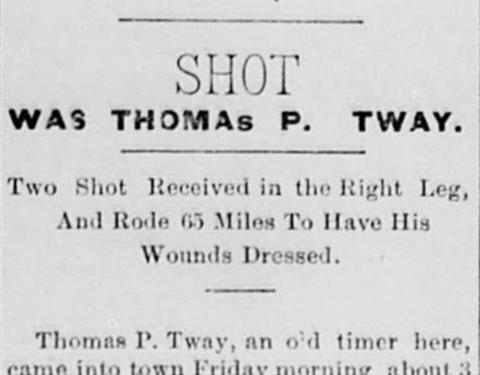
On the evening of Thursday, May 21, 1896, Thomas P. Tway walked out of a saloon at Rongis, in Fremont County’s Sweetwater Valley, and headed for his wagon. Gib Stevens stepped from behind a building and fired a revolver. As Tway reached for his own gun, a shotgun blast tore a ten-inch furrow through his right thigh. With a fresh team and driver, Tway reached Lander, some sixty-five miles away, at about 3:00 a.m. to have his wounds dressed. “No, we never had any trouble before,” he told the Wind River Mountaineer, “and I thought we were friends.”
Gib Stevens had a different story. His wife, Julia, had written to him that Tway had raped her. Two days after the shooting, Stevens swore to a complaint charging Tway with rape. The case that followed ended in a conviction, a reversal by the Wyoming Supreme Court, and, in the end, no verdict at all.
It’s a case worth revisiting this fall. In Ithaca, New York, prosecutors have said they will reopen an alleged 2024 rape case involving Cornell University students. The news has renewed an old question: how does the law decide whether a sexual encounter was consensual?
A Night in May
Julia Stevens had known Tway about five years. On May 9, by her later testimony, he stopped at the ranch where she lived with her three children, ages six, two, and ten months, while her husband was away working on the range. He explained that his horse was tired. She gave him supper, showed him to a bedroom, and locked his door. Through the log partition between their rooms, she said, he made an indecent proposal and offered her a cow. She refused. Then he asked for matches.
From there the accounts split. Julia Stevens testified that when she brought the matches, Tway broke open the door, dragged her in, and forced intercourse on her. She said she resisted with all her strength at first but was soon exhausted, and that she was not afraid of him; he overpowered her. Tway testified that she opened the door, came into his room, and consented.
The next morning, by her account, she made breakfast and the two ate together. That day she visited a neighboring ranch and told no one there what had happened.
Newspaper accounts from the time add detail but leave questions. The Mountaineer described Julia Stevens as a woman of “good character” and stated that, from what its reporter had learned, that her letter accused Tway of forcing her at gunpoint. The letter itself has not been found, and the account is secondhand. The Casper Derrick said Gib Stevens “claims intimacy between his wife and Tway,” a period euphemism that could describe either a consensual relationship or the assault his wife reported. Tway, the paper noted, was himself married, with three children.
Conviction and Reversal
In late June 1896, a jury in Lander found Tway guilty. He was sentenced to fifteen years in the penitentiary at Laramie.
Wyoming’s 1890 rape statute made sex with a girl under eighteen rape, consent or no consent. That was an unusually high age for the time. For an adult woman, though, the state had to prove the act was done “forcibly and against her will,” and the law didn’t say how.
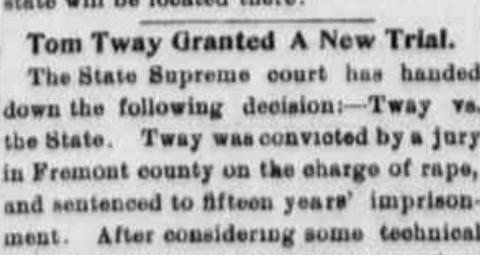
In September 1897, the Wyoming Supreme Court threw out the conviction. The justices said two things. First, a woman’s word can be enough: a jury doesn’t need other evidence to convict a man of rape. Second, the court maintained that Julia Stevens’s own story showed that she hadn’t fought back hard enough. Because she had testified that she wasn’t afraid of Tway, the justices held, she had to resist “to the utmost of her power.” To their way of thinking, signs of that resistance were missing: no bruises, no torn clothing, no sign the door had been forced, no outcry loud enough to wake the children, and no prompt complaint. They also noted that the two had parted on friendly terms the next morning. The court ordered a new trial.
No Second Verdict
The new trial never came. In June 1897, the charge against Gib Stevens for the shooting was dismissed. That October, Tway was brought from the Laramie penitentiary to Lander and posted a $200 bond to await retrial. In December 1897, on the county attorney’s motion, the rape case was dismissed. Tway had served about sixteen months. None of the newspaper reports gave a reason.
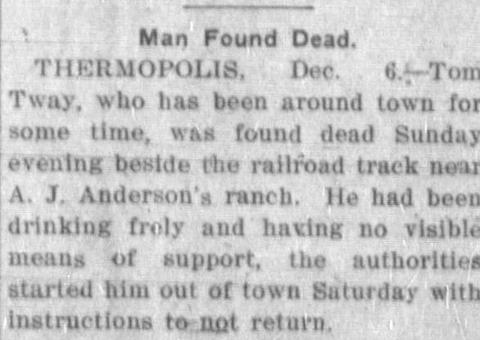
Fourteen years later, in December 1911, the Laramie Daily Boomerang carried a short dispatch from Thermopolis: Tom Tway had been found dead beside the railroad track outside town. The authorities had ordered him out of town the day before. He was forty-six.
Then and Now
The rule that a woman had to resist “to the utmost of her power” is gone. Wyoming’s 1890 rape statute stayed in force, nearly unchanged, for decades. In 1977, the legislature replaced it with a set of sexual-assault laws. Today the question is whether a victim’s submission was caused by means “that would prevent resistance by a victim of ordinary resolution,” or by a substance given without the victim’s knowledge.
The old rule also rested on assumptions about how victims behave that research has since undercut. Researchers now understand that people being sexually assaulted often don’t fight back. In a 2017 Swedish study of 298 women treated at an emergency clinic after an assault, 70 percent reported significant involuntary paralysis during the attack. Survivors may also act calmly or even stay friendly with an assailant afterward, out of shock, fear, or denial.
The court’s other rule, that a woman’s word can be enough, lasted. In rejecting Tway’s argument that a rape conviction needed corroborating evidence, the court affirmed that a victim’s word alone could be enough. The Wyoming Supreme Court cited Tway for that principle as recently as 1989: “We have long recognized that uncorroborated testimony of a victim may sustain a conviction for sexual assault.”
None of that settled what happened at the Stevens ranch in May 1896. A jury believed Julia Stevens, the Supreme Court held that the evidence fell short of the standard of its day, and no jury heard the case again. Her account reached the court through a letter to her husband, a shooting, and newspapers that told the story in different ways, and the justices weighed it against their own assumptions about how a woman should behave. More than a century later, cases like the one at Cornell still turn on more than whose account is believed: what counts as evidence, how a victim’s behavior is read, and how the people and institutions responsible for investigating respond.
If you or someone you know has experienced sexual assault, free, confidential help is available 24/7 through the National Sexual Assault Hotline: 800-656-4673, or online chat at online.rainn.org.
The Wyoming Coalition Against Domestic Violence and Sexual Assault can connect you with local advocates: 307-755-5481 or 844-264-8080, wyomingdvsa.org. The Wyoming Division of Victim Services lists sexual assault advocacy programs, including sexual assault nurse examiner programs, by county at dvs.wyo.gov/victim-service-providers.
Primary Sources
- Tway v. State, 7 Wyo. 74, 50 P. 188 (1897). Quotes Laws of Wyoming 1890–91, chap. 6, sec. 1.
- Full text of Tway: OpenJurist, 7 Wyo. 74.
- Muniz v. State, 783 P.2d 141 (Wyo. 1989), Justia.
- Wind River Mountaineer (Lander), May 27, 1896, “Shot Was Thomas P. Tway”; July 1, 1896; July 8, 1896; October 18, 1897; December 20, 1897.
- The Clipper (Lander), March 26, 1897; June 25, 1897; “Tom Tway Granted a New Trial,” October 1, 1897.
- Daily Boomerang (Laramie), June 5, 1896, reprinting the Casper Derrick; “Man Found Dead,” December 6, 1911.
- Weekly Boomerang (Laramie), September 30, 1897.
- “Cornell fraternity rape case is reopened as new details emerge.” NPR, via KUNC, September 28, 2026, updated September 29, 2026.
Secondary Sources
- Randall B. Carnahan, “An Examination of Wyoming's Indecent Liberties Statute and Proposals for Reform,” Wyoming Law Review 2, no. 2 (2002): 533, 538.
- Wyo. Stat. §§ 6-2-302, 6-2-303, as given by WomensLaw.org, current through the 2025 General Session.
- Kimberly Hamlin, “What Raising the Age of Sexual Consent Taught Women About the Vote,” Smithsonian, August 26, 2020.
- Anna Möller et al., tonic immobility study, Acta Obstetricia et Gynecologica Scandinavica (2017), as reported in Wiley’s press release, June 2017.
- Thomas Perry Tway, Find a Grave, memorial 91765193. Created by Rose Wenstrom, added June 11, 2012.