Memories of a 1990 Girl Guard
By Rosalind Routt Schliske
All our professional military lives, we had constructed barriers, sometimes physical, always emotional, against one another, for we feared we wouldn’t be accepted in the boys’ club known as the U.S. Army and Air Force. But then in the late 1980s, something extraordinary occurred in the Wyoming National Guard.
A large group of Army and Air Guard officer and enlisted women organized themselves into a special group called the “Girl Guard” ostensibly to participate in the 1990 Centennial reenactment of Wyoming’s statehood ceremony. A decade later, the group has evolved into much more than that.
It now seems hard to believe how little Wyoming Guard women knew about one another. In fact, during our early meetings we had to learn not only first names but also military affiliations; later whether a Girl Guard member was Army or Air, officer or enlisted mattered little. What did matter was the remarkable collection of talent we had assembled without really planning it. Each of us brought a much-needed military skill to the organizational phase.
We used logistics, transportation, finance, drill and ceremony, training, administration, clerical, public affairs, planning and operations, and supply, to name a few. In short, we operated as a well-oiled military machine. (However, we will also be eternally grateful to the few military women who had learned to sew and then oversaw the construction of our complicated uniforms for a variety of dress sizes–all without a pattern!)
Ironically, as military women, most of us had neither the time nor inclination to be a part of “a little women’s civic group.” In addition, we were consumed with our other roles as wives and mothers (sometimes mothers-to-be) as well as our full-time civilian jobs. Yet unconsciously the Girl Guard assumed so many different identities.
Sometimes I felt as if I were back in my college sorority house in the 1960s. As we crammed into small dressing areas before an event, the air would be so filled with hair spray it was a wonder some agency didn’t declare a health alert. Other times the Girl Guard acted like a fun-loving social club. I remember one spring weekend we took over Cheyenne’s Old West Museum for a catered dinner, dance, casino gambling, and auction to raise operating funds. Still, at other times, we felt like a civic club although the phrase chanted often like a mantra at meetings still rings in my ears, “No bake sales.” We also served as an educational force in various communities to spread not only the message of today’s Wyoming Guard but also of yesterday’s Girl Guard.
I’ll always remember speaking to about 400 elementary school students on their next to last day of school one June. When I asked a teacher who seemed to be in charge of the mob assembling in the combination auditorium/cafeteria how long she wanted my presentation, she wearily shook her head and whimpered, “Please take all afternoon.”
But throughout it all, we were always a patriotic organization. We had a soft spot in our hearts when the American Legion or VFW called and especially for the governor because we were “his own.”
From the first day, contrast was to be the hallmark of our existence. Here were these modern women, trained by the most sophisticated military in the world, dressed in 19th-century military caps and jackets—but full, ankle-length skirts—carrying wooden rifles in our white-gloved hands.
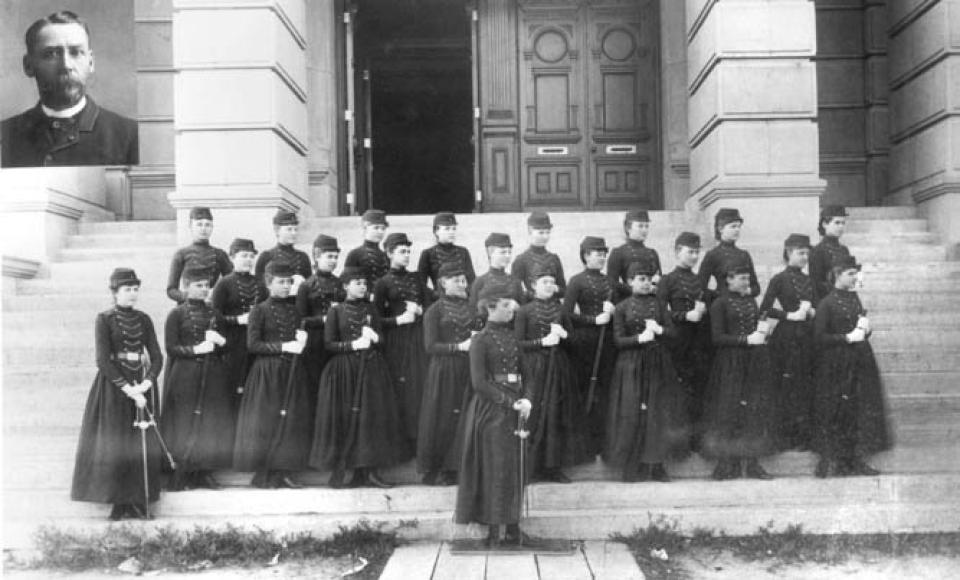
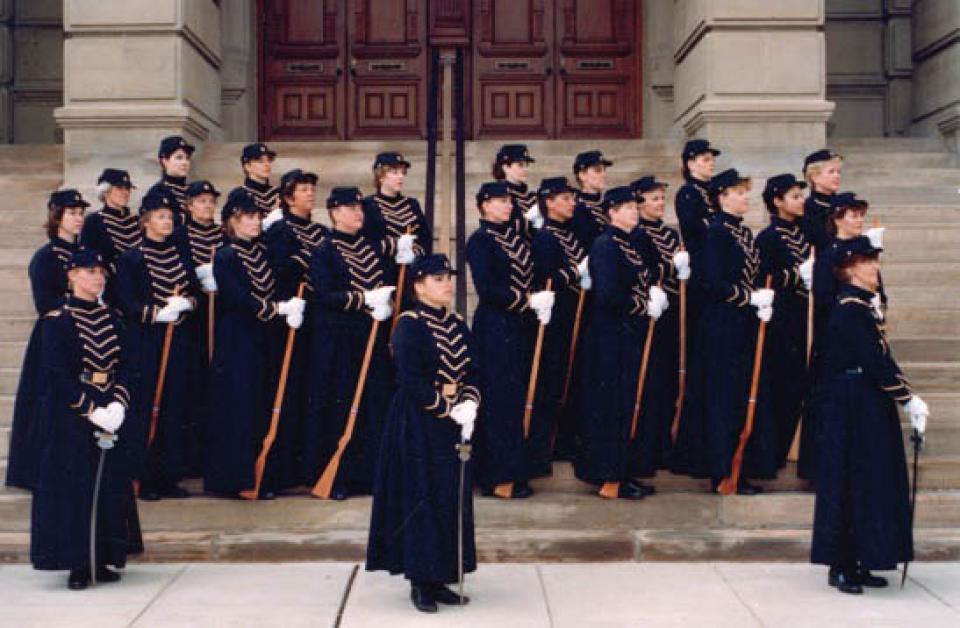
Often that contrast came as a startling jolt. For example, because Girl Guard members already possessed security clearances, one hot summer afternoon we served as an honor guard for a high-ranking dignitary deplaning at Cheyenne’s airport. Beforehand, however, the Secret Service had briefed us on how to handle possible terrorist attacks.
One November at War Memorial Stadium during halftime of the University of Wyoming–Brigham Young University football game, we marched as part of a Veterans’ Day salute. As I provided the narration from high atop the press box, I recall, first, how small we looked on the playing field, and second, how anachronistic we looked next to the military units and marching bands.
And who could forget the endless parades we marched in, especially those whose planners placed us after—not before—the horses? In fact, we were much like the U.S. Postal Service. We marched through rain, sleet, snow, and dark of night, which pretty much summed up one evening’s Christmas parade in Cheyenne when the air temperature was below zero.
On the other hand, sometimes when the Girl Guard gathered, you would swear you had been transported to Wyoming in the 1800s. That point was dramatically illustrated the one Saturday afternoon we hosted a reception at the Historic Governors’ Mansion to honor our contributors. We looked so elegant as we chatted with our donors in the Victorian style drawing room or served tea from a 20-foot-long table laden with silver trays of desserts. OK, so we baked, but we didn’t sell.
We were also a hit at the opening of the restored frontier prison at the Territorial Park complex in Laramie. We looked right at home when we conducted walking tours of historic houses in downtown Cheyenne.
Yet the reason for our organizing in the first place was to participate in the centennial reenactment of the ceremony marking Wyoming’s admission as the 44th state of the United States. We researched diligently so that we could be as authentic as possible, and we each took the name of one of the original Girl Guard members.
But, God, how we hated the group’s name—“girl.” It represented the antithesis of all we had worked for our entire professional lives. Nevertheless, historical accuracy had to prevail.
Years later, I was taking my college journalism students to Wyoming’s Capitol to learn how to cover a bill in the Legislature. En route, the students wanted to stop at the statue of Esther Hobart Morris, a symbol of women’s equality. Suddenly, a wave of nostalgia came over me as I recalled precisely where I was standing on July 10, 1990. I tried to convey to the students some of the feelings we Girl Guard members experienced that day when we had a front-row view of history.
What I didn’t share was memories from those beginning organizational days. We had learned so much history and shared so many inspiring moments. But, in the end, what I will always cherish is the fact that we were just a bunch of girls in the Guard.
In the more than 30 years since the Girl Guard was reorganized, the women participated in the 1997 dedication of the Military Women’s Memorial at the gateway to Arlington National Cemetery and led the march from downtown Cheyenne to the ceremony at the Capitol on December 10, 2019, to mark the 150th anniversary of women’s suffrage becoming law in Wyoming. Annually, the group participates in the Wyoming National Guard’s Governor’s Reception as well as the Outstanding Airman and Soldier of the Year awards banquet.
Learn more about the Wyoming National Guard by reading:
Cowboy Soldiers: The History of the Wyoming National Guard, Volume 1, 1870–1945. Order your copy at https://www.wynghistory.org/. Copies are available for purchase at the Wyoming National Guard Museum, 624 E. Pershing Blvd. Cheyenne, Wednesday–Friday, 10 a.m.–4 p.m. Call 307-432-0057 to ensure it is open.
Rosalind Routt Schliske taught journalism at Laramie County Community College for 40 years and served in the Wyoming Army National Guard as commander of the 197th Public Affairs Detachment. After her retirement from teaching, she volunteered to be managing editor of the first comprehensive history of the Wyoming National Guard, Cowboy Soldiers: The History of the Wyoming National Guard, Volume 1: 1870–1945. Nearly 40 years later, she still fondly recalls her time as a Girl Guard.
Related articles
The Wyoming Guard on the Mexican Border, 1916
Esther Hobart Morris, Justice of the Peace and Icon of Women’s Rights
Right Choice, Wrong Reasons: Wyoming Women Win the Right to Vote