Layers of Paint: Rediscovering the Capitol Vaults
By Kylie L. McCormick
When workers began restoring the six vaults at the Wyoming State Capitol, they made a remarkable discovery. Hidden under layers of dull brown and mint green paint were dreamy landscapes framed by Art Nouveau line drawings. The discovery led to a full restoration effort.
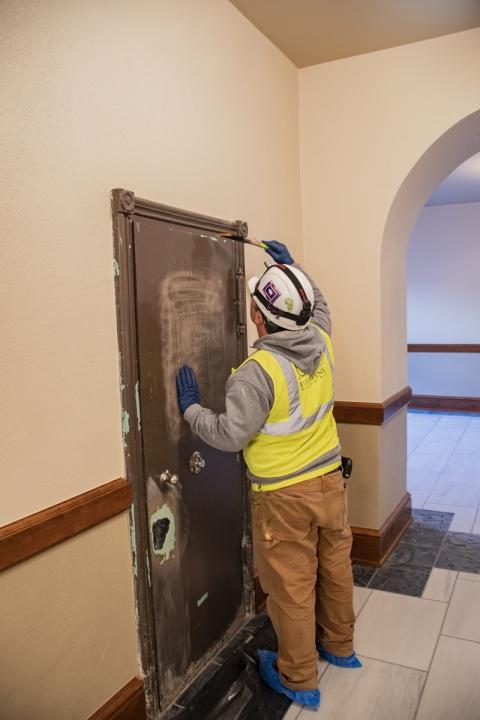
Two employees of EverGreene Architectural Arts meticulously stripped back the layers of paint, revealing the original artwork, then diligently repaired the damage sustained over years of wear and cover-up. One of the workers was a classically trained artist with a background in conservation, while the other had a background in construction and learned conservation on the job. A Capitol employee recalled walking by one of the artists lying on his back and painting slowly, “like a sloth,” to restore the fine lines framing the vault.
By the time WyoHistory.org and Dimensional Innovations joined the project to create text panels for the Capitol exhibit, the doors of the vaults were back to their original glory. Still, there were more discoveries to be made.
Researching history can often feel like removing layers of paint. Peeling back layer after layer, you can find pieces of the original picture, while other parts remain lost and require an educated guess to tell a complete story.
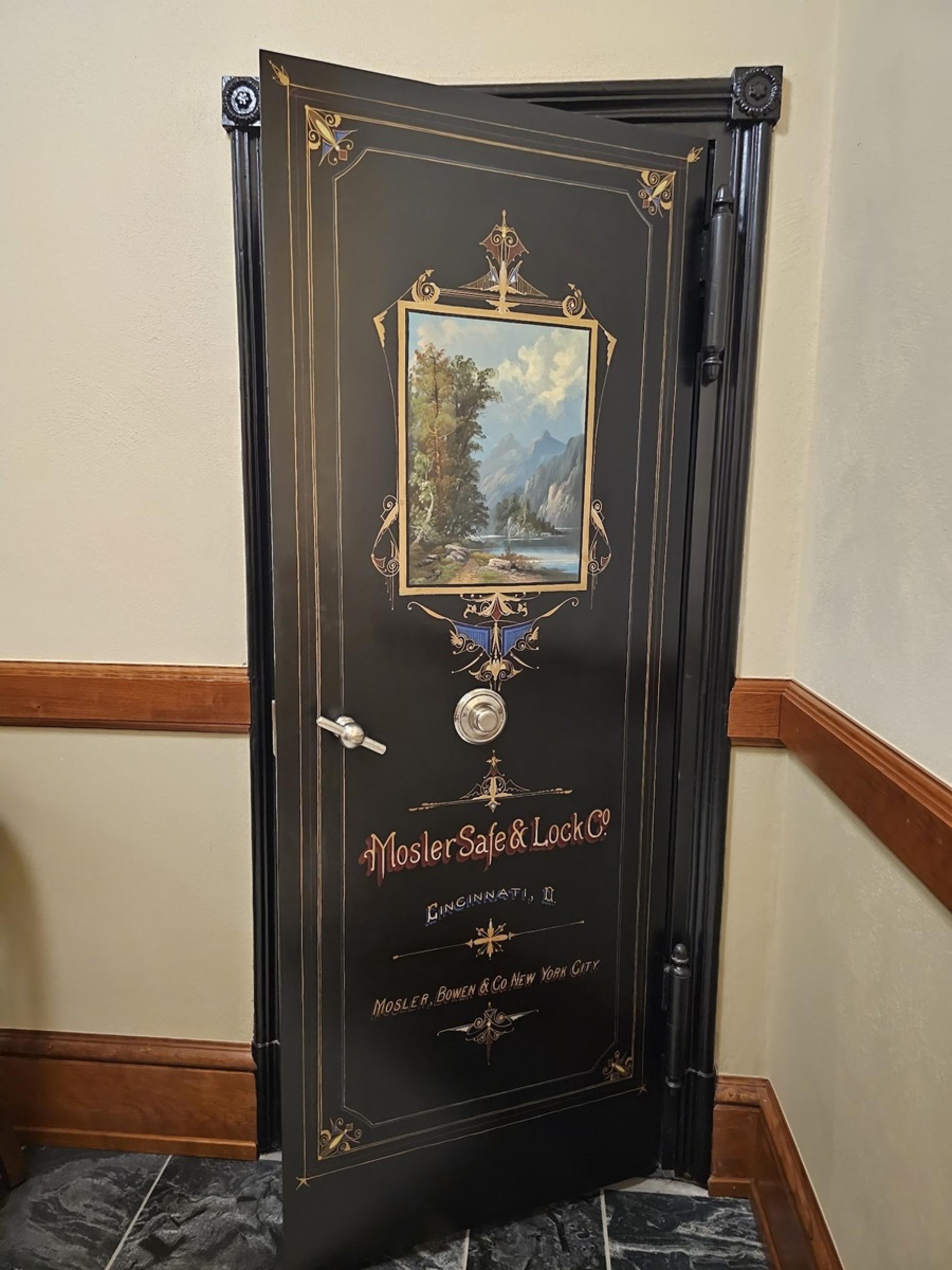
My first layer of research required learning more about the company behind the vaults and trying to explain why there were paintings and artistic details on the vaults.
The vaults were made by the Mosler Safe & Lock Company of Cincinnati, one of the largest safe and vault companies in the country at the time. When the Mosler Company installed the vaults during the 1888 construction of the Wyoming State Capitol, the company was under the direction of brothers Moses, Julius, and William Mosler.
Moses Mosler served as the company’s president. He had a mechanical mind and improved the company’s safes by inventing new locking mechanisms, fireproof methods, and vault doors.
Julius and William Mosler were more business-minded. Julius was the company’s vice president and treasurer, while William was the company’s secretary. Julius’s untimely death in 1890 left the company to Moses and William.
They were sons of Gustave Mosler, who founded Mosler, Bahmann & Company with Fred Bahmann in Cincinnati, Ohio, in 1867. After Gustave died, three of his sons formed Mosler Safe & Lock Company in 1874. Another son, Henry, had taken a different path: he was a painter, and by the mid-1870s he was working and studying in Munich.
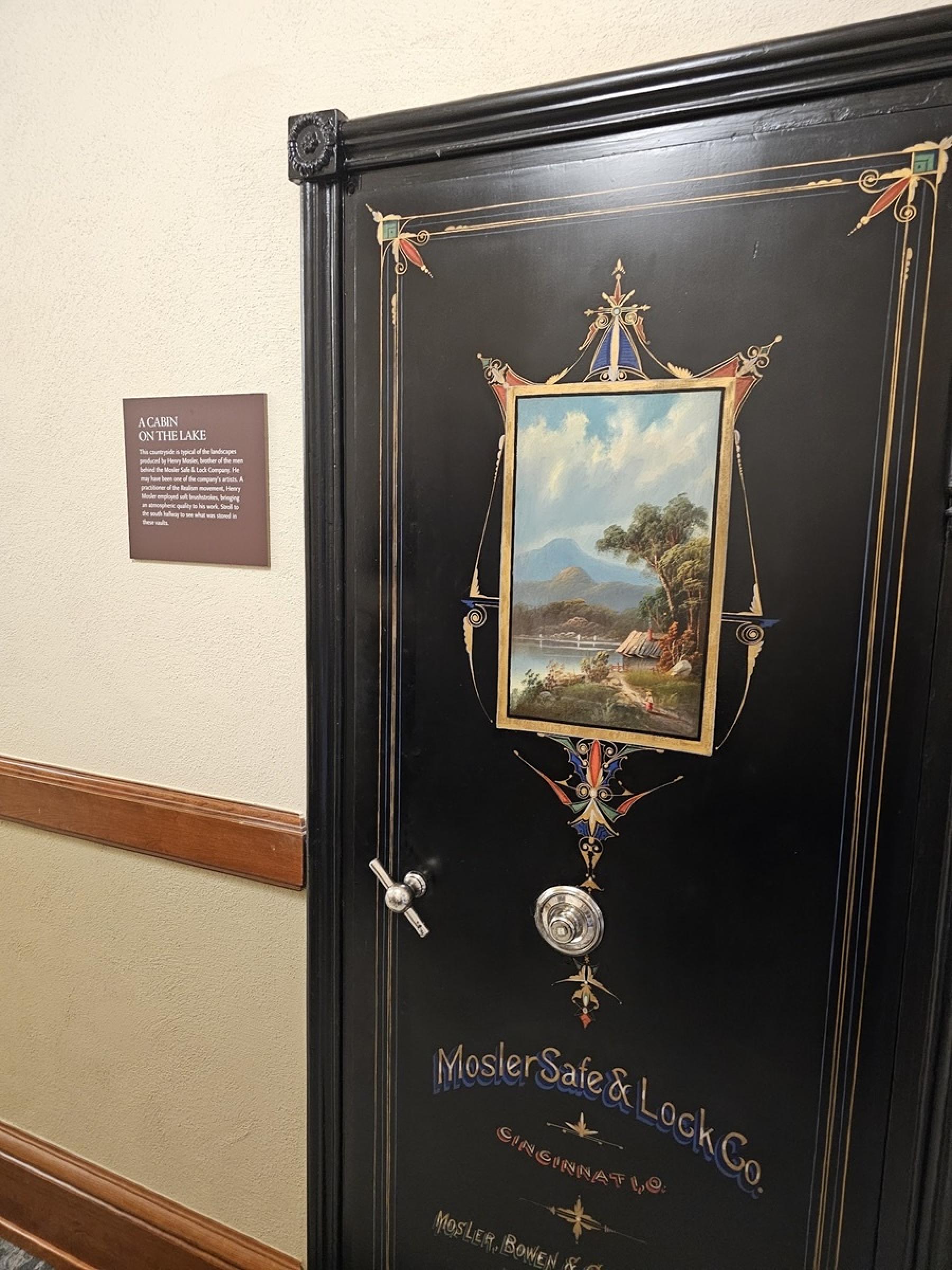
By 1887, when the Capitol Commission bought the vault doors at $70 apiece, Henry Mosler had moved to Paris, where he was exhibiting his work and earning accolades. It would be tempting to credit him with the vault paintings, but he almost certainly had nothing to do with them. Still, his career shows that art ran in the family that built the vaults. Who did paint them remains unknown. None of the six paintings is signed, and painted landscapes were common on safes made by Cincinnati manufacturers in this period, so the work was likely done by a decorative painter in that trade. The doors were finished in Ohio and shipped by rail to Cheyenne, and whoever painted the landscapes probably never set foot in Wyoming Territory. Many of the scenes are imagined landscapes you would never find here.
The artwork on the vaults mixes realism in the landscapes with line work, in a style that anticipates Art Nouveau, of geometric shapes forming organic patterns like flowers blossoming. The line work frames the doors and the landscapes, and it even decorates the locking mechanisms, which would have been seen only by those opening and closing the vaults. This attention to detail, even on the interior of the vaults, suggests that the Mosler brothers, like other craftsmen of the era, saw art and beauty as a way to reflect the quality of their workmanship.
The layer of paint peeled back in my research of the vaults revealed not only an artistic family, but also an entire movement in the 1880s. There was another layer to go.

One of the central debates in the project at this stage was how the interior of the vault on display would look. Dimensional Innovations did general research on bank vaults of the era and proposed a historically accurate, plain metal shelving. The team for the Capitol project requested something more intricate and beautiful to match the exterior of the vaults and asked me to dig further into it.
I turned to the Mosler Company again, this time on restoration forums. I found small safes with wooden interiors and carpeted shelving. All were undated, and it was unclear whether the interiors were original. I searched for period company advertisements and found none with images or descriptions of the interior of the vaults. It looked like a dead end, a chip in the original drawing that could not be recovered. Then luck came my way.

On an unrelated visit to Rawlins, I stopped in at the Carbon County Museum and found exactly what we had been looking for: a period Mosler vault, with its original interior intact.

According to the Carbon County Museum, Wyoming Supreme Court Justice Homer Merrell bought the Mosler vault from the Carbon County Courthouse in 1875. The vault was originally purchased from Mosler, Bahmann & Company, founded by the Mosler patriarch, Gustave. Eventually, the vault was walled in by optometrist P. H. Dimick, creating a time capsule. It was rediscovered in 1982 with the doors locked and subsequently donated to the museum. It wasn’t until a visiting technician from the Mosler company came in June 1999 that the doors were finally opened.
The vault was empty, with no gold bars or old paperwork, but for me it held a true treasure. Inside was the original interior of a Mosler vault: wooden shelving cut with a flourish and lined with patterned cloth, matching the smaller safes I found on the restoration forums.
Although the final display did not fully replicate the original interior, the Capitol project moved forward, incorporating artistic elements into the vault display thanks to this discovery at the Carbon County Museum.
I have no doubt that there are still layers to be peeled back on the Mosler vaults. Parts of the story are still covered up by time, such as the name of the unknown artist. In truth, the work of a historian never feels quite finished. When do you stop researching and start writing the story down? Writing it feels like lying on the floor, painting slowly “like a sloth,” in a feeble attempt to get all the details just right. Still, there are parts of the story that will always stay unfinished.

See the vaults for yourself! Visit the vaults and our exhibits at the Wyoming State Capitol, and see the Merrell vault at the Carbon County Museum.