Rock Springs, Wyoming
An Oct. 4, 2008, New York Times article shows the picture of a well-paid gas-field operator in a Rock Springs, Wyo., strip club surrounded by four $500-a-night strippers stating, “I spend over $3,000 a weekend here.” The article was about the latest of the booms in the Rock Springs economy.
Sometimes it seems that almost every time the town makes the national news, it’s for something negative. Rock Springs was the site of one of the worst ethnic massacres in United States history in the 1880s, and nearly a century later, 60 Minutes depicted the baser nature of Rock Springs in an exposé titled, “Our Town,” about alleged police and government corruption.
But there’s much more to Rock Springs than scandalous headlines. Its close-knit community of immigrant coal miners from 56 nations laid the foundation of the town’s culture, and this impressive diversity has survived even while this place has endured ongoing evolutions in its economy.
The first documented mention of coal in the Rock Springs area came from an 1850 U.S. Army survey party seeking a quicker way through what’s now Wyoming. The party was commanded by Howard Stansbury and guided by the famous mountain man, Jim Bridger. Stansbury noted, “We found a bed of bituminous coal cropping out of the north bluff of the valley, with every indication of its being quite abundant.”
He was right about the abundance. Millions of years ago, an inland sea deposited what became the seams of coal and trona of the Rock Springs Dome, along with traps for oil and gas of the Overthrust Belt. Stansbury’s reports were widely read, but no changes were made at that time to the routes of the pioneer trails through Wyoming farther north. It was Ben Holladay’s Overland Stage Company that more fully developed the area, creating a stage stop because of the springs, a valuable source of water in the midst of the desert.
Taking over the stage stop and further developing it were Archibald and Duncan Blair—brothers who opened the first coal mine in Rock Springs in 1868—just as the coal-thirsty Union Pacific Railroad arrived.
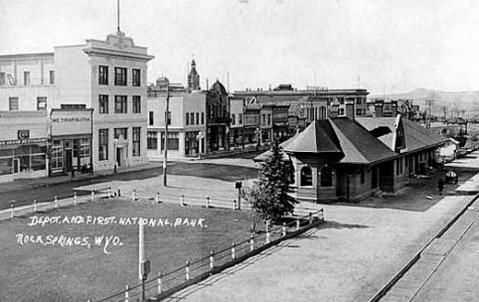
The arrival of the Union Pacific Railroad, with its congressional mandate for a transcontinental line, opened the floodgates of economic development in Rock Springs. The railroad’s route across relatively flat southern Wyoming was determined by that flatness—and by a string of good coal deposits. According to Wyoming historian T.A. Larson, the high-quality coal was lucrative for the railroad as the U.P. could use it in engines, sell it at a profitable markup in the open market and charge high freight rates to competing coal companies.
The Rock Springs mines were so important to the railroad in its formative stages that U.P. President Charles Adams said that they were the “salvation of the UP; those mines saved it. Otherwise the UP would not have been worth picking up.” There was once so much coal flowing through the town that winter snows turned black. At one time there were more than 130 mines operating in Sweetwater County in places like Winton, Reliance, Superior, Dines, Lionkol and others that surrounded the hub of Rock Springs.
There were other pieces to the early Rock Springs economic puzzle, especially sheep ranching. The Blair brothers were unable to hold onto their mine because they did not have the financial resources. They did invest in sheep ranching, however; and like several ranchers of the time, were able to establish other businesses in Rock Springs. The Hay family, descendants of the Blairs, developed a successful, still-thriving bank and continue to be leading citizens of the city.
The coal miners of the past shared some similarities with the strutting gas field worker of the Times article: They also would probably have enjoyed a drink at a bar, or even, had there been the opportunity, watching strippers; the town was famously anti-Prohibition and did have a red-light district.
But the town had numerous saloons because of its ethnic diversity at a time when the U.P. hired workers from all over the world to keep the unions weak. Each nationality had its own saloon or meeting place, such as the Slovenian Slovenski Dom, still in existence.
In the 1920s, the town began celebrating its diversity with “International Night,” a festival that showcased cultural differences by sharing costumes, food, songs and dance. This annual celebration continues today. The town at the time was such a mixing pot, longtime resident Thomas Cullen remembered decades later, that one could find “a Greek baker, a Chinese restaurant, and a Jewish market” on a single street.
The Wyoming economy has often experienced booms and busts because of its ties with the resource extraction industries, and Rock Springs is no exception. In 1920, when the U.P. was operating in profitable economic conditions after World War I and the rails were humming with loads of passengers and freight, coal workers made almost $8 per day, equivalent of about $91 in 2012. In that period, prior to the mechanization of mining and the widespread use of the automobile, coal demand was high and miners were flush with cash.
The miners of the past were also different in important ways from the modern-day gas worker, however. Reliance upon one’s neighbors, coupled with a mining culture where workers depend upon one another for safety and share in dangerous work, made for a tightly knit community.
During the depression of the 1890s and during the Great Depression in the 1930s, coal miners would be lucky to be working three days a week, and they earned far less money than in more prosperous times. In 1933, the Rock Springs Rocket estimated that a quarter of the population used the soup kitchen.
Author Dudley Gardner reported that in order to survive, sometimes several families lived together in one house, and people depended on gardens, livestock and hunting and fishing for sustenance. Free housing offered by the U.P. and the generosity of bankers like the Hays who didn’t foreclose upon their homes helped many people get through hard times.
As a result, these miners transcended their diverse national identities and unionized early. Because of this tradition, Rock Springs remains one of the more Democratic-leaning cities in Wyoming.
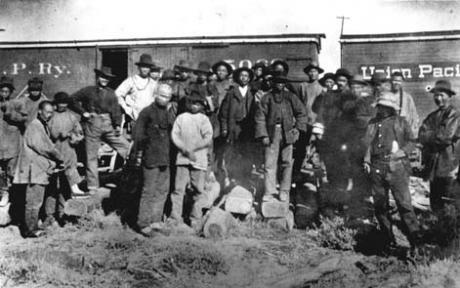
Running counter to these claims of closeness and the embrace of diversity, however, is the notorious Chinese Massacre. On Sept. 2, 1885, 150 white miners attacked their Chinese co-workers. Twenty-eight Chinese were killed, fifteen were wounded and several hundred more were run out of town. Most of those responsible for the conflict didn’t stay. Three years later, when Rock Springs incorporated, a new group of miners was working there.
Rock Springs continues to evolve, although coal mines like Black Butte and Jim Bridger, still in operation, serve as reminders of the impressive production of the past. A bust occurred in the mid-1950s when the U.P. locomotives switched from burning coal to burning diesel fuel, and all of the mines closed. Luckily for the local economy, trona mines began to open at the same time in the Green River area to the west, where one of the largest known natural deposits in the world was discovered as prospectors searched for oil.
Like coal, trona, or sodium carbonate, was created when the inland sea existed millions of years ago, and is a valuable mineral used to make glass, detergent, and many other products. Coal and trona mining are similar, and the trona companies hired many former coal miners.
Some of those same miners and their descendants have stayed through several other booms. In the 1970s, thousands of workers came to build the billion-dollar Jim Bridger Power Plant, mine coal in the strip mines that powered the facility and explore for oil and gas. With that growth-- great for the city coffers because the town’s population tripled--came the burdens of the rapid increase: the social consequences of huge increases in crime, the necessity of finding shelter for workers camping out in every little draw surrounding the town and of improving local infrastructure.
The city expanded far beyond its old downtown center, adding subdivisions in all directions. As one example of the stresses such an influx causes, mental health services reported an increase of nine times the usual requests for assistance. Vice, too, came with all the new workers and their money. Not surprisingly, the 60 Minutes episode focused on the salacious aspects of that time.
Yet while the booms added uncertainty, volatility and wealth to life and the economy of Rock Springs, its community college has stabilized the town and served as an engine of long-term economic and intellectual growth.
Western Wyoming Community College was founded in 1959, the fifth of Wyoming’s seven community colleges. It began with 40 students and five instructors meeting classes in the evenings at Rock Springs High School. In 1961, the college moved to the Reliance High School building in the little coal town of Reliance, five miles north. Western moved back to Rock Springs in 1969, when the first buildings were finished at the present site on College Hill. Three residence halls were completed in 1976.
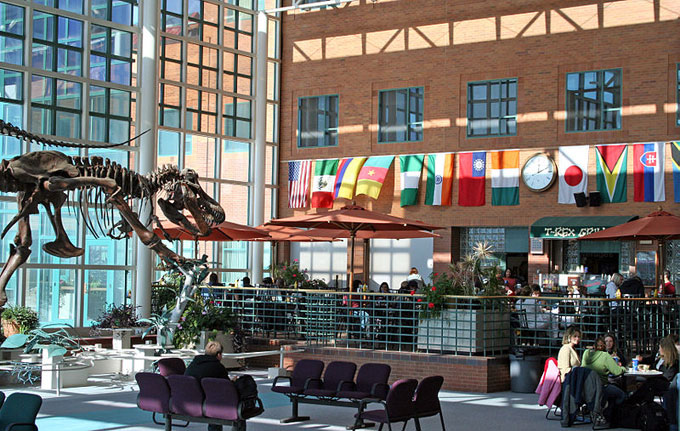
In 1981, local voters approved a $63 million expansion. The result was a one-building, all-weather campus, which has won numerous architectural awards. Western now serves both as a transfer institution, offering the first two years of four-year programs leading to a university bachelor’s degree, and also offers workplace training. In spring 2010, the college counted around 4,500 students, about 1200 of whom were enrolled full time.
The most recent minerals boom, meanwhile, has some similarities to the boom of the 1970s, especially the strains placed on city government because of increased population. The current expansion began around the year 2000 after the discovery of newly exploitable natural gas deposits in the Jonah Field and Pinedale Anticline fields 80 miles north in Sublette County, with approximately 33 trillion cubic feet of reserves.
People weren’t camping out in gullies, but the problems with this boom also included private housing and public financing for sewer, water and other infrastructure needs for 200 new businesses and 46 new subdivisions, according to the Wyoming Business Report.

And though the 2000 census put Rock Springs’ population at 19,000, Mayor Timothy Kaumo estimated as many as 30,000 people lived in the area soon afterward—further strapping local public resources.
Because the quantity of natural gas awaiting recovery is said to be huge, this boom may be sustainable for decades. The 2010 census placed the population at 23,000—down considerably from Mayor Kaumo’s estimate but still a 23 percent increase from 2000.
Hispanics are the most recent group of immigrants seeking economic opportunity in Rock Springs, whether to make new homes and lives or send money back to their families in other nations, much like their Chinese and European forerunners. They now make up 16 percent of the population. The majority of Hispanic immigrants are from Mexico, and work in the natural gas fields, but they also work throughout the community, and are such a substantial presence that they have several businesses dedicated to their cultural needs—tacquerias, bakeries, and Spanish-speaking check cashing services, to name a few.
Of the original “56 Nationalities” that pioneered Rock Springs, Dr. Dudley Gardner, a professor of history and political science at Western Wyoming Community College, and prolific author of Wyoming history, has ascertained that close to 100% of that national diversity remains. A good number of descendants have continued to live in the area, with new sets of immigrants and populations moving in to make up for any losses.
For example, the town now has Hispanics from South America, notably Venezuelans, working in the gas patch, but also new populations of Vietnamese, Nigerians, Russians and others. Of course, the descendants of the original Eastern European, British, and other settlers have now become culturally assimilated, and now identify themselves as white; thus firm numbers are hard to come by from census data. However, a look at a Rock Springs phonebook or the online White Pages reveals that diversity on any given page.
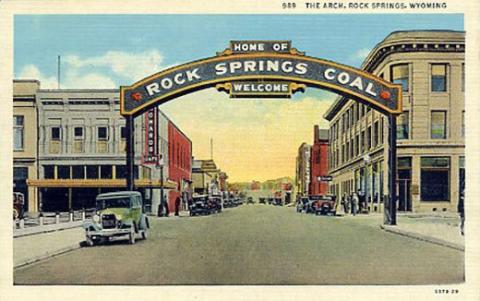
Despite the decades-long shock waves of booms of several kinds rolling through Rock Springs, the town’s identity is still intimately tied to coal mining. If an early-day coal miner were dropped into present-day Rock Springs, he would wonder where all the coal disappeared to and be surprised at the huge subdivisions on the former outskirts of town. But the Rock Springs Coal sign still arcs above downtown, even though the city center has shifted. That rock-solid miner and his descendants have given Rock Springs its unique character, one that will continue to weather booms, busts and any negative media coverage that comes along.
Resources
Primary Sources
- “Our Town,” 60 Minutes. CBS News Productions, 1977. Copies are available at the Hay Library at Western Wyoming Community College in Rock Springs.
- Steinhauer, Jennifer. “In a Red State Rolling in Green, a Relaxed Attitude” Jennifer Steinhauer. New York Times, politics section, 4 October 2008, accessed 1/12/12 at http://www.nytimes.com/2008/10/05/us/politics/05wyoming.html?scp=1&sq=Rock+springs%2C+wyoming&st=nyt.
Secondary Sources
- Bogart, Barbara Allen. Slovenski Dom—Rock Springs, Wyoming: National Registry of Historic Places Nomination Form, 1997. Sweetwater County file. Cheyenne: Wyoming State Historic Preservation Office.
- Brinkerhoff, Val and A. Dudley Gardner. An American Place: A Centennial Portrait of Rock Springs, Wyoming Then and Now 1889-1989. Rock Springs: Pioneer, 1990.
- Cullen, Thomas P. Rock Springs: Growing Up in a Wyoming Coal Town, 1915-1938. Self published, 1985.
- Gardner, A. Dudley. “You Could Still Live Off the Land: Sweetwater County During the Great Depression,” Annals of Wyoming, Winter 2011.
- Larson, T. A. History of Wyoming. 2nd ed., rev. Lincoln: University of Nebraska Press, 1978.
- Rea, Tom. “The Rock Springs Massacre,” WyoHistory.Org, accessed 1/8/12 at /essays/rock-springs-massacre.
- Rhode, Robert B. Booms and Busts on Bitter Creek: A History of Rock Springs, Wyoming. Boulder, Colo.: Pruett Publishing, 1987.
- Robatcek, David A. “Rapid growth challenges Rock Springs.” Wyoming Business Report, 1 April 2007, accessed 1/8/12 at http://www.wyomingbusinessreport.com/article.asp?id=85912.
- Tanner, Russel and Margie Fletcher Shanks. Images of America: Rock Springs. Arcadia Publishing, Charleston, SC, Chicago, Portsmouth, NH, and San Francisco: 2008.
- Western Wyoming Community College. Spring 2010 enrollment figures, accessed 1/20/12 at http://www.wwcc.wy.edu/mis_admin/Summary_Info.pdf.
- Western Wyoming Community College. “History,” accessed 1/20/12 at http://www.wwcc.wy.edu/info/history.htm.
- Wyoming State Historic Preservation Office, National Register of Historic Places. “Reliance Tipple,” accessed 1/8/12 at https://wyoshpo.wyo.gov/index.php/programs/national-register/wyoming-lis....
- Wyoming State Historic Preservation Office, National Register of Historic Places. “Slovenksi Dom,” accessed 1/8/12 at https://wyoshpo.wyo.gov/index.php/programs/national-register/wyoming-lis....
Illustrations
- The photos of the Rock Springs Coal sign, of Front Street in 1919 showing Rock Springs’ Union Pacific depot and the First National Bank, and of the Rock Springs City Hall about 1910 are all from Wyoming Tales and Trails. Used with thanks.
- The photo of the Chinese miners in front of Union Pacific boxcars is from the Wyoming State Archives, Department of State Parks and Cultural Resources. Used with permission and thanks. The State Archives catalogs the photo as showing the Chinese miners who left Rock Springs at the time of the 1885 massacre and returned a few days later. Bob Nelson of the Rock Springs Historical Museum notes that it seems highly unlikely anyone would have taken such a photo at such a tense time.
- The photo of the atrium at Western Wyoming Community College, complete with a cast of Tyrannosaurus rex, is from Wikipedia, and was taken in 2008 by Joanna Fritz, public information officer. Used with thanks.
- The photo of the gas-field worker in the bar in Rock Springs is by Monica Almeida, from the 2008 New York Times story. Used with thanks.